An unusual vehicle aimed at performance, fit, and visibility
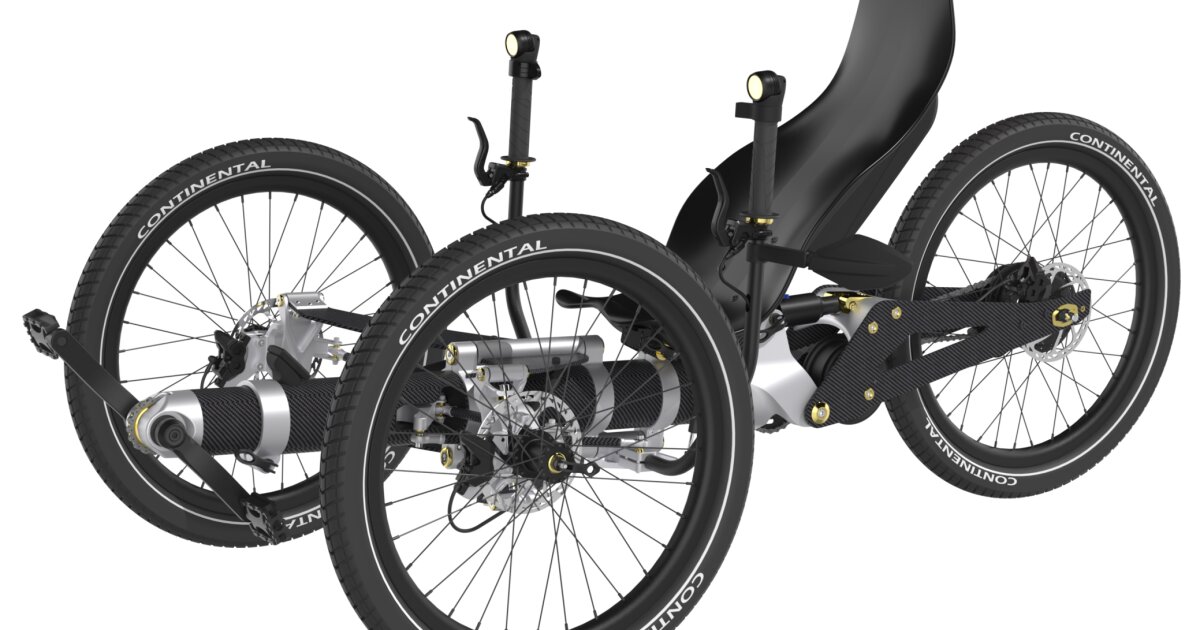
The Allroadracer TriX is the kind of prototype that makes a point before it makes a market. Its basic proposition is familiar enough: a recumbent electric trike built for stability and range. But nearly every visible design choice pushes the concept into more experimental territory.
According to the supplied source text, the TriX is currently in preproduction and was recently shown at the Spezi International Special Bikes Show. Invented by German cyclist and entrepreneur Ahmad Omari, it combines a telescoping carbon-fiber tube body with tilting front wheels, independent front-wheel travel, rear suspension, and mid-mounted electric assistance.
The telescoping body is the visual centerpiece. The chain runs internally through a boom-style carbon-fiber tube that extends horizontally to fit the rider’s body size. That approach turns the main structure into both a frame element and a fit-adjustment mechanism, which is a more integrated solution than the seat-and-rail adjustments seen on many specialty cycles.
The tilting front wheels are just as important functionally. The source text says the front wheels can tilt by up to 27 degrees when cornering, helping stability, while each front wheel also has up to 260 millimeters of independent vertical travel. Add a rear shock with 120 millimeters of travel, and the vehicle starts to look less like a novelty commuter and more like a machine meant to stay composed over rough or uneven surfaces.
The powertrain is also unconventional. The TriX uses a 250-watt hub motor mounted mid-vehicle that delivers 90 newton-meters of torque, with one chain running from the pedals through the carbon boom to the motor and a second chain carrying drive to the rear wheel. The rear wheel is paired with an Enviolo AutomatiQ continuously variable hub transmission. Buyers can choose either a 500- or 800-watt-hour battery, with quoted range of roughly 70 to 100 kilometers depending on pack size.
Those numbers place the vehicle in a premium personal-mobility niche rather than a mass-market e-bike category. The first batch of 10 units is expected to sell for 10,000 euros each, and total claimed weight is 25 kilograms. That pricing and limited run suggest the early audience will be enthusiasts, specialty riders, or buyers interested in the engineering statement as much as the transportation function.
Still, concepts like this can matter even if they never scale directly. The TriX explores several useful ideas at once: adaptive fit without a conventional frame triangle, suspension and tilt integration for three-wheeled stability, and a carbon-forward body architecture that treats the central boom as more than a structural tube. Even the suggestion that future models may not use a chain points to further experimentation in how human and electric input could be packaged.
In a transportation landscape full of incremental product updates, the TriX stands out because it is willing to look strange in pursuit of a different ride experience. Whether it becomes a category-shaping platform or remains a niche specialty machine, it shows that personal mobility innovation is still alive in the margins, where radical geometry and unconventional engineering can still earn a hearing.
Notable specifications
- Front wheels tilt up to 27 degrees and each has up to 260 mm of travel.
- A 250-watt motor delivers 90 Nm of torque with 500- or 800-Wh battery options.
- The first batch of 10 preproduction units is priced at 10,000 euros each.
This article is based on reporting by New Atlas. Read the original article.
Originally published on newatlas.com