Object removal is no longer the whole task
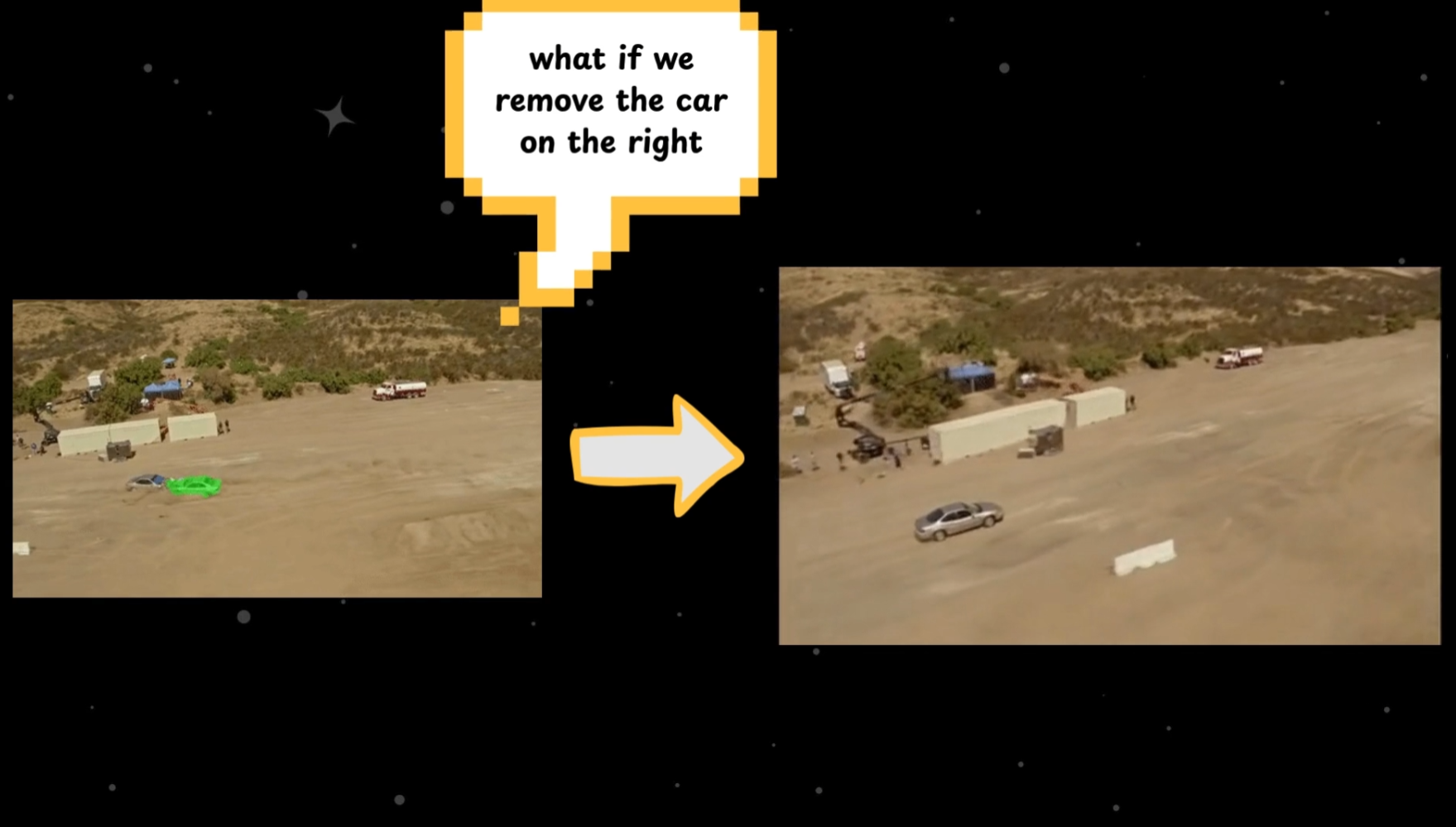
Netflix has open-sourced a new AI framework called VOID, short for Video Object and Interaction Deletion. On its surface, the system addresses a familiar video-editing problem: remove an object from a scene. What makes the project notable is that it does not stop there. According to the supplied report, VOID also attempts to rewrite the physical consequences that the removed object had on the rest of the scene, including interactions such as collisions.
That distinction is what makes the release more consequential than a standard inpainting tool. Traditional object removal can erase a person, prop, or obstruction from a frame, but the edit often breaks down when the missing object previously affected motion, contact, or scene dynamics. If a removed object bumped another item, blocked motion, or changed how surrounding elements behaved, the visual world no longer makes sense unless those downstream effects are also repaired. VOID is designed around that harder problem.
How the system is assembled
The supplied description presents VOID as a composite system built on multiple existing AI components. Its foundation is Alibaba’s CogVideoX video diffusion model. Netflix researchers then fine-tuned the system using synthetic data from Google’s Kubric and Adobe’s HUMOTO for interaction detection. Google’s Gemini 3 Pro is used to analyze the scene and identify affected areas, while Meta’s SAM2 handles segmentation of the objects that need to be removed.
An optional second pass uses optical flow to correct shape distortions. That extra step matters because video manipulation often looks plausible frame by frame but fails when motion continuity is inspected across time. Optical flow methods can help preserve temporal consistency by tracking how pixels or features should move between frames.
The project was developed by Netflix researchers in collaboration with INSAIT Sofia University. Code, paper, and demo are available through GitHub, arXiv, and Hugging Face, and the report says the release uses the Apache 2.0 license, allowing commercial use.

Why open-sourcing matters here
Netflix’s decision to release the framework under a permissive license changes the significance of the work. This is not just an internal research demo from a major streaming company. It is a toolchain that others can inspect, test, adapt, and potentially commercialize.
That matters because video generation and editing are increasingly converging. Systems that once specialized in either synthesis or post-production are beginning to do both. VOID sits in the middle of that shift. It uses diffusion-model foundations associated with generative AI, but it is aimed at a concrete editing task with clear production implications.
Open access also gives researchers and developers a benchmark for a more advanced definition of video cleanup. Instead of asking whether an unwanted object can be erased, the more relevant question becomes whether the scene still behaves believably after the edit. That is a higher bar, and it is likely to influence how future video-editing systems are judged.
A production problem with wider reach
The immediate use case is obvious. Video editors, VFX teams, and content producers frequently need to remove equipment, bystanders, logos, or other unwanted elements from footage. But many of the hardest edits are not difficult because the object itself is hard to mask. They are difficult because the object interacted with the environment.
If a removed item changed shadows, interrupted motion, caused a collision, or altered where another object should be, the rest of the scene has to be reinterpreted, not merely repainted. The supplied report positions VOID as a system that attempts to do exactly that by identifying affected areas and accounting for physical interactions left behind.
That expands the practical scope of AI-assisted editing. A tool that can remove an object and also rewrite the evidence of its interaction starts to look less like a cleanup filter and more like a scene-level editing assistant. It is still bounded by model quality, data, and artifact control, but the conceptual step is important.

What the release says about the state of video AI
VOID is also a snapshot of how modern AI systems are increasingly assembled: not as single monolithic models, but as pipelines. In this case, scene understanding, segmentation, generation, and correction are distributed across multiple components from different research and corporate ecosystems. The result is a system designed for a narrow but difficult task.
That pattern is likely to continue. Video AI is becoming less about one model doing everything and more about coordinating specialized models that each handle a part of the problem. The supplied report makes that especially clear by naming the roles played by CogVideoX, Gemini 3 Pro, SAM2, synthetic-data sources, and optical-flow correction.
It also signals how quickly the field is moving from novelty toward tools that target workflow pain points. Removing an object from video has always been useful. Repairing the world that object altered is more ambitious, and much closer to the kind of capability that could change how post-production is done.
The next test is whether the ecosystem builds on it
For now, Netflix’s release should be read as both a research contribution and a practical challenge to the rest of the field. If VOID performs well enough in real-world footage, it could help define a new baseline for video object removal. If it struggles outside controlled conditions, it will still have clarified what the next generation of tools needs to solve.
Either way, the direction is clear. Video editing AI is moving from subtractive tasks toward causal ones. It is not enough to make something disappear. The system has to make the scene look as if that thing had never been there in the first place. Netflix’s VOID is an early open-source attempt to do exactly that, and that makes it one of the more interesting AI tool releases of the week.
This article is based on reporting by The Decoder. Read the original article.

Originally published on the-decoder.com