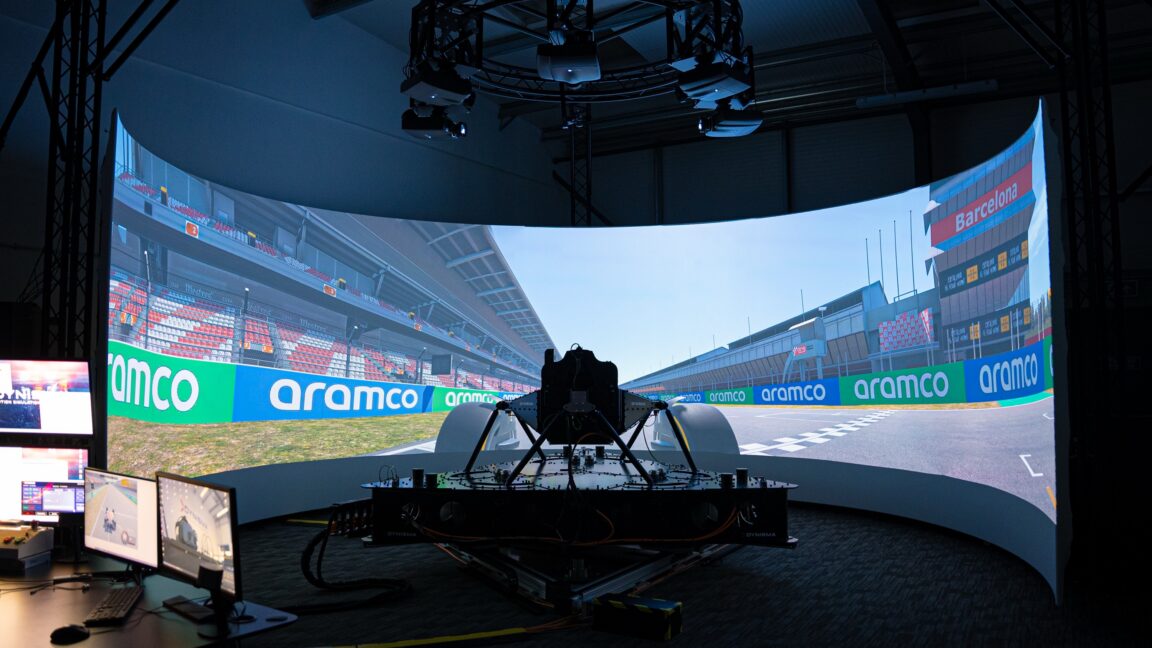
The High-Stakes World of F1 Simulation
Formula 1 has undergone a quiet revolution in the 21st century, with driver-in-the-loop (DiL) simulators becoming an indispensable tool for teams chasing milliseconds on the track. These simulators are not your average gaming rigs; they cost between $3 million and $10 million, and for good reason. The technology behind them is a blend of cutting-edge engineering, physics modeling, and human-machine interaction that pushes the boundaries of what simulation can achieve.
Ash Warne, founder and CTO of Dynisma Motion Generators, a UK-based company that supplies simulators to Ferrari, Alpine, and soon Cadillac, explains the core challenge: “There’s this intimate link between the inputs that a driver provides to the car, the way the car responds, and then the driver immediately feels that and reacts to it. So this is a very dynamic closed loop involving the driver and the car.” In a simulator, the real car is replaced by a system that must replicate the driving experience with extreme accuracy. Any deviation is instantly detected by a world champion driver who has an innate understanding of the car’s behavior.
Latency: The Critical Factor
One of the most important metrics in a DiL simulator is latency—the time delay between a driver’s input and the simulator’s response. Warne emphasizes that Dynisma’s systems achieve latencies between 3 and 5 milliseconds. “This is from the moment that the car physics model says, for example, the back end of this car is stepping out and starts to accelerate the car in yaw to when we can actually measure, on an accelerometer on the chassis of the simulator, that movement happening,” he says. For context, this is about an order of magnitude faster than the best commercial flight simulators or the National Advanced Driving Simulator in Iowa.
Low latency is crucial because it preserves the natural feedback loop that drivers rely on. In a real car, when a driver turns the steering wheel, the car responds almost instantaneously. In a simulator, any delay can break the illusion of reality, causing the driver to overcorrect or misjudge the car’s behavior. This is especially critical in F1, where drivers operate at the limit of adhesion and must make split-second decisions.

Bandwidth and Fidelity
Beyond latency, bandwidth and fidelity are equally important. Bandwidth refers to the range of frequencies the simulator can reproduce, from low-frequency motions like braking and accelerating to high-frequency vibrations from curbs or tire slip. Fidelity encompasses the accuracy of the motion cues, force feedback, and visual rendering. A high-fidelity simulator must replicate not just the gross movements of the car but also the subtle nuances that provide the driver with essential information about grip, balance, and traction.
Warne’s journey to founding Dynisma began after working for both McLaren and Ferrari, where he realized that an ultra-low-latency simulator was possible. The technology has evolved significantly since the early 2000s, when teams like McLaren, Toyota, and Ferrari first began experimenting with DiL simulators. Today, these systems are so advanced that they can simulate not only the car’s dynamics but also track conditions, weather, and even tire wear.
Why Not Just Use Consumer Sims?
High-end consumer simulators, like multi-axis setups costing tens of thousands of dollars, offer impressive performance for enthusiasts. However, they fall short in several key areas. Consumer sims typically have higher latency, lower bandwidth, and less precise motion cueing. They also lack the sophisticated physics models that F1 teams develop in-house, which are calibrated using real-world data from telemetry and wind tunnels.
Moreover, F1 simulators are integrated with the team’s broader engineering workflow. They allow engineers to test setup changes, aerodynamic configurations, and even new parts before they are built. This integration saves time and money, as teams can iterate on designs virtually rather than relying solely on track testing, which is heavily restricted by regulations.
The Cost of Precision
The price tag of $3 million to $10 million reflects the engineering effort required to achieve such low latency and high fidelity. Dynisma’s simulators use custom motion platforms, high-performance actuators, and advanced control algorithms. The visual system often includes multiple high-resolution projectors or large curved screens, with rendering engines that can maintain low latency while producing realistic graphics.
For F1 teams, the investment is justified by the competitive advantage it provides. A simulator that can accurately replicate the feel of a car allows drivers to practice and refine their technique without the wear and tear of real track time. It also enables teams to evaluate new drivers and develop their skills in a controlled environment.
Conclusion
As F1 continues to push the boundaries of technology, driver-in-the-loop simulators will remain a critical tool. The quest for lower latency, higher bandwidth, and greater fidelity is ongoing, with companies like Dynisma leading the way. For fans, the next time they see a driver making a perfect overtake or setting a blistering lap time, they can appreciate the countless hours spent in a multimillion-dollar simulator honing those skills.
This article is based on reporting by Ars Technica. Read the original article.
Originally published on arstechnica.com