Warp Launches Enterprise-Grade Platform for Orchestrating AI Coding Agents Across Teams
The landscape of AI-assisted software development is undergoing a fundamental shift as teams increasingly recognize the limitations of isolated, local agent deployments. Warp, the developer-focused platform known for reimagining command-line interfaces and AI agent management, has introduced Oz—a cloud-native solution designed to address the growing complexity of managing AI coding agents at the organizational level.
The announcement marks a significant evolution in Warp's trajectory. The company, which boasts over 700,000 active developers using its software, has progressively expanded beyond its origins as an enhanced terminal interface. According to the company, annual recurring revenue surged by a factor of 35 in the previous year, reflecting substantial market momentum in the AI-assisted development space.
The Collaboration Challenge in Agent-Driven Development
While the rise of "vibe coding"—instructing AI systems to generate code based on natural language descriptions rather than manual implementation—has captured developer enthusiasm, the infrastructure supporting these workflows has remained largely fragmented. Competing solutions including Anthropic's Claude Code and Google's Antigravity have emerged to facilitate this paradigm shift, yet most existing implementations operate within individual developer environments on local machines.
According to Zach Lloyd, Warp's founder and chief executive, this decentralized approach creates significant organizational friction. Teams struggle to maintain visibility into what AI agents are currently executing, making collaboration difficult and introducing security vulnerabilities. Additionally, ensuring consistent configuration across agents and protecting sensitive company data from threats like prompt injection attacks becomes exponentially more challenging when agents operate independently across multiple machines.
Lloyd characterizes the current state of distributed agent deployment as operating in an unstructured environment where organizational oversight remains minimal. This lack of centralized control has prompted enterprises to seek more robust solutions.
Oz: A Centralized Command Center for AI Agents
Oz addresses these organizational gaps by providing secure, cloud-based execution environments where AI agents operate transparently. Every agent action generates comprehensive audit logs accessible through both native Warp applications and web interfaces, creating complete operational visibility.
The platform enables granular permission management, allowing organizations to customize which employees can access specific agents and what capabilities individual agents possess. This multi-layered access control architecture substantially reduces the risk surface associated with autonomous code generation.
Flexible Deployment and Automation Capabilities
Beyond security and visibility, Oz introduces operational flexibility through multiple execution modes:
- Agents can operate exclusively in cloud environments or transition seamlessly between cloud and local machine execution depending on development requirements
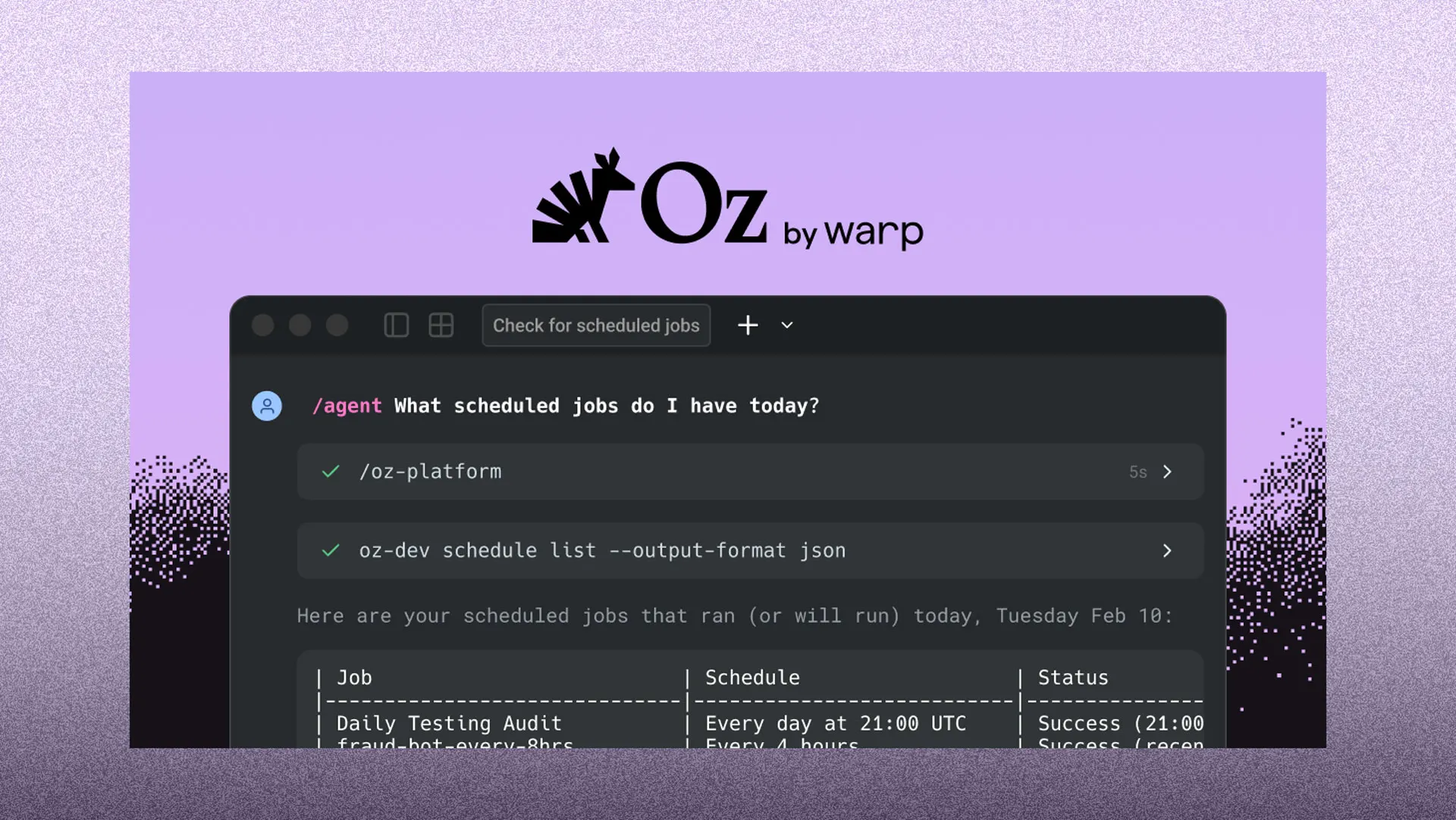
- Automated scheduling enables agents to trigger at specified times or in response to predefined events
- Manual invocation remains available for immediate, on-demand agent deployment
- Context from previous interactions persists automatically across execution environments
The platform's standardized interface architecture enables cross-system integration. Local applications and agents can invoke cloud-based agents through this common protocol, facilitating workflows where local systems generate requests—such as code generation for bug fixes or feature implementation—that trigger cloud agent execution.
Warp internally demonstrates this capability through an agent designed to detect fraudulent platform usage, showcasing how automated systems can monitor and respond to security concerns without human intervention.
Expanding Warp's Developer Platform Ecosystem
Oz represents the latest expansion of Warp's increasingly comprehensive developer toolkit. The platform has evolved substantially from its original focus as an enhanced command-line interface for Linux and macOS users. Recent additions include collaborative knowledge-sharing capabilities and AI agent orchestration features, positioning Warp as a comprehensive development environment rather than a singular productivity tool.
The company reports that its AI agents have edited 3.2 billion lines of code as of the previous year's conclusion, indicating substantial adoption and impact within development workflows.
Pricing and Deployment Flexibility
Warp structures Oz pricing around cloud computing resources and AI inference expenses, with limited functionality available through free tier plans. The company offers flexibility for customers preferring to utilize existing infrastructure or proprietary AI models, enabling organizations to maintain control over computational resources and model selection.
Market Positioning and Future Outlook
Lloyd articulates an ambitious vision for Oz's market potential. As organizations increasingly recognize AI agents' capacity to multiply software development productivity, demand for enterprise-grade agent management platforms should accelerate significantly. Rather than building custom orchestration systems internally, companies are expected to gravitate toward purpose-built solutions offering security, usability, and rapid deployment capabilities.
This strategic positioning reflects Warp's confidence that the developer tools market will increasingly value comprehensive, managed platforms over fragmented point solutions as AI-assisted development becomes standard practice across the software industry.
This article is based on reporting by Fast Company. Read the original article.
Originally published on fastcompany.com