Configurable Autonomy at Scale
UK-based autonomous vehicle software company Oxa has closed a Series D funding round to bring its industrial mobility automation platform to commercial scale. The company has developed configurable self-driving software designed to be deployed across a diverse range of vehicle types—more than 20 in total—covering the ground vehicles used in ports, airports, manufacturing facilities, solar farms, and other large industrial campuses.
Unlike consumer autonomous vehicle efforts that focus on a single vehicle form factor (typically a passenger car) navigating public road environments, Oxa's approach targets the structured, semi-private environments of industrial operations where automation can be deployed without the full complexity of public road scenarios. This focus has allowed Oxa to move closer to commercial deployment while better-funded consumer AV efforts continue to grapple with the edge cases of public driving.
The Industrial AV Market
Industrial vehicles—the forklifts, tractors, tow vehicles, shuttle buses, and inspection robots that keep large facilities operating—are a substantial global market. These vehicles are typically operated in repetitive patterns within defined geographic areas, making them strong candidates for automation: routes are predictable, environments are controlled, and the cost savings from autonomous operation (reduced labor, 24/7 operation, improved safety) are directly measurable.
The pandemic exposed the vulnerability of operations dependent on human workers for repetitive ground transport tasks. Ports and airports experienced significant disruption when worker availability declined. Manufacturing facilities found that critical internal logistics—moving materials from storage to assembly lines—could become bottlenecks when workforce levels varied. Automation of these functions reduces operational fragility while improving efficiency.
What Makes Oxa's Approach Different
The key differentiator in Oxa's platform is configurability. Rather than building purpose-specific autonomy systems for each vehicle type—a forklift system for forklifts, a tow vehicle system for tow vehicles—Oxa has developed a software architecture that can be adapted to different vehicle geometries, sensor configurations, and operational requirements through configuration rather than fundamental re-engineering.
This matters commercially because it reduces the cost of expanding into new vehicle types and new customer environments. When a port operator wants to automate not just container tractors but also baggage tugs and passenger shuttles, Oxa can potentially address all three with variations of the same core platform rather than three separate development efforts. The resulting economies of scope are a significant competitive advantage in a market where development costs are high.
Deployment Environments
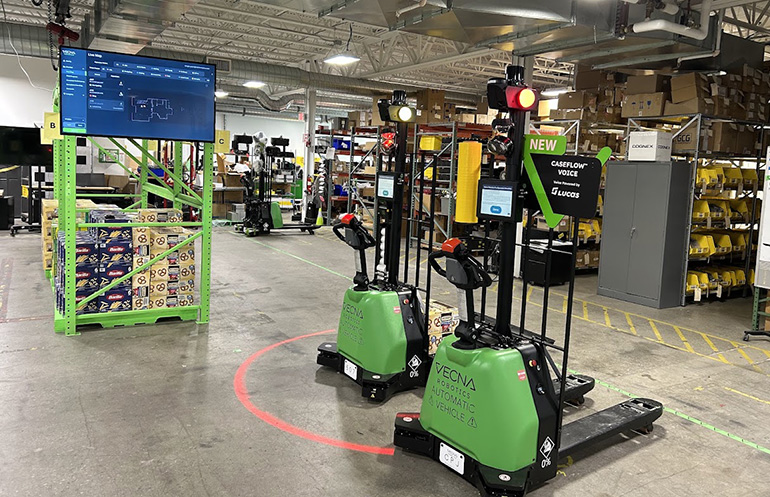
Oxa's current deployment environments span several industrial categories. In ports and airports, the company's systems handle cargo and baggage movement between terminals, aircraft, and storage areas—repetitive point-to-point logistics that are well-suited to automation and high-value due to the labor costs and precision timing requirements involved. In manufacturing facilities, Oxa's platforms handle internal materials movement, keeping assembly lines supplied without the continuous attention of human operators.
Solar and wind farm monitoring is an emerging application area: large renewable energy facilities require regular inspection of panels and turbines across vast areas. Autonomous ground vehicles equipped with sensors and cameras can perform these inspections more thoroughly and at lower cost than human inspection teams, while generating data that feeds into predictive maintenance systems.

The Autonomy Maturity Curve
Industrial AV deployments are generally at a higher maturity level than consumer applications because of the controlled environments involved. Many of Oxa's deployments operate in geofenced areas with significant infrastructure support—high-definition maps, roadside sensing, managed traffic of other autonomous and human-operated vehicles. This operational design domain reduces the number of scenarios the system must handle, allowing higher reliability at lower levels of general AI capability.
As the technology matures and operational track records accumulate, the scope of autonomous operation can be expanded—to more complex environments, more interaction with human workers, and eventually to less structured settings. The industrial deployment record serves as a proving ground for technology that may eventually be applicable in more demanding contexts.
The Road to Commercial Scale
The Series D capital will be used to expand Oxa's commercial deployment capacity—more vehicles under automation, more customer sites, more geographies. The company has indicated it is focused on demonstrating the economic case for industrial autonomy at meaningful scale, generating the operational data needed to continuously improve system performance, and building the customer relationships that will anchor the business through the transition from early-adopter to mainstream industrial deployment.
The market timing appears favorable: industrial operators are under sustained pressure to improve productivity with constrained labor pools, and the technology has matured to the point where autonomous operation in structured environments is reliable enough for commercial deployment at scale.
This article is based on reporting by The Robot Report. Read the original article.
Originally published on therobotreport.com