Inside Omron's Next-Generation LD Mobile Robots
Ask anyone who watched the early waves of warehouse automation what made a mobile robot successful, and the answer usually came down to hardware: payload capacity, navigation sensors, and battery life. That framing is fading. In a conversation on Episode 264 of The Robot Report Podcast, Omron Industrial Automation Europe's Miguel Garcés Moreno argued that for modern autonomous mobile robots (AMRs), the surrounding layers — software, safety architecture, and fleet management — have become just as consequential as the machines themselves.
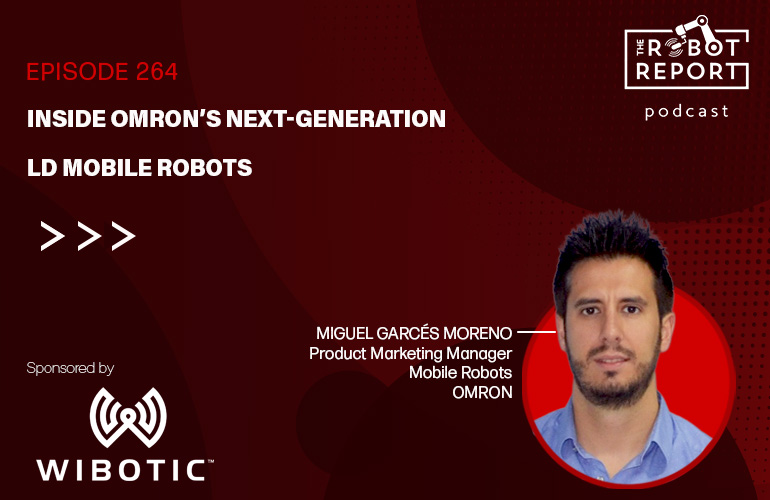
Garcés Moreno serves as product marketing manager for mobile robots across Europe, the Middle East, and Africa at OMRON Industrial Automation Europe, where he oversees product strategy spanning AMRs, industrial automation, and force- and power-limited, or collaborative, robots. His academic background — an industrial engineering degree paired with a Master's in Industry 4.0 — reflects the hybrid skill set the field increasingly rewards. His technical grounding reaches across AI vision, motion control, and programmable logic controllers, giving him a view of the factory floor that connects the robot on the ground to the control systems governing the building around it.
Today his work centers on helping manufacturers redesign factory floors around flexible, space-efficient, and fully automated intralogistics — the movement of materials and parts within a facility, from receiving dock to production line to finished-goods staging.
Why the LD Line Represents a Broader Shift
The LD family sits at the center of Omron's mobile robotics strategy, and the podcast discussion used it as a lens for where the category is heading. The central thesis is straightforward: closing the loop on autonomy takes more than a well-engineered robot. A single AMR navigating a quiet aisle is a demonstration. A fleet of them operating safely alongside human workers, coordinating traffic, and recovering gracefully from blocked routes is a system — and systems live or die on their software.
That has several practical implications for the manufacturers Omron serves:
- Fleet management as the real product. As deployments scale from one or two vehicles to dozens, the ability to assign tasks, balance traffic, and monitor vehicle health becomes the deciding factor in return on investment.
- Safety as a design constraint, not an add-on. Robots sharing space with people require behavior that is predictable under uncertainty, not just fast on a clear floor.
- Space efficiency. Flexible automation only pays off if it fits into existing facilities, which pushes vendors toward compact footprints and routes that squeeze value out of constrained layouts.
- Integration with plant control. Mobile robots increasingly have to speak the same language as the PLCs, motion systems, and vision equipment already running the line.
None of these are purely mechanical problems. They are software and systems problems wearing a hardware costume, and that is the shift Garcés Moreno's product strategy appears built around.

The Industrial Engineering View of Industry 4.0
What makes the Omron position distinctive is the breadth of its portfolio. A company that already supplies motion control and PLCs to a factory can approach mobile robotics not as a standalone gadget but as one more node in a connected production system. That framing matters for manufacturers weighing automation investments, because the cost of a robot that cannot coordinate with the rest of the plant is measured in integration labor, not just purchase price.
Garcés Moreno's stated focus on AI vision and motion control suggests where differentiation is being sought: perception that remains reliable in busy, changing environments, and movement that stays smooth and predictable when the aisle is crowded. Both depend heavily on tuning and software maturity rather than raw sensor count.
What Else Landed in Episode 264
The episode opened with a news roundup before the interview segment, which began at roughly the 19:53 mark. The stories covered included:
- Boston Dynamics' new humanoid hand. The company drew attention with a redesign of its humanoid end effector, continuing the industry-wide push toward manipulation hardware that can handle real-world objects.
- Flourish One. A Raspberry Pi-powered humanoid robot pitched at busy parents — a reminder that humanoid form factors are drifting out of the lab and into consumer-adjacent niches.
- Amazon's Indiana investment. The company plans to put $100 million into a new manufacturing facility in Indiana, another signal of how heavily logistics and production infrastructure are being rebuilt around automation.
Those three items, taken together, describe the same trend from different angles: humanoid manipulation is maturing, low-cost compute is democratizing robot development, and the largest buyers of automation keep expanding their physical footprints.

Charging, Uptime, and the Economics of a Fleet
The episode also highlighted a practical problem that rarely makes headlines but quietly determines whether a fleet succeeds: energy. Sponsoring the podcast, WiBotic supplies wireless charging and fleet energy management for autonomous robots and other battery-powered systems. Its patented technology is designed to let robots charge opportunistically throughout their normal workflow rather than being pulled out of service for a manual plug-in.
The vendors making this argument point to three outcomes: higher uptime, better ROI, and improved safety, since workers no longer need to handle charging cables around heavy equipment. WiBotic's systems are pitched at AMRs, drones, floor scrubbers, humanoids, and similar battery-powered platforms — a list that itself illustrates how broad the autonomy category has become.
A Category Marking an Anniversary
There is a certain symmetry in this conversation arriving as RoboBusiness approaches its twentieth year. Two decades ago, mobile robots were a research curiosity with narrow industrial applications. Today the discussion has moved on to fleet orchestration, safety standards, wireless energy management, and how a robot fits into an existing Industry 4.0 stack.
For manufacturers, the takeaway from Omron's position is that the evaluation checklist needs to change. When comparing mobile robot platforms, the questions worth asking are less about what the vehicle can lift and more about how the software handles a blocked corridor, how the fleet scales from five units to fifty, and how cleanly the system talks to everything else on the floor. As Garcés Moreno's framing suggests, the robot is only the visible part of the answer.
This article is based on reporting by The Robot Report. Read the original article.

Originally published on therobotreport.com