Robotics may be approaching its usability inflection point
The next major shift in robotics may not come from a new humanoid machine or a breakthrough actuator. It may come from software that makes robotic systems far easier to use. That is the central argument in the supplied article from The Robot Report, which compares today’s edge AI opportunity in robotics to the role Windows once played in personal computing.
The analogy is straightforward. Early PCs were powerful, but their practical use was limited to a relatively small group of technically skilled people who could navigate command-line interfaces, low-level hardware protocols and custom software development. Windows changed that by giving users a common interface, bundled capabilities and plug-and-play behavior. The source argues that robotics is now at a similar stage: the hardware is increasingly capable, but the usability layer remains immature.
The hardware is no longer the only bottleneck
According to the source text, a rapidly expanding market of edge AI processors from companies including NVIDIA, AMD, Qualcomm and Hailo is making it possible for robotic and automated systems to run AI workloads directly in the field. These embedded processors can analyze camera feeds and other sensor data quickly enough to support split-second control decisions without depending on a cloud connection.
That matters because robotics often requires local responsiveness. Machines working around people, moving through unpredictable environments or performing inspection and industrial tasks cannot always tolerate network latency or connectivity loss. Edge AI chips therefore solve an important part of the problem: they bring real-time inference to the machine itself.
But the source argues that raw compute is no longer enough to broaden the market. The chips may be fast, cheap and efficient enough, yet only a narrow band of engineers can turn them into complete robotic applications.

Why existing operating systems fall short
The article makes a sharp distinction between desktop-style usability and robotics usability. Many edge AI processors ship with Linux-based environments that include familiar operating system components such as applications, hardware support and user interfaces. In principle, that sounds helpful. In practice, the source says these features do not address what robotic customers actually need.
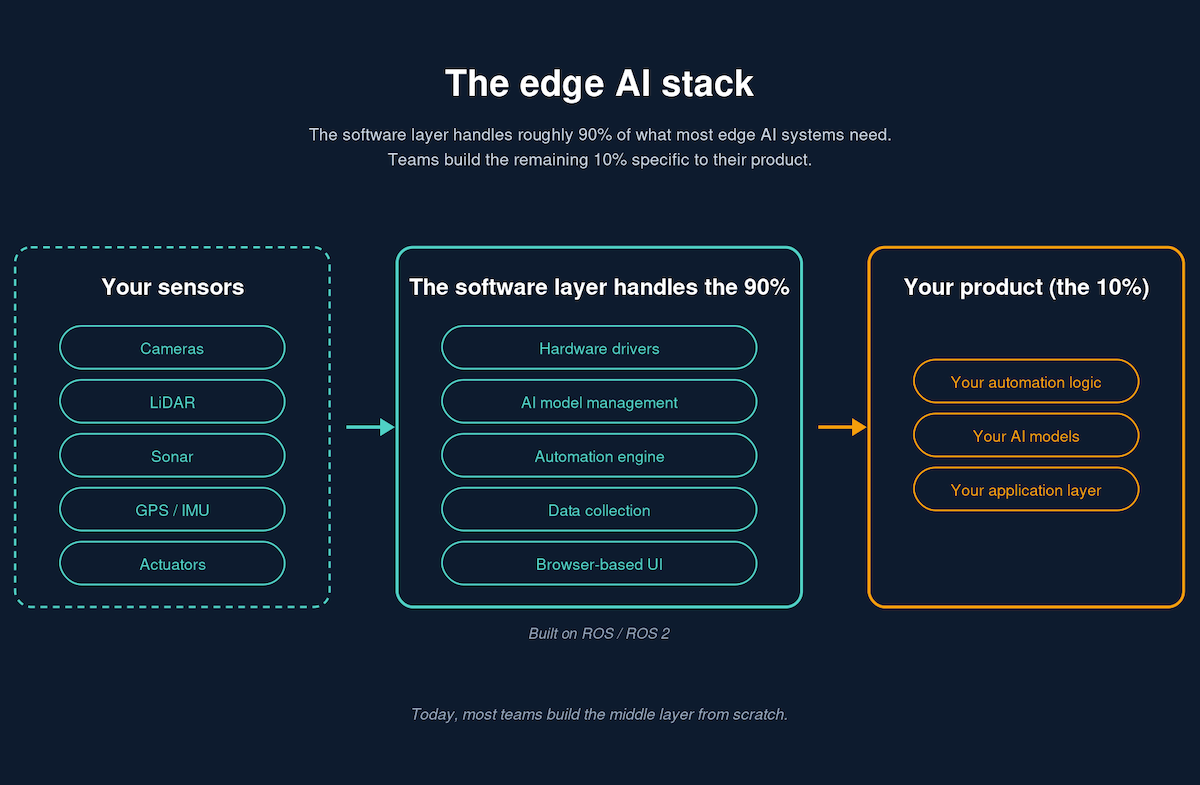
Robots do not primarily connect to keyboards, mice and printers. They connect to cameras, lidar systems, GPS units, motors and industrial control systems. They need software that links live sensor data to AI models and then connects those model outputs to actuation and control. They also often operate without a built-in display or keyboard, which means management and interfaces must be accessible through browsers on networked computers rather than through a local desktop metaphor.
The gap is not only technical but economic. If building useful robotics applications requires deep expertise across embedded hardware, AI inference, sensor integration, controls and user interface design, then the market stays limited. Deployment remains slow, custom and expensive.
The case for a robotics software layer
The supplied article points to an emerging software layer designed to bridge that gap. The idea is to provide a more integrated platform that abstracts away some of the complexity of edge AI hardware and robotic interfacing. In effect, it would make edge AI processors more like usable products and less like raw components.
Such a layer would need to handle the specific needs of robotics rather than simply adapt desktop computing patterns. That includes standardized connections to sensors and motion systems, workflows for routing live data into AI models, and remote user experiences that fit headless machines deployed in the field. If successful, that approach could expand who is able to build robotics applications and how quickly they can move from prototype to deployment.
The broader claim is that lowering the skill threshold would do for robotics what graphical interfaces and bundled software once did for PCs: unlock demand from people who care about outcomes more than low-level implementation details.
What this could change for the market
If the argument holds, the commercial effect could be significant. Edge AI hardware suppliers have already created the computational conditions for broader adoption. The next winner may be the software environment that turns those chips into accessible, domain-ready robotic building blocks.
That would matter across logistics, inspection, defense-adjacent autonomy, environmental monitoring and industrial automation. In all of those areas, organizations may want robotic capability without maintaining teams of specialist developers for every deployment. A more complete software abstraction layer could reduce integration work, shorten deployment cycles and widen the customer base.
The source does not present this shift as complete or inevitable. Instead, it suggests that robotics is at the point where hardware capability has crossed an important threshold and software usability now determines how much of that capability can be turned into real products. That is the same turning point that once separated powerful-but-niche computing from mass adoption.
The larger lesson
The comparison to Windows is useful not because robotics will repeat PC history exactly, but because it highlights a recurring pattern in technology. Breakthrough hardware rarely reaches its full market impact on hardware alone. Adoption accelerates when the surrounding software stack reduces friction, standardizes common tasks and lets more people participate.
In that sense, the story is less about a single chip vendor or software company and more about where value may shift next. The robotics market has spent years proving that autonomous and semi-autonomous machines can work. The next challenge is making them straightforward enough to deploy that many more organizations can actually use them.
This article is based on reporting by The Robot Report. Read the original article.
Originally published on therobotreport.com