Wheels Instead of Feet
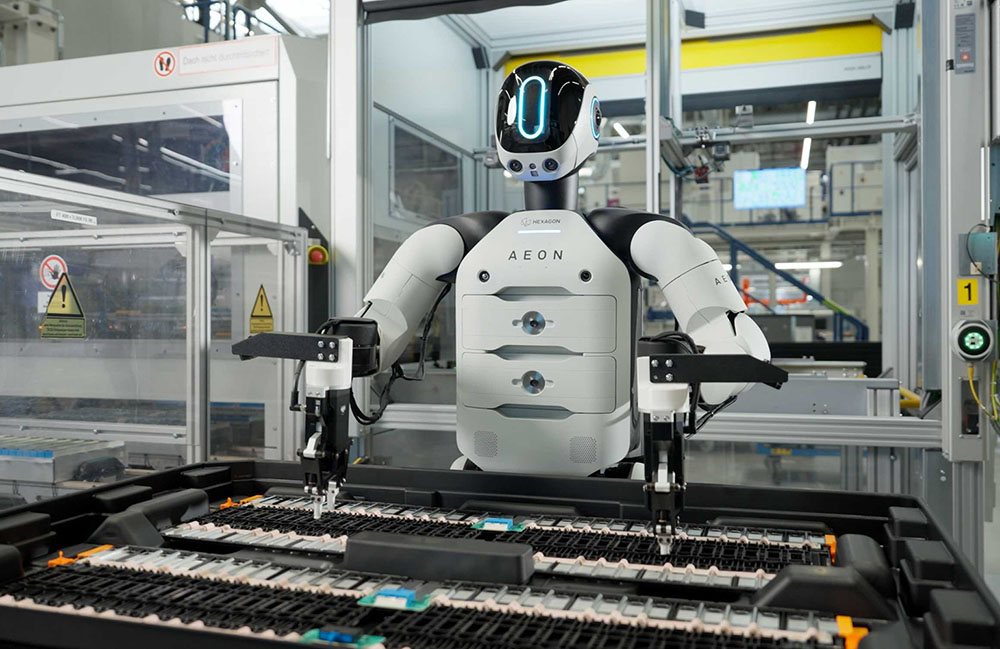
BMW is bringing humanoid robots to its German assembly lines, but not the walking kind that have dominated headlines. The automaker has begun testing Hexagon Robotics' AEON robot at its Group Plant Leipzig — a semi-humanoid system that rolls on wheels attached to each leg rather than walking on feet, allowing it to move faster across factory floors while retaining the ability to step over obstacles when needed.
The deployment marks one of the first serious industrial pilots of humanoid robotics by a major automaker, moving beyond the demonstration videos and trade show appearances that have characterized much of the humanoid robot industry. BMW is not just evaluating whether the technology works — it is integrating the AEON into real production workflows with the explicit goal of improving manufacturing competitiveness.
The AEON Platform
Released by Hexagon Robotics in June 2025, the AEON is designed as a practical industrial platform rather than a research curiosity. Its most distinctive feature — wheels in place of feet — reflects a pragmatic engineering decision. Walking is extraordinarily difficult for robots and consumes substantial energy and computation. Rolling is efficient, reliable, and fast. By combining wheeled mobility with a humanoid upper body, the AEON captures the manipulation advantages of human-like arms and hands without the locomotion challenges that plague fully bipedal designs.
The robot supports interchangeable hand and gripper elements, allowing it to be configured for different tasks. Scanning tools can replace manipulators when inspection tasks take priority. This modular approach means a single platform can serve multiple roles within a production environment, improving the return on investment for manufacturers evaluating the technology.
From Testing to Pilot
BMW's engagement with the AEON follows a deliberate timeline. Initial test deployments began in December 2025, with the robots operating in controlled sections of the Leipzig plant. A second test phase is scheduled for April 2026, and the full pilot program is planned to begin in summer 2026.
During testing and the pilot phase, BMW is targeting two primary application areas: high-voltage battery assembly and component manufacturing. Both are areas where the combination of precision manipulation, mobility, and the ability to work alongside human operators could provide genuine value. Battery assembly in particular involves handling heavy, sensitive components in configurations that change as BMW expands its electric vehicle lineup.
Integrating Across Departments
BMW's approach to the pilot reveals the organizational complexity of deploying humanoid robots in a modern factory. The company involved all production departments early in the evaluation process — not just the engineering teams that would program and maintain the robots, but IT infrastructure, occupational safety, production management, and shop floor logistics.
This cross-functional integration is essential because a mobile humanoid robot touches every system in a factory. IT must ensure network connectivity and data security. Safety teams must establish protocols for human-robot interaction in shared spaces. Logistics planners must account for the robot's movement patterns. Production managers must determine where the technology adds value versus where existing automation or human workers are more effective.
The thoroughness of this preparation distinguishes BMW's pilot from the more superficial evaluations that some companies have conducted with humanoid robots. This is not a publicity exercise — it is an operational assessment designed to determine whether the technology can earn its place on the production line.
The European Competitiveness Angle
Milan Nedeljkovic, BMW's board member responsible for production, framed the robot deployment in terms of European manufacturing competitiveness. His statement that digitalization improves competitiveness in Europe and worldwide reflects a broader anxiety within European industry about maintaining manufacturing relevance as labor costs rise and Asian competitors deploy automation aggressively.
Germany's automotive industry faces particular pressure. The transition to electric vehicles is restructuring supply chains and manufacturing processes, while competition from Chinese automakers operating with lower costs intensifies. Robotics and automation offer a path to maintaining production quality and efficiency without the labor cost advantages that some competitors enjoy.
Industry Context
BMW's pilot arrives amid a broader push by automakers to evaluate humanoid robots for manufacturing applications. Tesla has prominently displayed its Optimus humanoid at events, though factory deployment timelines remain vague. Hyundai, through its ownership of Boston Dynamics, has access to some of the most advanced bipedal robots in existence. Several Chinese automakers have announced humanoid robot partnerships of their own.
What distinguishes the BMW-Hexagon deployment is its pragmatism. The AEON's wheeled design sacrifices the visual appeal of a walking humanoid for the practical advantages of reliable mobility. The structured pilot program with defined phases and specific application targets reflects an engineering-driven evaluation rather than a technology showcase.
What Success Looks Like
For BMW, the pilot's success will be measured in concrete operational terms: can the AEON perform battery assembly and component manufacturing tasks reliably enough to justify the investment? Can it work safely alongside human operators in a production environment? Can it adapt to changing production requirements as BMW's vehicle lineup evolves?
The answers to these questions, expected to emerge through the summer 2026 pilot, will inform not just BMW's robotics strategy but the broader automotive industry's assessment of whether humanoid robots are ready for the factory floor — or whether they remain an expensive promise waiting for the technology to catch up with the ambition.
This article is based on reporting by The Robot Report. Read the original article.
Originally published on therobotreport.com