AGIBOT is positioning scale as the next test for embodied AI
AGIBOT says it has reached a new production benchmark: the 15,000th robot has rolled off its line. On its face, that is a manufacturing milestone. More importantly, the company is using it to make a broader argument about where embodied AI stands today. In AGIBOT’s framing, the industry is moving beyond demos and proof-of-concept systems toward repeatable delivery into real working environments.
That distinction matters because embodied AI has spent years attracting attention through vision-heavy demonstrations while facing harder questions about deployment, reliability, and operations. A robot that performs in a controlled showcase is one thing. A robot that can be manufactured in volume, adapted for specific tasks, shipped, installed, and kept running in the field is another. AGIBOT’s announcement is built around the idea that scale now depends as much on manufacturing and deployment discipline as on model capability.
According to The Robot Report, the milestone unit was an AGIBOT G2, described as a wheeled mobile manipulator with a humanoid torso and arms designed for industrial tasks. The company said the achievement reflects progress not only in assembly volume but across product portfolio development, supply chain readiness, standardized manufacturing, engineering delivery, and on-site deployment.
From 1,000 to 15,000: production speed is part of the story
The most concrete signal in the report is the pace of AGIBOT’s ramp. The company previously said it took about a year to grow from 1,000 to 5,000 units. The next jump, from 5,000 to 10,000, took just three months, with production speed increasing by more than four times compared with the earlier phase. It says that acceleration has now extended through the 15,000-unit mark.
Those numbers do not by themselves prove commercial success or durable field performance, but they do indicate that AGIBOT wants to be judged as an industrial operator, not simply a robotics lab. In embodied AI, this is a meaningful shift. Once companies pursue higher output, they have to solve for sourcing, assembly consistency, testing procedures, logistics, maintenance support, and customer integration. Those are often the areas where promising robotics concepts stall.
By emphasizing throughput and delivery capability, AGIBOT is effectively arguing that embodied AI is entering a phase where execution quality may separate winners from companies with strong demonstrations but weak deployment infrastructure.

What the company says it is building
Founded in 2023 and based in Shanghai, AGIBOT says it is developing both foundation models and the robotic bodies needed to apply general intelligence in the physical world. The company describes its approach as a “Three Intelligences in One” architecture integrating locomotion, interactions, and manipulation into a unified system.
The portfolio cited in the report spans humanoid robots, quadrupeds, dexterous systems, and commercial cleaning machines. That breadth suggests AGIBOT is not betting on a single robot form factor alone. Instead, it appears to be pursuing a platform approach in which common intelligence capabilities can be adapted across multiple embodiments and tasks.
If that strategy works, it could help the company spread development costs and address different commercial markets with shared underlying software and systems engineering. The challenge, of course, is that broad portfolios can also complicate manufacturing, servicing, and application-specific tuning. The operational burden rises quickly when a company must support several hardware families rather than one tightly defined product line.
Deployment, not just production, is the harder threshold
AGIBOT’s own language points to the central problem. The company said that bringing embodied AI from production to real-world use requires integrated capability across robot design, full-system manufacturing, software-hardware integration, adaptation for specific applications, and field implementation. That is a useful summary of why robotics scale is difficult.
Industrial customers do not buy a robot only because it exists. They buy when a machine can fit into workflows, handle variation, justify cost, and operate with enough reliability to avoid becoming a burden on staff. Even semi-humanoid systems aimed at industrial tasks must prove that they can work safely and predictably in environments shaped by human processes, legacy equipment, and production constraints.
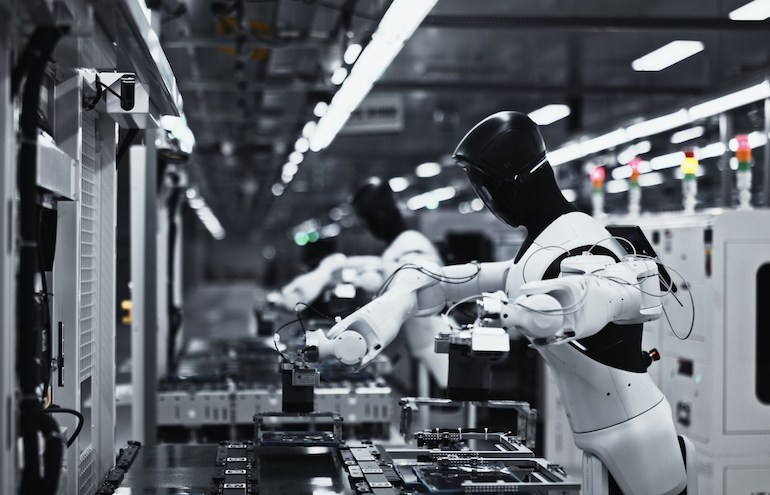
The report includes one concrete deployment example: AGIBOT G2 robots working on Longcheer’s tablet production lines. That kind of use case is more informative than a stage demo because it implies task-specific integration in a factory setting. Still, the source text does not provide performance metrics, utilization rates, or economics, so the milestone should be read as evidence of scaling intent and output rather than proof that embodied AI has solved its commercial challenges.

Why this milestone is worth watching
Even with those caveats, the announcement is notable for what it says about the current direction of robotics competition. Embodied AI is increasingly becoming a contest across whole stacks: model development, control systems, mechanical design, manufacturing capacity, and field deployment. Companies that can only excel in one layer may struggle to convert attention into sustained adoption.
AGIBOT is presenting itself as a company trying to cover that entire stack. Its statement frames the 15,000th robot not just as a factory output number, but as evidence that it can link design, production, delivery, and implementation into one repeatable process. Whether that claim holds up will depend on how many of those robots stay active in real environments and how broadly the company can extend deployments beyond early customers.
For the wider industry, the signal is that robotics firms no longer want to talk only about what their systems can do in principle. They want to show that they can manufacture in volume and place machines into practical settings. That change in emphasis is healthy. It pushes the conversation away from speculative capability and toward the operational evidence that customers and investors eventually demand.
AGIBOT’s milestone does not settle the question of who will lead embodied AI, and the source material does not provide enough detail to judge commercial durability. But it does mark a moment in which production scale itself is becoming part of the competitive narrative. In that sense, the 15,000th robot is significant less as a symbolic round number than as a sign of what robotics companies now believe they must prove next.
This article is based on reporting by The Robot Report. Read the original article.
Originally published on therobotreport.com