Custom fabrication is moving from cardboard templates to digital capture
For decades, building one-off car parts meant patience, repeated measuring, and a lot of trial and error. That workflow still works, but it is slow, especially when a project involves older vehicles, missing documentation, or parts that were never standardized in the first place. A new example from Tucci Hot Rods shows why 3D scanning is starting to matter in small-scale vehicle fabrication.
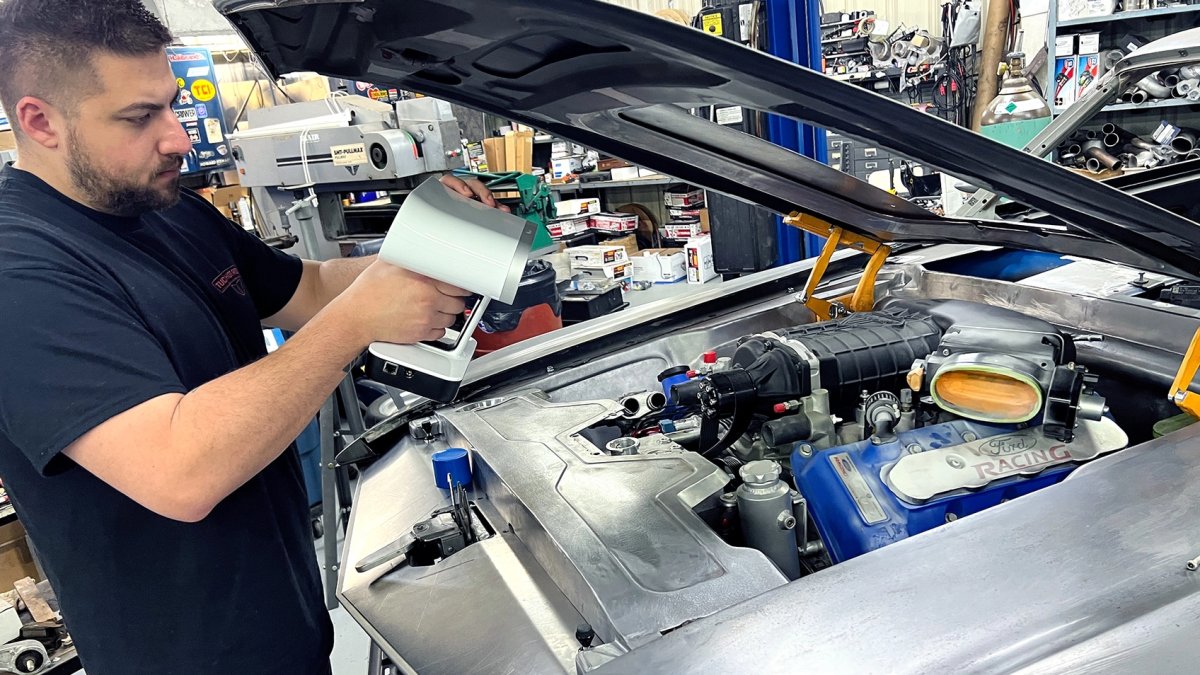
According to The Drive, the Upstate New York shop has been using an Artec Leo 3D scanner and related software to speed up the design of custom components. Tucci already uses 3D printing for parts such as lenses, vents, and trim pieces. The scanner changes the front end of that process by replacing repeated manual fitting with a fast digital model of the physical space.
Speed matters, but accuracy is the real shift
The most striking operational claim in the supplied source is the reduction in time. Dominick Tucci said a process that once involved three to four days of back-and-forth prototyping could be replaced by about 15 minutes of scanning. That does not mean every part instantly becomes production-ready, but it does change the economics of iteration. When a shop can capture geometry quickly and work from a more reliable template, the number of wasted prints and rework cycles falls sharply.
Accuracy may be even more important than speed. Older cars often resist modern fabrication because their real-world dimensions no longer match assumptions. Panels shift over time, replacement parts vary, and hand-built or repaired sections introduce small deviations that compound when new components are designed. The Drive reports that Tucci used the scanner to measure a 1936 Dodge grille closely enough to create headlight covers that traditional measuring methods had repeatedly missed by about a quarter inch.
In custom work, a quarter inch is the difference between a finished part and another prototype headed back to the printer. Reducing those misses has obvious value for labor costs, turnaround time, and customer confidence.
Why this matters beyond one hot rod shop
It would be easy to dismiss this as a niche story about hobbyist builds, but the underlying pattern is broader. Shops that work on restorations, low-volume specialty vehicles, motorsport projects, and aftermarket conversions all face the same geometry problem: they need parts that match reality, not just drawings. Digital scanning turns a physical object into a usable design reference quickly enough to fit real shop timelines.
That is especially useful when parts are discontinued, when the original manufacturer no longer supports a vehicle, or when a builder is combining components that were never meant to coexist. The Drive notes that Tucci used the scanning workflow on a 1931 Ford Model A project to design motor mounts after placing a new engine between the frame rails. That is a practical example of where digital tools can remove ambiguity before fabrication starts.
The result is not the replacement of traditional craftsmanship. It is a change in what craftspeople spend time on. Instead of burning hours measuring, mocking up, and correcting templates, shops can focus more of their energy on engineering choices, finish quality, and installation.
Digital tools are maturing into ordinary shop equipment
The automotive world often treats advanced fabrication technology as something reserved for major OEMs, race teams, or well-funded prototyping labs. What makes this case interesting is that the value comes from applying mature digital tools inside a working custom shop. The scanner is not presented as a concept demonstration. It is a way to solve recurring production problems.
That shift mirrors what happened earlier with CNC machining and desktop 3D printing. At first, the technology attracts attention because it looks futuristic. Later, it becomes important because it is boringly useful. Once a tool reliably saves time, reduces error, and expands what a shop can promise customers, it stops being a headline gadget and becomes infrastructure.
There is also a cultural angle here. Hot rodding is often described as defiantly analog, shaped by improvisation and hands-on skill. Tucci’s workflow suggests that the boundary between old-school fabrication and advanced digital tooling is fading. Builders can preserve the spirit of custom work while using better instruments to execute it.
The likely direction from here
The practical next step is straightforward: more scanning, more digital archiving, and tighter integration with 3D printing and part design software. Once a shop captures accurate scans of common platforms, body sections, or engine bays, those files can become reusable assets that accelerate future jobs. Over time, that creates a competitive advantage.
The broader implication is that custom automotive work is becoming more data-driven without becoming less hands-on. Scanning does not eliminate fabrication skill. It gives that skill a better starting point. For builders working where no off-the-shelf solution exists, that can be the difference between an idea that remains in the shop notebook and one that gets bolted onto the car.
This article is based on reporting by The Drive. Read the original article.
Originally published on thedrive.com