The Electric Bus America Has Been Waiting For
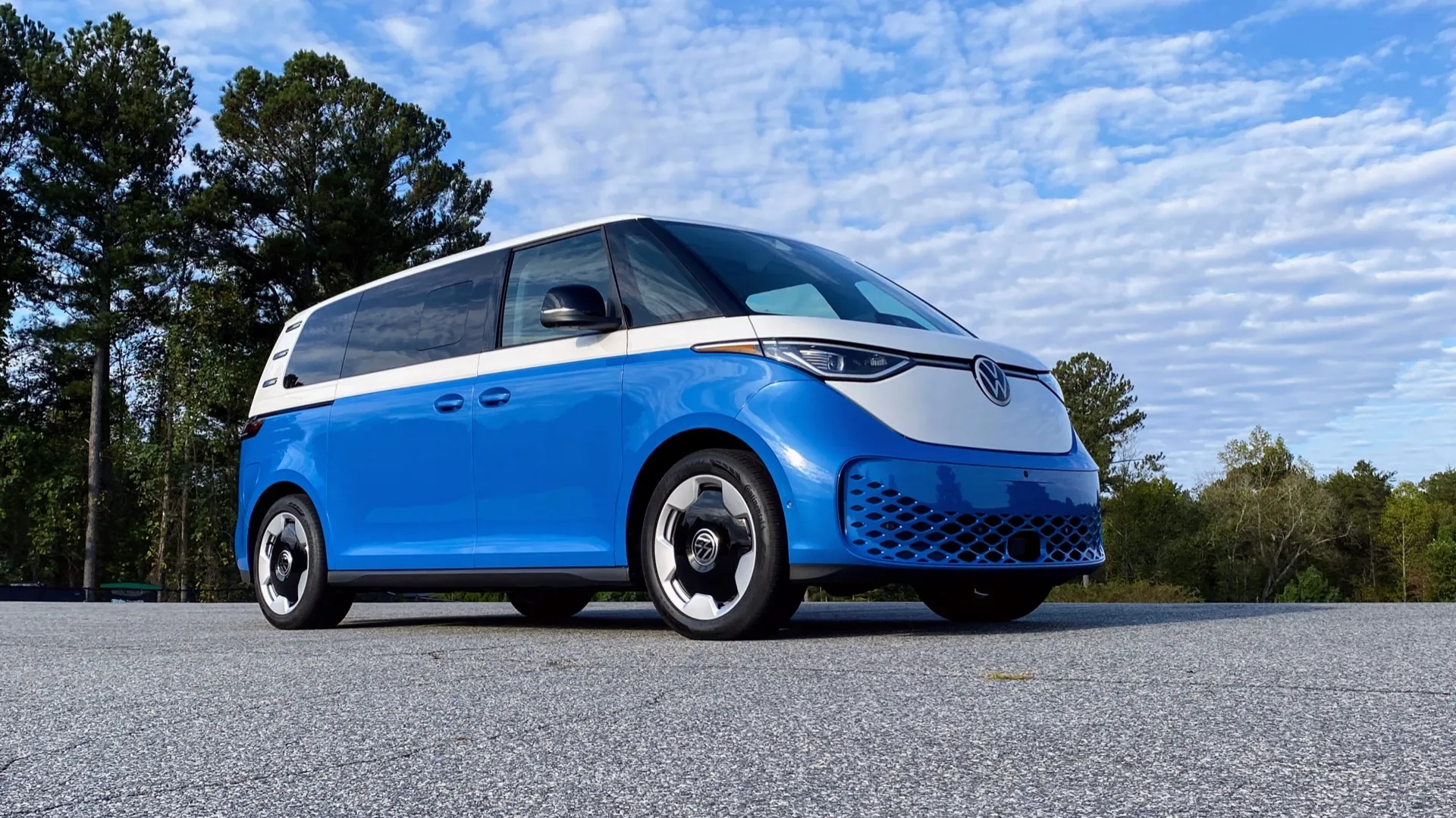
Volkswagen's ID.Buzz has been available in Europe for two years, but the version American buyers have been waiting for—a three-row, full-size electric minivan that evokes the company's legendary Type 2 Microbus—has finally arrived. The 2025 US-spec ID.Buzz is 10 inches longer than the European two-row model, adding a third row for six or seven-passenger capacity, and comes equipped with a larger 91-kWh battery pack and a more powerful rear motor tuned for American highway driving.
Pricing starts at $61,545 and stretches to $71,545 for the top-trim 1st Edition with all-wheel drive. That puts the ID.Buzz squarely in premium minivan territory, competing with the Chrysler Pacifica Hybrid and Toyota Sienna at the luxury end of the market. Whether buyers will pay a premium for the ID.Buzz's distinctive character over those proven alternatives will determine whether this vehicle becomes a niche curiosity or a genuine commercial success.
Performance and Range
The rear-wheel-drive base model delivers adequate power for daily driving, while the 1st Edition adds a front motor for all-wheel drive and improved performance in adverse conditions. EPA-rated range of up to 234 miles on a charge is competitive for the segment and should satisfy most family use cases—school runs, weekend trips, and occasional road trips with charging stops.
Fast charging performance is a particular strength: the ID.Buzz can charge from 10 to 80 percent in approximately 26 minutes on a 170-kW DC fast charger, which is genuinely convenient for road trip stops. VW's decision to adopt the North American Charging Standard (NACS) connector means the ID.Buzz is compatible with Tesla's Supercharger network, giving it access to one of the most extensive and reliable fast-charging networks in the country.
The Cabin Experience
The ID.Buzz's interior reflects its heritage as a people carrier—flexible, practical, and pleasant. The second-row seats can slide and recline, and the third row is more accommodating than most minivan equivalents thanks to the van's boxy proportions, which maximize interior volume relative to wheelbase. Cargo capacity behind the third row is modest but usable; fold the rears and the space becomes genuinely cavernous.
Volkswagen's infotainment system, historically a weakness in its electric vehicles, has been improved for the US model. Physical controls for climate settings—often a complaint in vehicles that moved everything to touchscreens—return in the ID.Buzz, a concession to ergonomic common sense that many owners will appreciate on cold mornings when gloved hands and a heated seat button are not a luxury but a necessity.
The Design Factor
The ID.Buzz's most commercially important attribute may be its appearance. The van is unmistakably descended from the Microbus—the rounded nose, the two-tone color combinations, the large windows—while being thoroughly modern in its proportions and details. Reaction from other drivers is reportedly enthusiastic: people smile at it, wave, and ask questions at charging stations.
That emotional response is difficult to quantify but commercially significant. Minivans have long suffered an image problem in the US market; the ID.Buzz actively reframes the segment as desirable rather than merely practical. VW is betting that families who would never consider a conventional minivan might embrace an electric one that looks like this.

The Competition
The ID.Buzz enters a market that is not well-served by electric alternatives. The Chrysler Pacifica and Chrysler Voyager remain the dominant minivan choices, available as plug-in hybrids but not full battery electrics. The Kia Carnival and Toyota Sienna are competitive in value and practicality but not available in electric form. For buyers who specifically want an electric minivan, the ID.Buzz has essentially no direct competition at launch.
That positioning is strategically astute: early EV adopters who also need family hauling capacity have been underserved, and the ID.Buzz offers them a product that doesn't require apologizing for its appearance. Whether the $61,545 starting price proves an obstacle in a segment historically associated with value will be the key test as the model's market reception develops.
Verdict
The 2025 VW ID.Buzz is a genuinely charming and capable electric vehicle that makes a strong case for itself in a segment where it faces no direct competition. Its combination of distinctive design, adequate real-world range, fast-charging capability, and practical three-row packaging is compelling for the right buyer. It is expensive—there is no getting around the premium pricing—but it is also one of the most characterful vehicles of any kind available in the American market today.
This article is based on reporting by Green Car Reports. Read the original article.

Originally published on greencarreports.com