A Reassessment of the Sun’s Quiet Reputation
The Sun is a dynamic star that flares frequently. These bursts of energy can be aimed in any direction, and occasionally they are aimed at Earth. Even so, when compared with other stars that resemble the Sun, our star has seemed unusually subdued. It has not been observed producing the superflares that appear on some stellar counterparts. For years, this apparent restraint has been treated as good news. Some scientists have even proposed that the lack of superflares was a crucial factor in allowing complex life to emerge and thrive on Earth.
That assumption is now facing fresh scrutiny. A new study led by Natalie Krivova of the Max Planck Institute for Solar System Research, with co-authors, published in Philosophical Transactions A, questions the idea that the Sun cannot generate such powerful eruptions. The work does not treat superflares as an immediate forecast, but it does suggest that the Sun may be physically capable of them. For a world increasingly dependent on advanced technology, that possibility carries weight. As the authors’ broader implications suggest, a highly technological society could eventually bear the brunt of such an event.
Active Regions and the Mechanics of Flares
To understand why the finding matters, it helps to review how solar flares work. The Sun’s magnetic field becomes twisted in areas called active regions. When those twisted magnetic structures snap and reconnect, they release a large amount of stored energy. That release is a solar flare. Active regions are commonly known as sunspots, and after the magnetic snap-back they leave behind a residual glowing area called a flare ribbon.
These features are not merely visual curiosities. They offer a way to connect what can be observed on the solar surface with the energy that a flare might unleash. For decades, scientists have gathered data on the Sun and watched flares carefully, trying to understand the relationship between the size of an active region, the resulting flare ribbons, and the total energy released.
A Clear Statistical Relationship
The new study used data from NASA’s Solar Dynamics Observatory collected between 2010 and 2016. The authors analyzed what they considered a critical relationship: the total area of an active region, the size of the flare ribbons it produced, and the total energy released when those ribbons formed. Their analysis revealed a strong and accurate statistical correlation. Intuitively, the larger the active region, the larger the ribbon area, and the greater the maximum potential flare energy. More importantly, the researchers found that flare energy scales exponentially with ribbon area.
That exponential relationship has significant implications. It means that relatively small differences in the size of an active region or its flare ribbons can correspond to much larger differences in the energy a flare might release. It also provides a tool for estimating the potential power of flares from observable features. The authors then extended their investigation to active region data from earlier periods, testing whether the same relationship could help interpret historical solar activity.
Learning From the Carrington Event
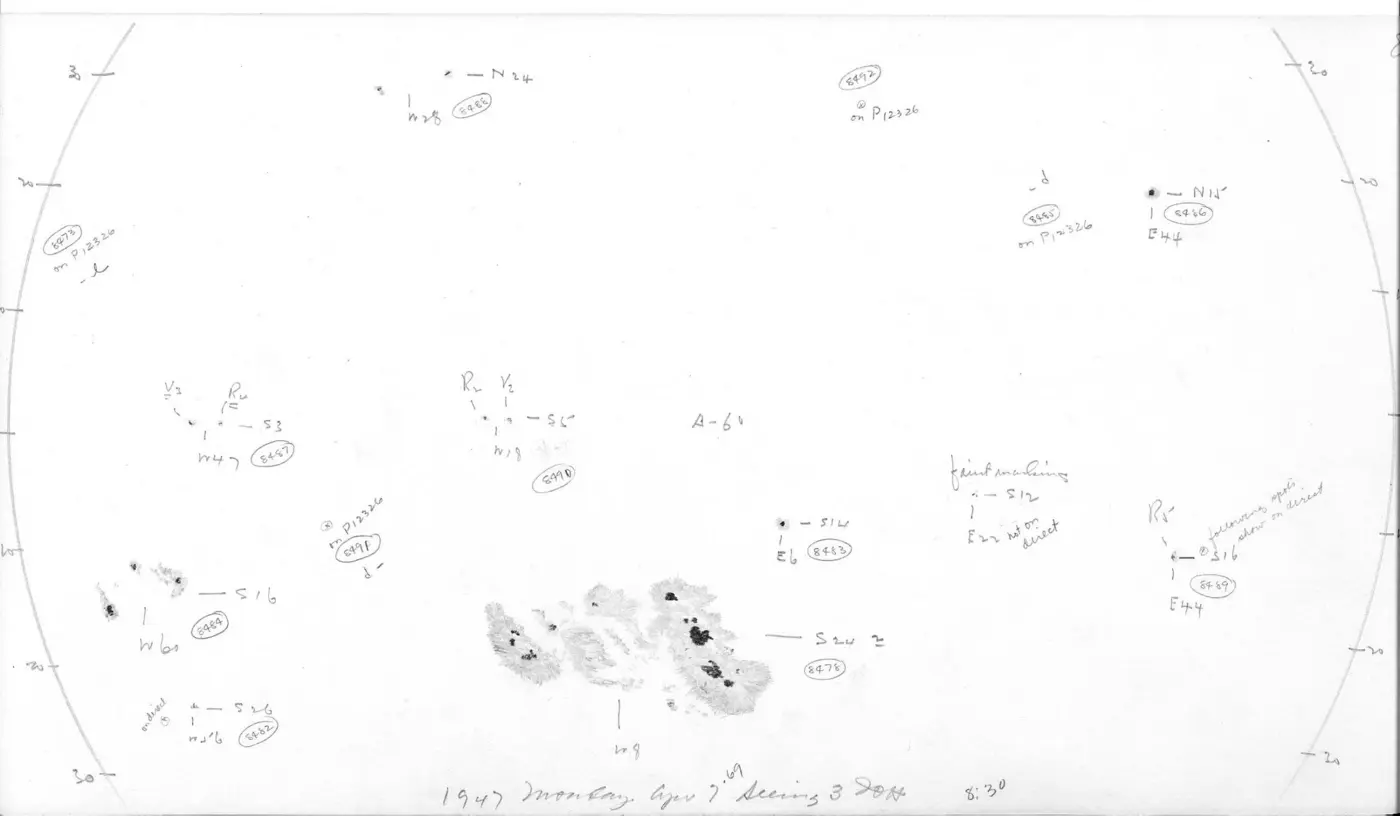
One historical benchmark stands out in solar science: the Carrington Event of 1859. It remains the most famous solar storm on record. The auroras it triggered were so bright that people in the Caribbean could read newspapers at night by their light. The event was more than a spectacle. It also caused telegraph poles and stations to catch fire spontaneously, revealing how solar activity can disrupt technology.
Using their understanding of the link between active regions, flare ribbons, and energy release, the authors looked back at the sunspot that preceded the Carrington Event. They calculated the maximum energy release that this active region could have produced. The exercise illustrates how modern statistical relationships can be applied to historical observations, sharpening estimates of what the Sun has done in the past and what it might do again.
Why Superflares Matter for a Technological Civilization
The implications of the paper are not limited to solar physics. If the Sun can produce superflares, then the assumption that Earth is permanently shielded from such extremes by the Sun’s mild temperament becomes less certain. A superflare would release an enormous amount of energy, and modern society relies on networks of technology that could be vulnerable to severe space weather.
The source of the concern is not that a superflare is guaranteed or imminent. Rather, the study challenges a long-standing belief about the Sun’s physical limits. The authors argue that the evidence for the Sun being incapable of superflares is weaker than previously thought. If that conclusion holds, it changes how scientists assess the Sun’s potential and how seriously planners should consider the most extreme solar events.
The Bigger Picture
The study also intersects with questions about life’s history on Earth. Some scientists have argued that a lack of superflares was a critical impetus for the development of complex life. A calmer Sun would have provided a more stable environment, avoiding the kind of catastrophic space weather that could damage the atmosphere or disrupt emerging ecosystems. If the Sun is actually capable of superflares, even if they are rare, that narrative becomes more complicated.
None of this means the Sun is about to unleash a civilization-threatening event. The new paper’s contribution is to question an assumption and to provide a statistical framework for understanding flare energy. It shows that the size of an active region and its flare ribbons can be linked to the maximum potential energy release, and that this relationship scales exponentially. That is a valuable step toward better estimates of the Sun’s worst-case behavior.
For now, the research adds a note of caution to the familiar image of a quiet, benign Sun. Our star is active and capable of powerful eruptions. The question raised by Krivova and her colleagues is whether our assumptions about its limits have been too optimistic. As scientists continue to mine data from the Solar Dynamics Observatory and historical records, the answer may shape how we prepare for the most extreme space weather the Sun can produce.
Key Findings at a Glance
- The Sun has appeared relatively quiet compared with other Sun-like stars and has not been observed producing superflares.
- A new paper by Natalie Krivova and co-authors in Philosophical Transactions A questions the assumption that the Sun cannot produce superflares.
- Solar flares occur when twisted magnetic fields in active regions snap and reconnect, releasing stored energy.
- Active regions are commonly known as sunspots; they leave behind flare ribbons after a flare.
- Using NASA Solar Dynamics Observatory data from 2010 to 2016, researchers found that larger active regions produce larger flare ribbons and greater maximum potential flare energy.
- Flare energy scales exponentially with ribbon area, according to the study.
- The authors applied their analysis to historical data, including the sunspot linked to the 1859 Carrington Event.
- If the Sun can produce superflares, a highly technological society could eventually face significant consequences.
This article is based on reporting by Universe Today. Read the original article.
Originally published on universetoday.com