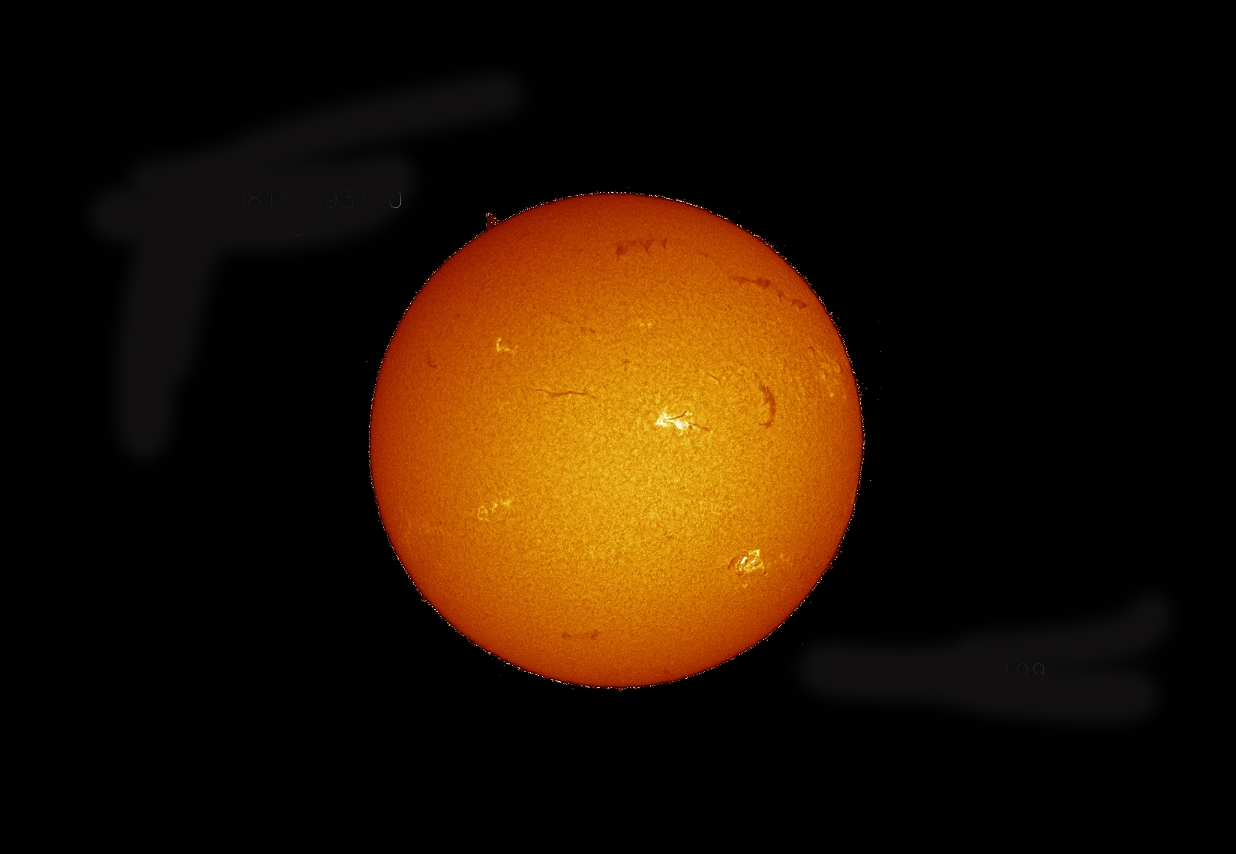
A rare look at the fading phase of a solar flare
Solar physicists studying a C-class flare observed in August 2022 have reported an unusual set of spectral signatures that current computer models do not fully explain. Using the Daniel K. Inouye Solar Telescope on Maui, researchers captured detailed observations of the flare’s decaying phase and found unexpectedly strong signals from calcium II H and hydrogen-epsilon lines. According to the source report, this is the first time those two signatures have been seen in such detail during the decline of a solar flare.
The result matters because solar flares are one of the clearest windows into the Sun’s magnetic violence and atmospheric heating. If observed light behaves in ways models cannot reproduce, that suggests researchers are still missing part of the physical story behind how energy moves through the solar atmosphere.
Why these spectral lines matter
Spectra are produced when light is split into its component wavelengths, allowing scientists to identify how matter emits, absorbs, or reflects energy. In this case, the flare produced strong emission associated with ionized calcium and hydrogen. Those signatures sit close together in the solar spectrum and are particularly useful for probing the chromosphere, the highly dynamic layer between the visible surface of the Sun and the outer corona.
The chromosphere is a crucial but difficult region to model because it sits at the boundary between deeper atmospheric layers and the hotter outer environment shaped by magnetic activity. It is where flare-driven heating, particle motion, and radiative processes interact in complicated ways. If calcium II H and hydrogen-epsilon behave differently than expected there, the discrepancy could point to missing assumptions in how simulations treat the flare environment.
The source material says the observed lines were broader and differed in brightness in ways current models could not fully explain. The models were able to reproduce some features, but not all of them. That kind of mismatch is often where astrophysics makes progress. A model that nearly works, but not quite, identifies exactly where the theory needs to improve.
What made the observation possible
Ground-based observations of these flare signatures have historically been difficult. Telescope time, instrumentation limits, and the challenge of capturing the right moment in a transient event have all worked against detailed study. The Daniel K. Inouye Solar Telescope changed that equation by combining high resolution with the ability to capture subtle structure in the relevant wavelengths.
The flare in question occurred in active region 3078. Rather than observing only the explosive onset, the telescope caught the fading remnants of the event. That timing turned out to be valuable. Solar flares are often discussed in terms of their peak violence, but the decay phase also contains important information about how heated plasma cools, how energy dissipates, and how atmospheric layers respond after the main release.
Seeing calcium II H and hydrogen-epsilon in this level of detail during that stage gives scientists a new diagnostic tool. It also provides a harder test for simulation frameworks that aim to describe the Sun’s behavior from first principles.
What the models got wrong
According to the report, researchers compared the observations with existing flare-heating simulations and found that the models captured some aspects of the measured behavior but failed to account for others. The reported discrepancies centered on line width and brightness structure. In practical terms, that means the model atmospheres did not produce the same spectral fingerprints as the real flare.
There are several possible implications, even within the limited source description. The heating profile may differ from what the simulations assume. Energy transport through the chromosphere may be occurring on different scales or through different mechanisms than expected. Magnetic field effects or local density conditions may also be more important to the observed light than current treatments capture.
The source does not claim that researchers have resolved those questions. Instead, it makes a narrower and more important point: the observations reveal weaknesses in present solar flare models. That is exactly the kind of result strong telescopes are supposed to produce. Better instruments do not just confirm theory. They expose where theory is incomplete.

Why this matters beyond our Sun
The report notes that the same models can be used to study flares on other stars. That broadens the relevance of the finding. Solar physics often serves as the test bed for stellar physics because the Sun can be observed in far greater detail than distant stars. If models fail against the Sun, where the data are richest, that raises caution about how confidently those models can be applied elsewhere.
At the same time, improved understanding of flare spectra in the solar chromosphere can sharpen how astronomers interpret activity in other stellar systems. Flares affect space weather, atmospheric chemistry, and potentially the habitability conditions around active stars. Even incremental improvements in how researchers model flare heating can therefore ripple outward into exoplanet science and stellar evolution studies.
The importance of high-resolution solar astronomy
The observation is also a reminder of why next-generation solar instruments matter. The Sun is our closest star, but it is not a solved object. Its atmosphere remains difficult to explain in detail, especially when magnetic processes drive rapid, structured energy release. Instruments like DKIST expand the range of questions scientists can ask by capturing fine structure that earlier facilities could not resolve consistently.
That matters not just for academic theory, but for the broader goal of understanding solar behavior as a physical system. Flares, sunspots, and active regions are linked to the Sun’s magnetic engine. The more precisely researchers can track what happens in those events, the better they can refine the models used across solar and stellar astrophysics.
A small flare with outsized scientific value
This was only a C-class flare, not one of the Sun’s most powerful eruptions. Yet it produced an observation significant enough to challenge prevailing expectations. That is a useful lesson in itself. Scientific value does not always track with spectacle. Sometimes a modest event, seen at the right time with the right instrument, reveals more than a larger one observed less well.
The August 2022 flare now stands as a case study in that principle. It provided the first high-detail view of two important spectral signatures during flare decline, exposed weaknesses in current heating models, and opened a more precise path for future work. For solar physicists, that is not a side note. It is the foundation for the next round of questions.
This article is based on reporting by Universe Today. Read the original article.
Originally published on universetoday.com