
Orbital data centers are no longer being discussed as science fiction alone
On-orbit computing has advanced far enough that the debate is shifting from whether it is imaginable to how it could actually be built, powered, and managed. That transition is captured in an upcoming SpaceNews event in Washington, D.C., where industry and government speakers are set to discuss orbital data centers, off-planet computing infrastructure, and the technical bottlenecks that still stand between investment enthusiasm and operational reality.
The framing in the event announcement is telling. Orbital data centers, it says, have moved from hypothetical to “seemingly inevitable,” while companies in the space sector raise millions to compete in a race to establish off-planet computing. That is not the language of a distant research curiosity. It is the language of an emerging infrastructure category trying to define itself before the market fully forms.
Why the idea is gaining traction now
The source material points to several forces driving attention toward on-orbit computing. One is the broader buildout of data infrastructure and the search for new capacity models. Another is power. The event will explore whether solar and nuclear approaches could address one of the biggest constraints in space-based computing: how to supply and manage enough energy for meaningful processing beyond Earth.
A third driver is artificial intelligence. The announcement explicitly raises the question of how AI changes the calculus of what computing remains on Earth and what may eventually be handled in space. That question matters because AI has altered expectations for compute demand in nearly every industry discussion. Once data centers become a strategic constraint on power, cooling, land, and grid planning on Earth, more speculative alternatives start receiving more serious attention.
The space sector has a history of ideas that sound futuristic until adjacent economic or technical pressures make them easier to take seriously. In that sense, orbital computing now sits at the intersection of two surging narratives: the rapid expansion of data and AI workloads, and a commercial space market that increasingly looks for infrastructure businesses rather than one-off missions.
The technical questions are becoming more concrete
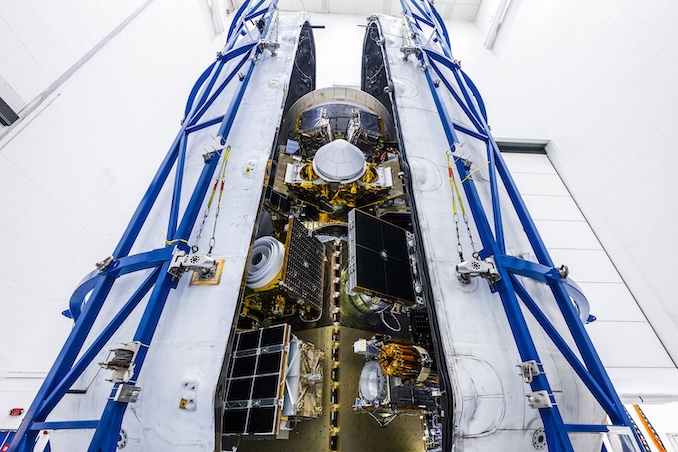
What makes this stage noteworthy is not that orbital data centers are close to routine deployment. It is that the conversation has become concrete enough to organize around specific engineering and business questions. According to the event agenda, discussion will focus on how to build, power, and manage data infrastructure in space. Those are practical categories. They imply questions about spacecraft design, thermal control, power generation, communications, launch economics, and operational maintenance.
The announcement also highlights energy as a central hurdle. Solar and nuclear options are specifically named as possible answers. That matters because power is foundational to any data center business, whether on Earth or off it. In orbit, the challenge becomes harder. Reliable energy generation, storage, and delivery are inseparable from system viability. A concept for space computing that cannot solve its power problem remains a concept.
Management is the other understated challenge. A terrestrial data center can rely on dense logistics, constant physical access, and mature maintenance practices. Space hardware cannot. Any meaningful orbital computing platform would need to be designed around autonomy, resilience, remote management, and a tolerance for failure modes that conventional data infrastructure can often service in person.
Why the event format itself is informative
SpaceNews is structuring the discussion as part of its Orbital Data Centers Series, which suggests this is becoming a sustained reporting and industry topic rather than a one-off curiosity. The event will bring together speakers from industry and government, including Overview Energy, The Aerospace Corporation, and SpaceNews leadership. A networking reception follows the program, and while the event will not be livestreamed, SpaceNews plans to publish a post-event report in May and may feature select conversations in its Space Minds podcast.
Those details matter because they show where the conversation currently lives: in the early market-forming layer between technical speculation, policy interest, and commercial positioning. Limited-capacity in-person events are often where sectors test terminology, compare assumptions, and start aligning around what problems are worth funding first.

The gap between buzz and deployment
The announcement is careful to present both opportunities and challenges. That balance is important. Orbital data centers may be drawing attention and capital, but the field is still defined by unanswered questions. It is one thing to say some computing might migrate off Earth. It is another to show that such systems can be launched economically, powered reliably, managed safely, and integrated into the wider communications stack that real customers would need.
Even the phrase “what computing stays on Earth and what begins to be handled in space” implies a hybrid future, not a wholesale migration. That is a more credible framing. The immediate opportunity, if one emerges, is likely to be selective. Specific workloads, missions, or edge cases may justify space-based processing earlier than general-purpose cloud infrastructure would.
The presence of sponsors also reveals how the ecosystem is trying to define adjacent enabling businesses. The event is sponsored by Star Catcher, which describes itself as building an orbital energy grid designed to eliminate spacecraft power constraints through optical power beaming. Whether or not that model succeeds, its presence underscores a key point: space computing does not stand alone. It depends on a broader orbital infrastructure stack that includes power delivery, communications, and platform services.
A sign of where space commercialization is heading
The most important signal in this announcement is not a specific product launch or government contract. It is the normalization of orbital computing as an area worthy of sustained industry attention. Commercial space has spent years proving markets in launch, Earth observation, and broadband connectivity. The next wave increasingly revolves around infrastructure and services that exist because activity in orbit is becoming more complex and more continuous.
On-orbit computing fits that pattern. It is speculative, but it is no longer being treated as purely speculative. The field now has investors, conference panels, specialist reporting, and adjacent infrastructure narratives around energy and AI. That is often how new categories begin to harden into real sectors.
The April 30 event in Washington will not settle whether orbital data centers become a major industry. But it does capture a genuine shift. The discussion has moved past futurist shorthand and into the language of engineering constraints, power economics, and deployment strategy. In emerging technology, that is often the point at which an idea becomes worth tracking seriously.
This article is based on reporting by SpaceNews. Read the original article.

Originally published on spacenews.com