NASA is drawing attention to the infrastructure behind autonomy research
NASA has published new details on indoor testing facilities available at the NASA Unmanned Autonomy Research Complex, or NUARC, at Ames. The announcement is narrowly focused, but it highlights something important about the state of autonomy and flight research: progress depends not only on algorithms and vehicles, but also on controlled environments where systems can be stressed, measured, and repeated under known conditions.
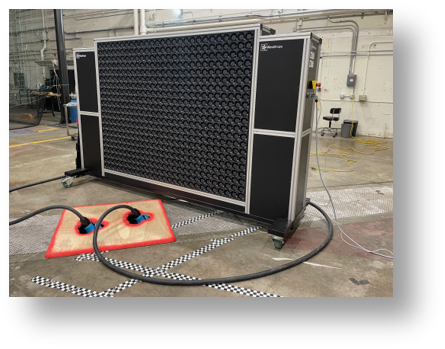
The agency’s update centers on two tools: a large WindShaper fan array for dynamic low-speed and hovering flight research, and a companion WindProbe that can quickly survey flows using the lab’s OptiTrack motion capture system. The hardware is meant to support studies of how air movement affects flight in scenarios that are difficult to reproduce consistently outdoors.
The WindShaper is built for controlled and programmable disturbance
NASA describes the WindShaper as a large dynamic fan array measuring 9 feet by 7 feet and made up of 1,134 fans arranged as 567 “wind pixels.” The setup can produce wind speeds from 0 to 16 meters per second, or roughly 0 to 36 miles per hour, with acceleration up to 4 meters per second squared and deceleration up to 2.5 meters per second squared. Each fan is programmable through Python scripting.
Those details show why the facility matters. Instead of relying on naturally occurring wind, researchers can generate specific patterns on demand. NASA says the system can replicate steady winds, gusts, and wind gradients. That capability is especially useful for low-speed aircraft and hovering vehicles, which can be highly sensitive to abrupt changes in flow. The point is not merely to create wind, but to create structured, repeatable wind.
For autonomy research, repeatability is critical. A system that appears robust in one outdoor flight may fail in another because the underlying conditions have changed in ways that were not fully measured. Indoor infrastructure like this makes it possible to isolate variables, recreate conditions, and compare different control strategies against the same aerodynamic challenge.
Why indoor test environments matter for unmanned systems
Autonomous and remotely operated aircraft increasingly need to function in environments that are cluttered, turbulent, or operationally constrained. That includes indoor spaces, urban corridors, low-altitude logistics routes, and complex takeoff-and-landing zones. In many of those cases, wind behavior at small scales matters a great deal. A localized gust or gradient can affect vehicle stability, sensing, and control response.
NASA’s description of the WindShaper suggests the facility is designed for exactly that kind of problem. By allowing researchers to impose arbitrary wind gradients and gusts, the setup becomes a way to test how vehicles behave under conditions that are dynamic rather than static. That is a better match for the real world, where airflow is rarely uniform.
It also supports faster iteration. Field testing is essential, but it is expensive, weather-dependent, and often difficult to instrument completely. Indoor research environments reduce those frictions. They make it easier to run multiple trials, compare settings, and gather data before moving out to larger operational spaces.
The WindProbe turns airflow into measurable data
The second part of NASA’s announcement is the WindProbe, a handheld mobile wind data collection tool. According to the agency, the probe uses the lab’s OptiTrack motion capture system to determine the position and orientation of the five-hole cone probe mounted at its tip. In practice, that means researchers can move through the test space and gather mapped measurements of airflow while maintaining precise knowledge of where the measurement was taken.
That pairing is important. A programmable wind field is only as useful as the ability to characterize it. If a lab can generate gusts and gradients but not verify them accurately in space, the research value drops. The WindProbe helps close that loop by giving investigators a way to survey the flows produced in the facility and correlate those flows with vehicle behavior.
The result is a more rigorous environment for experimentation. Researchers can generate a condition, measure it, fly within it, and compare responses across repeated runs. That is the sort of foundation that underpins serious autonomy research but often receives less public attention than the aircraft or software being tested.

NASA’s update is a reminder that autonomy is an infrastructure challenge too
The public conversation around unmanned autonomy often gravitates toward visible endpoints: drones, autonomous aircraft, delivery concepts, and advanced control systems. NASA’s NUARC update shifts focus to the enabling layer underneath. The facilities, sensors, and programmable environments used during development determine how quickly researchers can learn and how confidently they can validate performance.
That is especially true for systems intended to operate in uncertain atmospheric conditions. Low-speed and hovering flight remain demanding regimes, not because they are impossible, but because disturbance rejection, stability, and control precision all matter intensely. Testing those behaviors indoors, under programmable and measurable wind conditions, provides a bridge between theory and field deployment.
NASA’s note is brief, but the implication is broad. The agency is making clear that NUARC is not just a generic indoor space. It is a specialized research environment with tools designed to study airflow-sensitive autonomous systems in a repeatable way. That makes it relevant not only to NASA’s own programs, but potentially to a wider set of unmanned aviation and autonomy efforts that depend on disciplined experimentation.
What the facility reveals about the next phase of drone research
As unmanned systems mature, the bottleneck increasingly shifts from proving that a vehicle can fly to proving how reliably it can operate under specific disturbances and edge cases. Facilities like NUARC are part of that transition. They support a more engineering-driven phase of autonomy work, one where robustness, validation, and environmental characterization matter as much as raw capability.
The WindShaper and WindProbe are therefore more than lab equipment. They represent a testing philosophy: build the ability to create realistic conditions, measure them precisely, and use that loop to improve flight behavior. For researchers working on low-speed or hovering vehicles, that is the kind of infrastructure that can shorten development cycles while improving confidence in results.
NASA’s announcement may read like a facilities update, but it points to something larger. The future of unmanned autonomy will be shaped not only by smarter systems, but by better places to challenge them before they ever leave the lab.
This article is based on reporting by NASA. Read the original article.

Originally published on nasa.gov