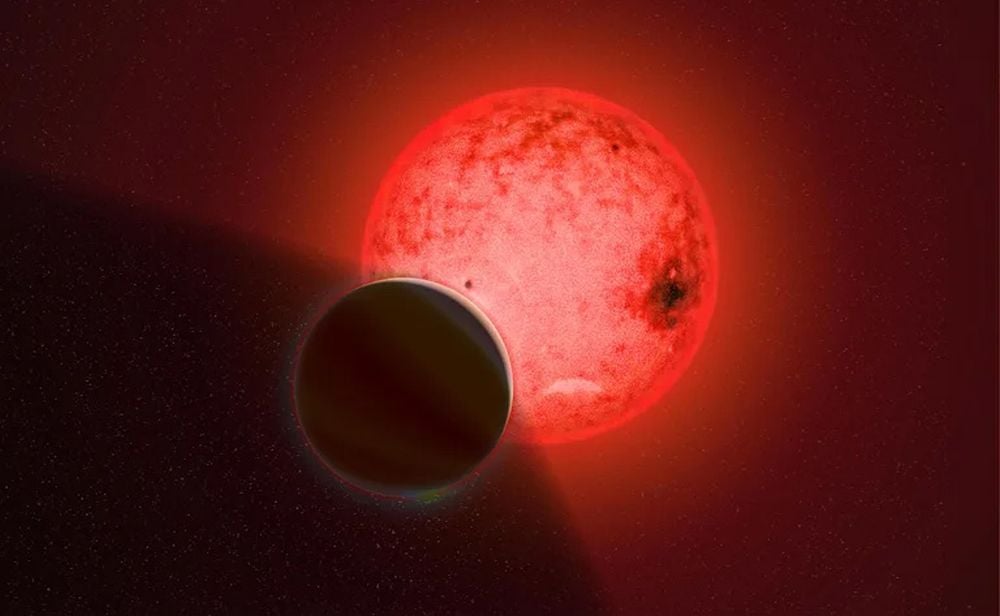
An awkward exoplanet is forcing a closer look at formation theory
Planet formation models are built around a fairly intuitive principle: bigger stars should generally have bigger protoplanetary disks, and bigger disks should be better at making giant planets. That expectation works well enough as a broad guide, but nature keeps producing exceptions. One of the most striking is TOI-5205b, a gas giant orbiting a small M-dwarf star, and astronomers are now using the James Webb Space Telescope to understand what such systems are trying to tell us.
Universe Today highlights the puzzle clearly. TOI-5205b is a close-in gas giant about 282 light-years away. It has roughly 1.08 Jupiter masses, yet it circles a host star of only about 0.392 solar masses. Even more dramatically, it completes an orbit in just 1.6 days. That is an enormous planet in a very tight orbit around a star that, by standard scaling expectations, should not have had such abundant building material available in the first place.
The system is therefore more than an oddity. It is part of a growing class of exoplanets that pressure astronomers to refine or rethink elements of the nebular hypothesis, the widely accepted framework in which stars and planets form from the same rotating cloud of gas and dust.
Why low-mass stars are supposed to struggle with giant planets
The issue begins with disk mass. In conventional models, lower-mass stars are expected to host lower-mass protoplanetary disks. Since planets form from those disks, giant planet formation should become harder as disk mass falls. Massive gas giants require large reservoirs of material and, depending on the model, rapid enough core growth or other conditions to trigger the accumulation of thick gaseous envelopes before the disk dissipates.
That is why systems like TOI-5205b stand out so sharply. The star is small, yet the planet is not. In the 2023 discovery paper cited by Universe Today, the authors wrote that TOI-5205b has one of the highest mass ratios for M-dwarf planets, at almost 0.3%. The same paper argued that the planet’s high mass stretches conventional theories of planet formation and disk scaling relations because those frameworks do not easily recreate the conditions needed for such a world to emerge.
In other words, the mismatch is not subtle. If the usual assumptions are broadly correct, then either rare pathways can sometimes produce giant planets around low-mass stars, or some part of the usual picture needs adjustment.

A larger pattern is starting to matter
One anomalous planet can be dismissed as a statistical oddball. A growing population of them is harder to ignore. Universe Today notes that TOI-5205b is not the only giant planet found around a low-mass star. Collectively, these systems challenge astronomers’ understanding of how planetary systems assemble and evolve.
That matters because exoplanet science increasingly advances through edge cases. Astronomers build theories from the regularities they observe, but the most revealing systems are often the ones that do not fit. A hot Jupiter around a small red dwarf can expose missing physics, alternative formation routes, or migration histories that standard simplified models do not capture well.
One possibility is that these giant planets formed farther out, where conditions were more favorable, and later migrated inward. Another is that disk properties around some low-mass stars are more varied than simple scaling relations imply. There may also be selection effects in the planets we detect most easily. The supplied source text does not resolve those options, but it makes clear why astronomers are motivated to study these systems in more detail.
JWST is now being used to probe the mystery more deeply
The researchers behind the original discovery are revisiting TOI-5205b through a JWST observing program called GEMS: Giant Exoplanets around M dwarf Stars. That alone indicates the scientific value of the target. Webb’s sensitivity gives astronomers a stronger chance to characterize exoplanets and their atmospheres in ways that ground-based follow-up or earlier observatories could not manage as effectively.
While the supplied text cuts off before detailing all of the new findings, the significance of the program is already clear. TOI-5205b is no longer just a discovery headline; it is becoming a test case in a more systematic attempt to understand giant planets around small stars.
That shift from detection to characterization is important. The first question in exoplanet work is whether an object exists. The next questions are often the ones that reshape theory: what is it made of, how did it get there, and what does it imply for the broader population?

Small stars may host more surprising systems than expected
M-dwarfs are the most common stars in the galaxy, which gives this puzzle extra weight. If giant planets around such stars are possible under a wider range of conditions than previously thought, that would affect how astronomers think about planet demographics across the Milky Way. It would not just alter an edge case. It could reshape expectations for how planetary systems form around the most abundant stellar hosts.
There is also a methodological lesson here. Planet formation theory has to explain both the systems that look familiar and the systems that seem improbable. The more exoplanets astronomers find, the less tenable it becomes to rely on a narrow template derived from our own solar system.
TOI-5205b embodies that challenge neatly. A Jupiter-mass world hugging a small red dwarf should be unusual by current expectations. Yet it exists, and it is not alone. That means the burden shifts back to theory.
The likely outcome is not the collapse of the nebular hypothesis, but its refinement. Broad frameworks in astronomy often survive by absorbing complexity, not by remaining unchanged. Systems like TOI-5205b may reveal new disk behaviors, migration pathways, or formation timescales that make the apparent contradiction less severe.
For now, the planet remains a productive problem. It is the kind of discovery that keeps exoplanet science moving: a world that should have been rare, orbiting where it should not be comfortable, around a star that should not have made it so easily. Those are exactly the cases that push a field from cataloging planets toward understanding them.
This article is based on reporting by Universe Today. Read the original article.
Originally published on universetoday.com