Europe Is Targeting a New Orbital Constraint
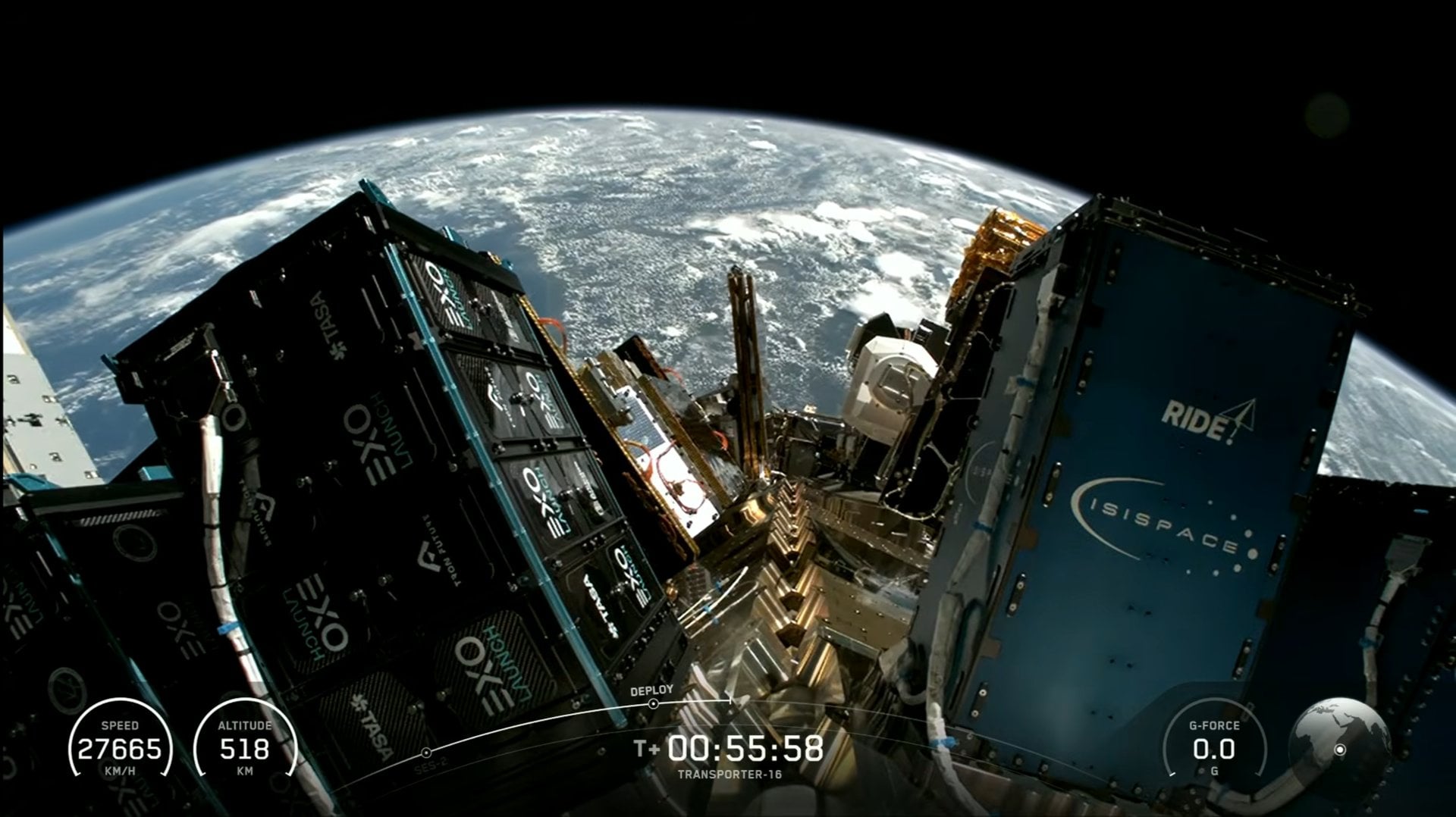
Space infrastructure is no longer limited primarily by launch access or satellite miniaturization. A new bottleneck is emerging in orbit: moving ever-larger volumes of data quickly, securely, and efficiently. According to Universe Today, the European Space Agency backed a series of eight CubeSats and one specialized payload launched on SpaceX’s Transporter-16 rideshare mission on March 30, 2026, with the explicit aim of testing high-throughput laser communications, inter-satellite networking, and in-orbit artificial intelligence processing.
The underlying problem is straightforward. Satellites are generating far more data than legacy communications architectures were designed to handle. High-resolution Earth observation, maritime monitoring, and other space-enabled services depend on getting that information off spacecraft and into usable networks without delay. At the same time, the radio-frequency spectrum that has traditionally carried much of this traffic is under increasing pressure.
That combination is pushing agencies and companies toward optical links, smarter routing, and more distributed processing in orbit. ESA’s Transporter-16 portfolio suggests Europe wants to accelerate all three.
Laser Communications Move From Concept to Small-Satellite Tests
Five of the satellites described in the report were developed under ESA’s Greek Connectivity Programme and focused on optical communications capabilities. Among them is OptiSat, operated by Planetek Hellas, a small satellite carrying a SCOT20 laser communication terminal built by TESAT. Its core mission is to establish secure, high-speed laser links with other small satellites in low Earth orbit.
Another spacecraft, PeakSat, developed by the Aristotle University of Thessaloniki, carries an ATLAS-1 laser terminal from Astrolight. Its role is to demonstrate improved space-to-ground laser communications by sending data to upgraded optical ground stations in Greece. That matters because laser links promise major throughput gains and reduced congestion compared with conventional radio systems, but only if end-to-end pointing, tracking, and receiving infrastructure matures in parallel.
The ERMIS constellation expands the experiment further. Led by the National and Kapodistrian University of Athens, ERMIS-1 and ERMIS-2 are intended to test 5G connectivity for satellite-enabled Internet of Things applications along with radio inter-satellite links. ERMIS-3, a somewhat larger spacecraft, adds another ATLAS-1 laser terminal and is designed to test the pointing and tracking needed to download large hyperspectral Earth-observation datasets directly to ground stations through optical links.
Taken together, those missions show ESA is not betting on a single communications layer. It is exploring a hybrid architecture in which optical systems, conventional radio links, and application-specific networking coexist.
Why the Data Problem Is Becoming Strategic
Data transfer in orbit is no longer a back-end engineering detail. It is becoming a strategic determinant of what satellites can economically do. A spacecraft that collects rich imagery, spectrum data, or environmental measurements is only as useful as its ability to deliver that information when needed. As constellations scale, delays and bottlenecks can undermine business models, limit public-service value, and raise security concerns.
Laser communications offer one route past those constraints. They can enable high-speed, narrow-beam links that reduce interference pressure and potentially improve secure transmission. But the technology also raises practical challenges, especially for small satellites. Precise pointing is critical. Ground infrastructure must be available and weather-resilient enough to sustain operations. Networks also need intelligence in how they route data between spacecraft and downlink nodes.
That is where the broader ESA mission set becomes significant. Universe Today reports that the launch included additional CubeSats under ESA’s Pioneer Partnership Projects umbrella to help commercial companies develop working space infrastructure. Even from the partial details available, the direction is clear: the objective is not only to test components, but to build toward operational ecosystems in which satellites can process, relay, and deliver data more efficiently than today’s architectures allow.
Europe’s Competitive Angle
There is also an industrial policy dimension to the story. Several of the named systems involve European universities, manufacturers, and operators. That suggests ESA is trying to grow regional capability in optical terminals, ground stations, constellation networking, and mission integration rather than simply adopting foreign systems after the fact.
This approach fits a broader pattern in space policy. Communications hardware, onboard computing, and network control are increasingly central to both commercial value and strategic autonomy. If Europe wants resilient access to Earth-observation, maritime, and connectivity services, it needs homegrown competence not only in satellites and rockets but in the data layer connecting them.
Transporter-16 will not resolve the orbital data crunch on its own. These are demonstrations, not a finished communications grid. But the mission set is a practical sign that the sector understands where the next scaling challenge lies. Building more satellites is only part of the job. Making them talk faster, route smarter, and process more before they transmit is the next phase of orbital infrastructure.
In that sense, ESA’s latest batch of experiments is aimed at a foundational question for the space economy: how to keep the information pipeline growing as fast as the machines generating it.
This article is based on reporting by Universe Today. Read the original article.

Originally published on universetoday.com