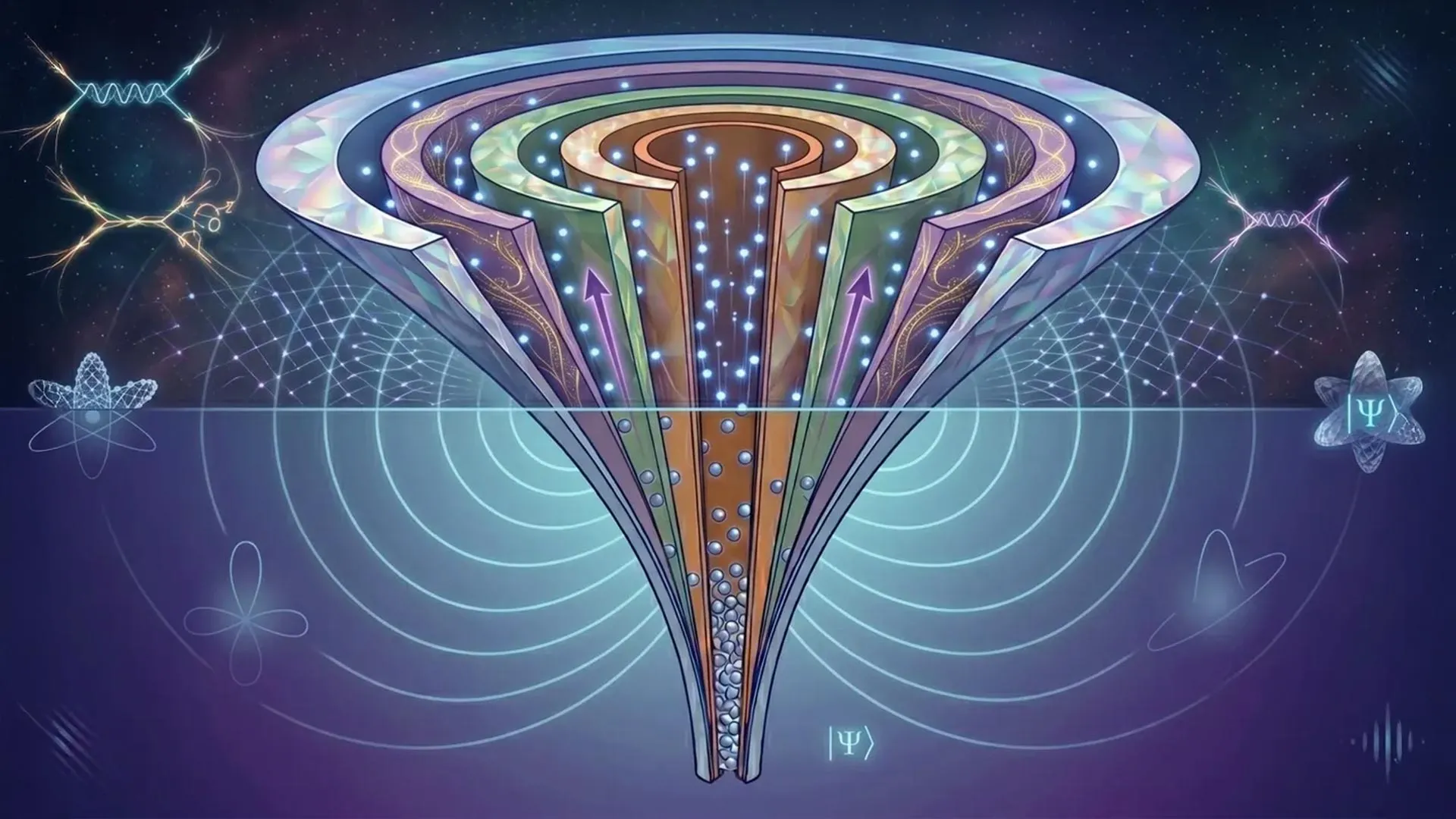
The oldest binding problem in modern physics
Every atomic nucleus poses the same deep question. Protons carry positive charge and should repel one another strongly, yet nuclei remain bound. The reason is the strong force, the interaction that holds protons and neutrons together and makes ordinary matter possible. Physicists have understood for decades that this force is central to reality as we know it. What they have not fully resolved is how a theory built from apparently massless ingredients gives rise to the heavy particles that populate the visible universe.
That puzzle is what gives the latest wave of work its importance. According to New Scientist, researchers now think new mathematical tools are finally prying open a problem that has resisted progress for more than 20 years. If they are right, the payoff will extend beyond better bookkeeping in particle theory. It could illuminate the origin of mass in visible matter and strengthen one of the foundational structures of modern physics.
Why the strong force is so hard to explain
The strong force is, in one sense, familiar. It is the reason atomic nuclei do not fly apart. By the 1930s, physicists already suspected that a new force of nature had to exist, one stronger than electromagnetism and capable of overcoming proton-proton repulsion at very short distances. Later experiments that smashed particles together revealed more about the substructure involved. But deeper theoretical progress proved stubbornly difficult.
The problem is not that the relevant equations look impossibly ornate. The article emphasizes almost the opposite: the equations can appear disarmingly simple. Yet when physicists follow them through, they confront a striking inconsistency. A theory formulated with weightless ingredients somehow produces particles that are unmistakably heavy. Explaining that emergence cleanly has been one of the great unresolved tasks in theoretical physics.

Mass from a theory that starts without it
This is part of what makes the issue so conceptually rich. The visible world is made of massive particles. Tables, rocks, planets, and bodies all depend on that fact. But if the underlying strong-force description begins with massless components, then mass must be generated through the dynamics of the theory itself rather than inserted by hand in a simple way. That is not just a technical wrinkle. It is a statement about how the universe builds substance from deeper rules.
Solving that issue would do more than clarify why nuclei hold together. It would provide a more coherent account of how the matter we actually observe acquires the heft that defines it. The article frames the challenge as one that could illuminate both the mysterious nature of mass in the visible universe and its even more elusive origins.
Why researchers think progress is real now
Physics is full of problems that periodically generate claims of imminent breakthrough. What makes this report notable is its emphasis on new mathematical methods and on the sense, voiced by researchers, that a long period of frustration may be ending. Ajay Chandra of Purdue University described the current moment as an exciting time, a modest phrase that in this context signals more than routine optimism.
The story suggests that the advance is not a single experiment or a sudden dramatic observation. It is a convergence of theoretical and mathematical tools that allow scientists to attack the strong-force problem from new angles. That matters because some problems in fundamental physics remain blocked not by missing data, but by missing ways of calculating, representing, or connecting ideas that have been in front of researchers for years.

Why this matters beyond physics departments
At first glance, the mystery of how nuclei stay bound may seem remote from ordinary life. In reality, it touches one of the most basic questions science can ask: why is there durable matter at all? If electromagnetism were the only relevant force inside nuclei, the universe would not have developed the stable atomic structures needed for chemistry, biology, or planets. The strong force is what keeps the core of matter from disintegrating.
Understanding that force more completely also strengthens confidence in the conceptual framework on which particle physics rests. Modern physics is not just a collection of measurements. It is a web of theories that must fit together without contradiction. When one of its central theories leaves a major explanatory gap, that gap becomes a pressure point for the entire enterprise.
A breakthrough, if it holds, would be foundational
The article does not claim the problem is solved. It claims something more careful and perhaps more interesting: that after years of stalled progress, scientists may finally be opening the door. That distinction matters. In frontier physics, real advances often arrive as improved traction rather than instant closure. A better mathematical handle on the strong force could start a period of compounding progress, where previously inaccessible questions become calculable one by one.
If that is what is beginning now, the consequences could be profound. A deeper account of the force that glues atomic nuclei together would not just tidy up a corner of theory. It would sharpen our understanding of why the visible universe has structure, weight, and persistence. For a problem so fundamental that it sits beneath every atom in every object around us, that would count as genuine progress at the foundations of reality.
This article is based on reporting by New Scientist. Read the original article.

Originally published on newscientist.com