The Lucky Accident of a Lifetime
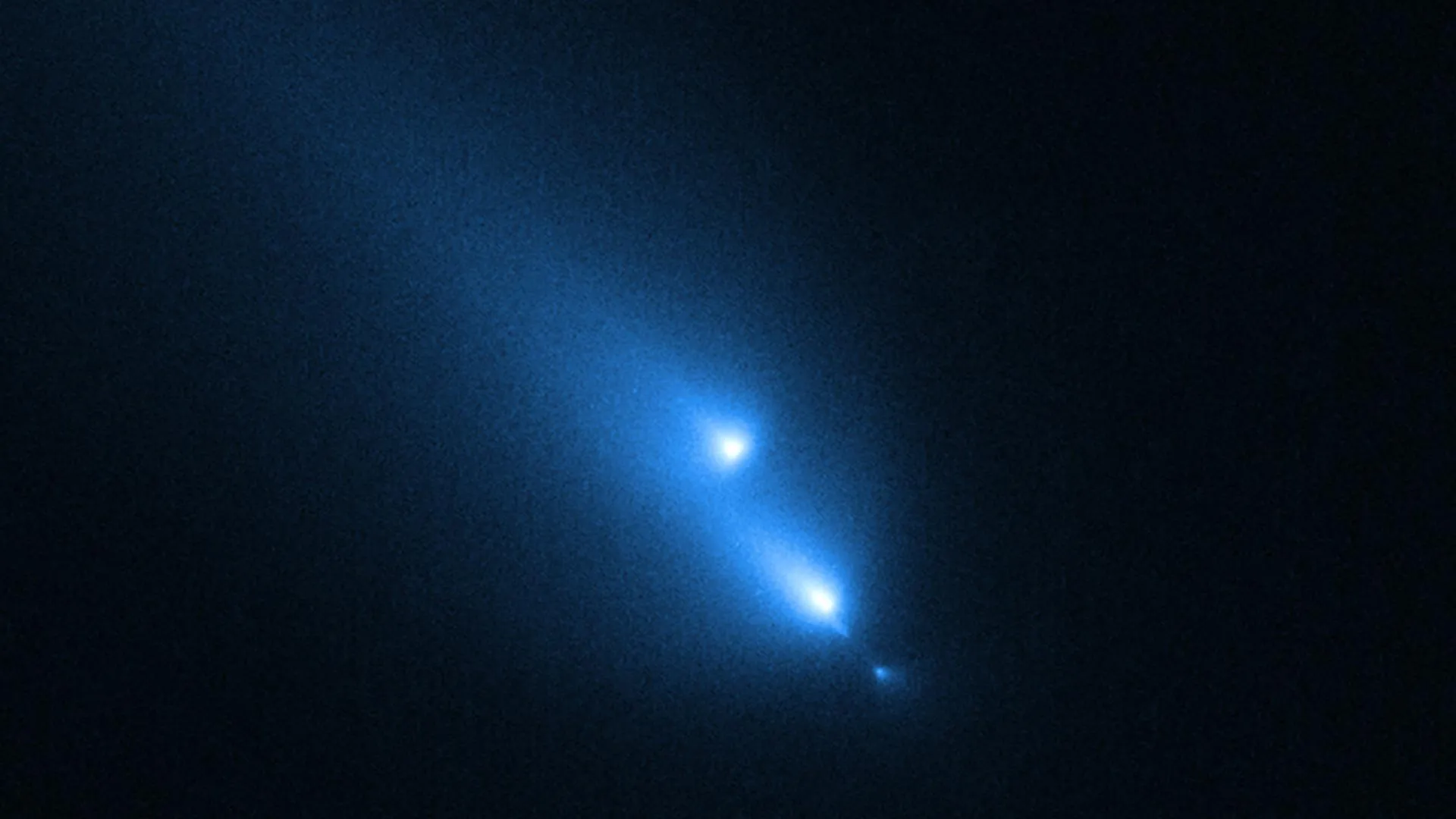
Hubble Space Telescope observations require careful planning months in advance. The telescope doesn't get lucky — or so the conventional wisdom holds. Yet NASA has announced exactly that kind of lucky accident: Hubble captured a comet in the process of breaking apart in real time, providing the most detailed imagery ever obtained of comet fragmentation in progress.
The observation wasn't planned; the comet happened to be in Hubble's field of view during an unrelated observation program. What astronomers found when they processed the data was something they had long hoped to observe but never expected to encounter this clearly.
What Comet Fragmentation Looks Like
Comets have been observed breaking apart before, but usually the evidence is indirect or the temporal resolution is too low to capture the process dynamically. Hubble's imagery shows the comet in multiple states of fragmentation, with distinct nuclear fragments separating and debris fields evolving across the observation sequence.
The images reveal what appears to be a sudden structural failure rather than a gradual erosion. The comet's nucleus — typically a coherent body of ice and rock several kilometers across — shows evidence of having fractured relatively rapidly. This finding has implications for models of comet internal structure and the forces holding cometary nuclei together.
Why Comets Break Apart
Cometary fragmentation happens for several reasons. Thermal stress from solar heating can cause rapid expansion of gases trapped in the nucleus, creating internal pressures that crack the structure. Tidal forces from close planetary approaches can fragment comets — the most dramatic historical example being Comet Shoemaker-Levy 9, torn apart by Jupiter's gravity and then impacting the planet in 1994. Rotational instability can also cause fragmentation as cometary outgassing creates torques that spin nuclei to failure.
The Hubble-observed fragmentation appears to be thermally driven, occurring near the comet's closest approach to the Sun, consistent with outgassing-driven breakup. Full analysis of the data will refine this assessment.
Scientific Value of the Observation
Comets are among the most primitive objects in the solar system — surviving remnants from the era of planetary formation 4.6 billion years ago. Their composition preserves a record of early solar system chemistry that has been largely erased from planets through geological activity.
Fragmentation events expose the interior of comet nuclei, giving astronomers access to material that would otherwise be buried beneath surface layers processed by repeated solar heating. Spectroscopic observations of the fragments and coma released during breakup can reveal compositional gradients within the nucleus — a form of comet geology that is normally inaccessible.
Connection to Planetary Defense
Understanding how and why comets fragment also has practical implications for planetary defense. A comet on a collision course with Earth is a different threat depending on whether it's likely to remain intact or break into fragments — a single large impactor versus a swarm of smaller ones. The physics of fragmentation informs impact risk assessment models and could eventually guide mitigation strategies.
What Happens to the Fragments
Cometary fragments typically follow diverging orbits that spread them along the comet's original trajectory over time, eventually creating meteor streams that produce annual meteor showers when Earth's orbit intersects the debris field. Hubble's continued monitoring of this comet over the coming months will allow astronomers to track the evolution of its fragments in unprecedented detail — a complete observational record of a fragmentation event from onset to aftermath. It's the kind of dataset that comes along rarely, which is why it's being treated as a discovery of genuine scientific consequence.
This article is based on reporting by Science Daily. Read the original article.

Originally published on sciencedaily.com