
A new route from light to magnetism
Researchers at Cornell University have demonstrated a way to generate strong static magnetic fields at the nanoscale without relying on external magnets or magnetic materials, according to a report on work published in Advanced Science. The approach uses an engineered metasurface that traps light and then, under carefully timed conditions, converts part of that optical energy into stationary magnetization.
If the result holds up across further experiments and device development, it could open a new design path for spintronics, quantum and photonic computing, and data storage. What makes the work stand out is not just that it manipulates light in a sophisticated nanostructure, but that it uses a phenomenon called a time interface to produce a zero-frequency magnetic mode: a pattern that stops oscillating and remains in place.
That is a departure from the ordinary behavior of light. In most situations, a light wave’s electric and magnetic fields oscillate rapidly as the wave propagates. The Cornell group asked whether part of that dynamic field could instead be arrested and turned into something static inside a material system engineered for the job.
What a time interface does
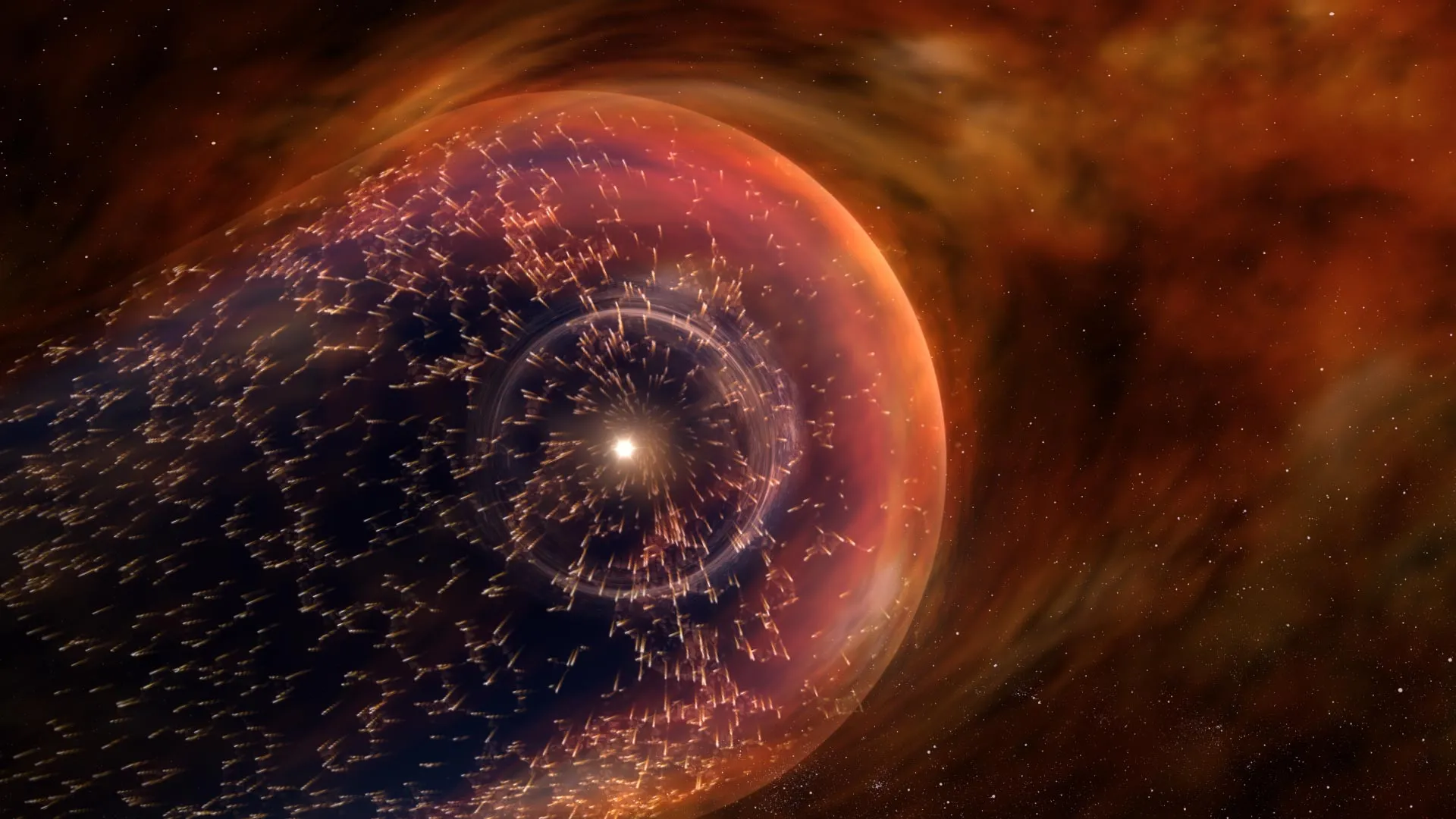
The supplied source text explains the concept through a familiar comparison. At a spatial interface, such as the boundary between air and water, part of an incoming light wave is reflected and part is transmitted. A time interface is different: instead of space changing, the optical properties of the medium change suddenly in time, such as through a rapid shift in refractive index. That temporal jump also creates reflected and transmitted waves, but it can do something else as well. It can excite a static, zero-frequency mode of the system.
In practical terms, that means a portion of the wave’s rapidly varying magnetic field can be converted into a stationary field pattern. Rather than continuing to oscillate and move onward, some of the magnetic character of the light is effectively frozen into place.
This is not something conventional materials produce easily on their own. The trick is to build a structure that both traps light and responds abruptly enough to create the temporal discontinuity needed for the effect.
The metasurface at the center of the experiment
The platform described in the source text is a two-dimensional metasurface: a rectangular array of germanium nanostructures engineered to trap mid-infrared light. Metasurfaces are designed materials whose structure, rather than just their chemical composition, determines how they interact with electromagnetic waves. By tuning nanoscale geometry, researchers can shape reflection, transmission, confinement, and resonance in ways ordinary bulk materials cannot.
Here, the trapping function is essential. The Cornell team wanted mid-infrared light to remain inside the metasurface long enough for a second optical event to intervene. While that light was still confined, the researchers illuminated the structure with an intense, short burst of higher-energy near-infrared photons.
According to the source text, modeling showed that this near-infrared pulse released electrons from germanium atoms, creating electron-hole pairs and abruptly changing the optical properties of the metasurface. That sudden shift created the time interface. Because the mid-infrared light was already trapped inside the structure, the temporal jump acted directly on the confined wave, enabling part of its energy to convert into static magnetization.

Why the result matters
The appeal of the technique is that it suggests magnetization can be written optically, locally, and without conventional magnets. That combination could matter in several technology areas named in the report.
In spintronics, where devices use electron spin as well as charge, the ability to generate localized magnetic patterns with light could offer a new control mechanism for switching and information processing. In quantum and photonic computing, nanoscale magnetic control can be valuable because it may help tune or couple components in architectures where precision matters more than brute force field strength. For data storage, the idea of selectively activating tiny regions of a material using laser pulses hints at possible routes to denser or more dynamic memory schemes.
The source text also references the metasurface’s capacity for selective regional activation. In the accompanying description, laser pulses can activate specific parts of the material, allowing dynamic tuning of optical properties. That point is important because it suggests the effect is not only physically interesting but potentially addressable. Addressability is often what separates a striking lab result from a technique that can be engineered into a device platform.
What is new here, and what still needs work
The strongest claim supported by the supplied material is that the researchers demonstrated a new way to generate strong static magnetic fields without external magnets or magnetic materials. That is already significant. But it is equally important to separate that claim from broader implications that remain prospective.
The report points to future applications in spintronics, quantum and photonic computing, and storage, but it does not establish that those applications are ready. At this stage, the work appears to be a proof of principle showing how a time interface in a specially designed metasurface can convert part of an optical wave into static magnetization. The value of that proof is conceptual as well as practical: it reveals a mechanism that engineers may now try to refine, miniaturize, stabilize, and integrate.
Questions likely remain about efficiency, repeatability, thermal effects, fabrication tolerances, and how long the induced magnetic pattern persists under different conditions. Those details are the next frontier for any result that hopes to move from a controlled demonstration toward usable hardware.
A broader trend in photonic control
The Cornell result fits a wider movement in advanced materials research: using nanostructuring to give light new jobs. Metasurfaces have already been explored for beam steering, lenses, filtering, and dynamic optical control. This work adds a more unusual capability to that landscape by showing that carefully trapped light, combined with a sudden temporal perturbation, can be turned into a static magnetic resource.
That matters because many emerging technologies increasingly depend on converging control over optics, electronics, and magnetism at very small scales. The more those domains can be linked inside a single engineered platform, the more options device designers will have.
For now, the immediate significance is scientific. The demonstration shows that a time interface is not just an abstract idea in wave physics, but a tool that can be used in a real nanostructured system to produce a qualitatively different magnetic outcome. That makes this more than another incremental metasurface result. It is an example of how controlling when a material changes can be just as powerful as controlling what the material is.
This article is based on reporting by Phys.org. Read the original article.
Originally published on phys.org