A safe ending to a mission with unusually high stakes
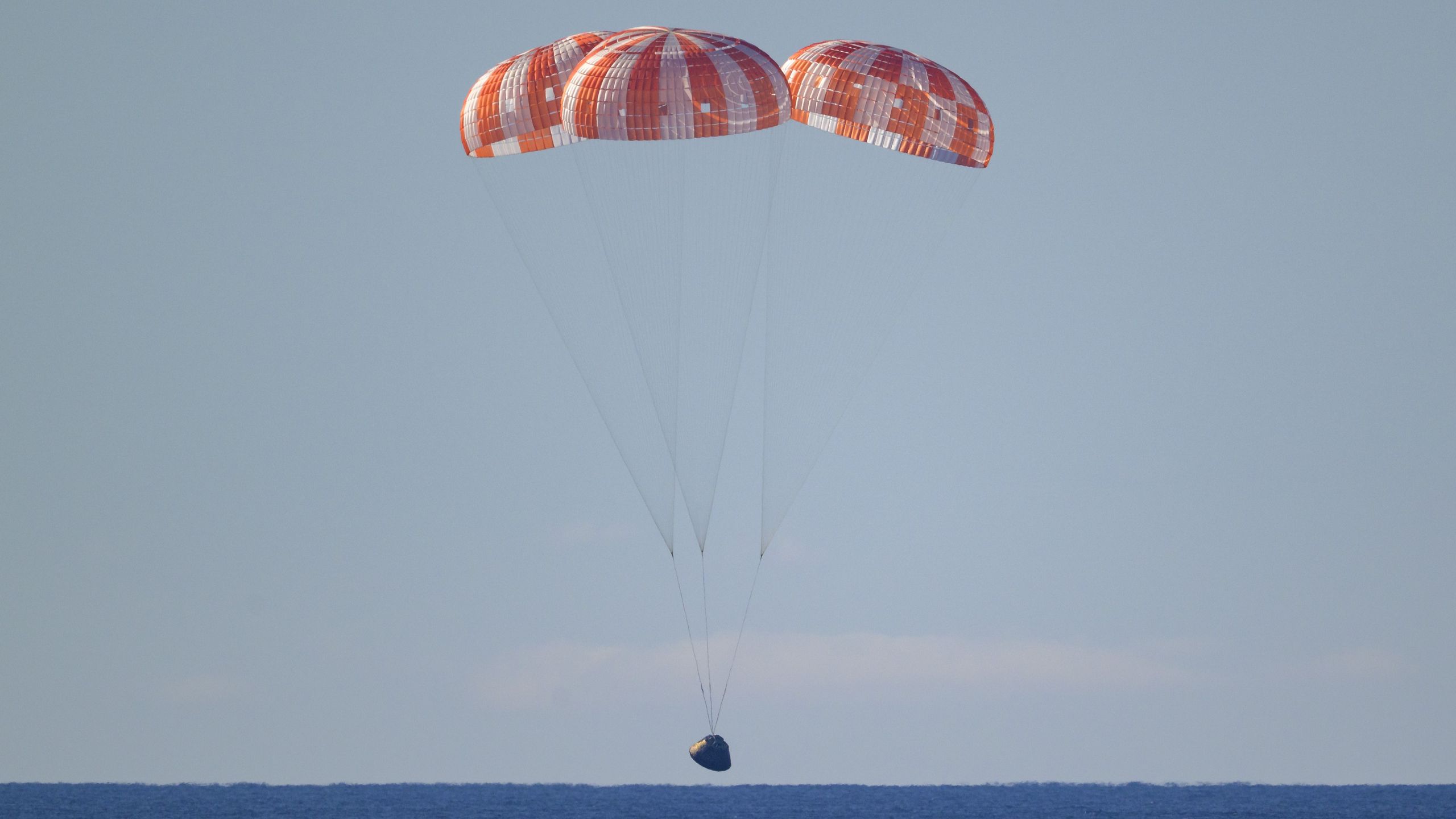
NASA’s Artemis II mission concluded with a successful splashdown in the Pacific Ocean, closing out a 10-day journey around the Moon that covered roughly 685,000 miles, or about 1.1 million kilometers. The Orion capsule, named Integrity, landed at 8:07 p.m. EDT, and mission commander Reid Wiseman confirmed that all four astronauts were in good condition after reentry and recovery.
The crew was later picked up by helicopter and brought aboard the USS John P. Murtha, completing the final operational phase of a mission that has carried both symbolic and strategic weight. Artemis II was not just a test flight. It was the first crewed mission of NASA’s Artemis program to travel around the Moon, and it served as a full-scale rehearsal for the agency’s effort to return astronauts to lunar space in preparation for future surface missions.
The crew and the journey
The four-person crew consisted of commander Reid Wiseman, pilot Victor Glover, and mission specialists Christina Koch and Jeremy Hansen. Over the course of the mission, the astronauts traveled to lunar distance, looped around the Moon, and returned to Earth while sending back images, scientific observations, and public moments that kept global attention fixed on the flight.
That public attention was not incidental. Artemis II has functioned as a technical mission, a political signal, and a cultural milestone at the same time. The crew represented the renewed human phase of lunar exploration after decades without a crewed mission beyond low Earth orbit. Their flight was intended to validate systems, procedures, and crew operations before more ambitious Artemis missions proceed.
The mission also demonstrated that a modern crewed lunar voyage can once again become part of the operational reality of spaceflight rather than remaining a historical achievement of the Apollo era. That alone makes the safe return especially significant.

Why reentry was one of the most critical moments
Even after a successful journey around the Moon, Artemis II still had to survive the most punishing part of the mission: reentry into Earth’s atmosphere. According to the mission coverage, Orion hit the top of the atmosphere at about 25,000 miles per hour, or roughly 40,000 kilometers per hour. That made the return one of the fastest and most thermally demanding parts of the flight.
To endure that descent, the capsule relied on its heat shield and parachute system. The heat shield had to absorb and shed enormous energy while protecting the crew from temperatures reportedly reaching around 2,800 degrees Celsius. The parachutes then slowed the spacecraft from hypersonic speeds to a splashdown speed of about 20 miles per hour, or 32 kilometers per hour.
Those numbers underline why splashdown is not merely ceremonial. It is the final systems test, the point where guidance, thermal protection, structural integrity, and recovery procedures all have to work together. A mission can be historic in orbit and still fail in its closing minutes. Artemis II did not.
Built on lessons from Artemis I
The return also carried extra importance because NASA had previously identified a heat shield issue on Artemis I after that uncrewed Orion capsule splashed down in 2022. That earlier finding turned heat shield performance into a closely watched aspect of Artemis II, even though the mission profile now involved a human crew.
In that sense, Artemis II was not just about proving that astronauts could fly around the Moon. It was also about demonstrating confidence in the spacecraft’s ability to bring them back safely under crewed conditions. Every successful minute of reentry strengthened that case.
Space exploration programs tend to advance not through a single dramatic leap, but through a chain of missions that each retire a specific set of risks. Artemis II was one of those missions. It took the unresolved concerns and engineering questions left by Artemis I and moved the program into a more mature operational stage.

Why Artemis II matters beyond this one flight
The immediate success of the mission is clear: Orion returned safely, the astronauts were recovered in good shape, and NASA completed the first crewed lunar voyage of the Artemis era. But the larger meaning lies in what the mission enables next.
Artemis II was a systems validation mission as much as an exploration mission. It tested crew operations, communications, spacecraft performance, reentry behavior, and mission recovery at lunar-return speeds. Those are the kinds of capabilities that must be demonstrated before the program can support later missions with more ambitious objectives.
It also sends a message about continuity in human spaceflight. After decades in which crewed exploration remained largely confined to low Earth orbit, Artemis II suggests that deep-space missions are again becoming operational targets rather than distant aspirations. That does not guarantee smooth progress ahead, but it changes the baseline assumption about what human spaceflight programs are for.
For the public, the mission revived something that has been mostly historical memory: astronauts visibly traveling to the Moon and returning home. For NASA, it delivered proof that the agency can execute a full crewed lunar mission profile in the modern era. For international partners, including Canada through Jeremy Hansen’s participation, it reinforced Artemis as a multinational project rather than a purely national one.
The mission closes, the program advances
There will be post-flight analysis, engineering reviews, and lessons to incorporate. That is unavoidable after any major mission, and especially after one designed to validate hardware and procedures. But the core result is already established. Artemis II completed its journey and brought its crew safely home.
That outcome gives the Artemis program more than a symbolic win. It gives it momentum. A crewed lunar mission is no longer a future promise on a slide deck. It is an accomplished operation with a recovered spacecraft, a safe crew, and a data record NASA can now use to prepare what comes next.
In spaceflight terms, safe return is the result that matters most. By that standard, Artemis II achieved exactly what it needed to do.
This article is based on reporting by Live Science. Read the original article.

Originally published on livescience.com