A high-altitude surveillance mission ended in abrupt uncertainty
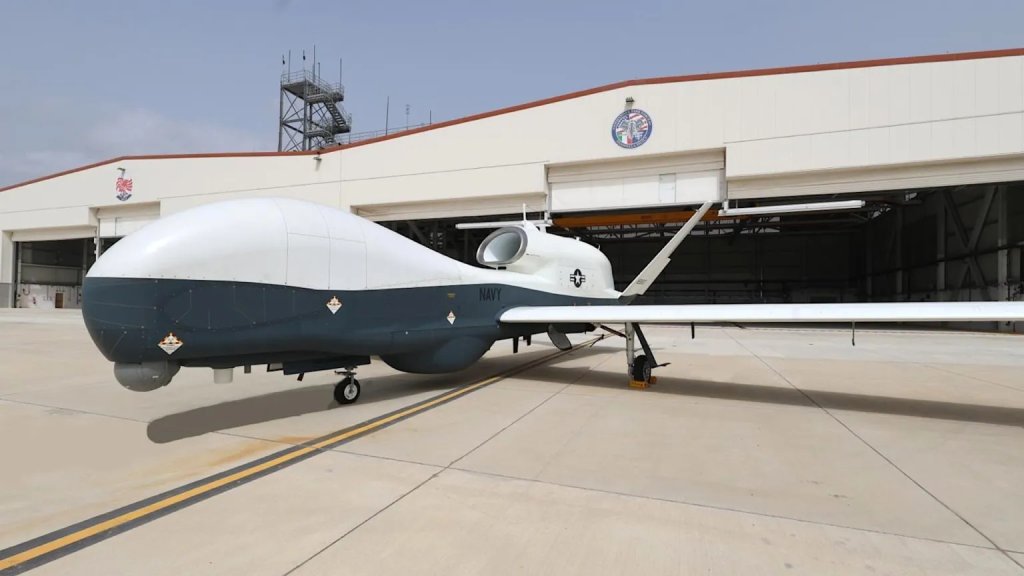
A U.S. Navy MQ-4C Triton surveillance drone vanished from public flight tracking after declaring an in-flight emergency and rapidly losing altitude while operating near the Persian Gulf and the Strait of Hormuz. The incident immediately drew attention because of the aircraft involved, the area in which it occurred, and the political timing: it came just two days after the United States and Iran agreed to a fragile ceasefire tied in part to the reopening of the strategically critical waterway.
According to the supplied report, the drone had completed roughly a three-hour mission over the Gulf and the Strait of Hormuz and appeared to be returning toward base at Naval Air Station Sigonella in Italy. Tracking data then showed a sudden turn to the northeast, toward Iran, followed by a steep descent from around 50,000 feet to below 10,000 feet before the aircraft dropped off public tracking.
What the emergency signals suggest
The Triton was reportedly squawking code 7700, the standard general emergency transponder signal, when the abnormal descent occurred. By itself, that code does not identify the cause of the problem. It can indicate a wide range of serious issues, from technical malfunction to broader loss of safe flight status. The report also notes unconfirmed claims that the drone may initially have transmitted code 7400, which is associated with a loss of connectivity between an uncrewed aircraft and its controllers.
If the connectivity report were confirmed, it would sharpen concern considerably, because command-and-control integrity is central to any high-endurance uncrewed surveillance platform. But even without that detail, the combination of a general emergency declaration, rapid descent, and disappearance from tracking strongly suggests the aircraft encountered a severe operational problem rather than an ordinary routing change.
Why the location matters
The Strait of Hormuz remains one of the world’s most strategically sensitive maritime chokepoints. Surveillance flights in and around it have immediate military, diplomatic, and energy-market relevance. That was already true before the latest U.S.-Iran confrontation. It is even more true in the current environment, where ceasefire terms, shipping access, and escalation risks are all under close scrutiny.
Because the aircraft disappeared after operating in that setting, the incident will inevitably be interpreted through both technical and geopolitical lenses. Was this a mechanical emergency, a systems failure, a control-link issue, or something more adversarial? At the moment, the available public information does not settle the question. But the ambiguity alone is consequential. In tense regions, uncertainty surrounding military aircraft can quickly become part of the strategic picture.
The platform at the center of the incident
The MQ-4C Triton is a high-altitude, long-endurance surveillance drone designed to provide broad maritime awareness. That mission profile makes it particularly relevant to contested sea lanes and regional monitoring. An aircraft built for persistent intelligence collection disappearing after an emergency declaration is not a routine operational footnote. It is a serious event even before the cause is known.
The fact that the aircraft had been publicly visible on tracking sites also contributed to the speed of the reaction. Open-source observers now monitor military aviation with remarkable persistence, and unusual transponder behavior can trigger widespread analysis within minutes. That does not replace official reporting, but it does mean incidents like this now develop in public almost in real time.
More questions than answers for now
At this stage, the most defensible conclusion is also the narrowest one: the aircraft encountered a serious in-flight emergency and then disappeared from public tracking after a rapid descent. Anything beyond that remains unresolved on the supplied evidence. Still, the stakes are obvious. If it was a mechanical or systems problem, it raises questions about mission reliability in a critical theater. If it involved outside interference or hostile action, the implications widen immediately.
Either way, the incident is a reminder that fragile ceasefires do not create stable operating environments overnight. Military surveillance continues, pressure points remain active, and even a single aircraft emergency can carry outsized significance when it happens over one of the world’s most contested waterways.
- A U.S. Navy MQ-4C Triton disappeared from public tracking after declaring an emergency.
- Tracking showed the drone rapidly descending from around 50,000 feet to below 10,000 feet.
- The incident occurred near the Persian Gulf and Strait of Hormuz amid a fragile ceasefire backdrop.
This article is based on reporting by twz.com. Read the original article.
Originally published on twz.com