A setback for a closely watched Air Force drone effort
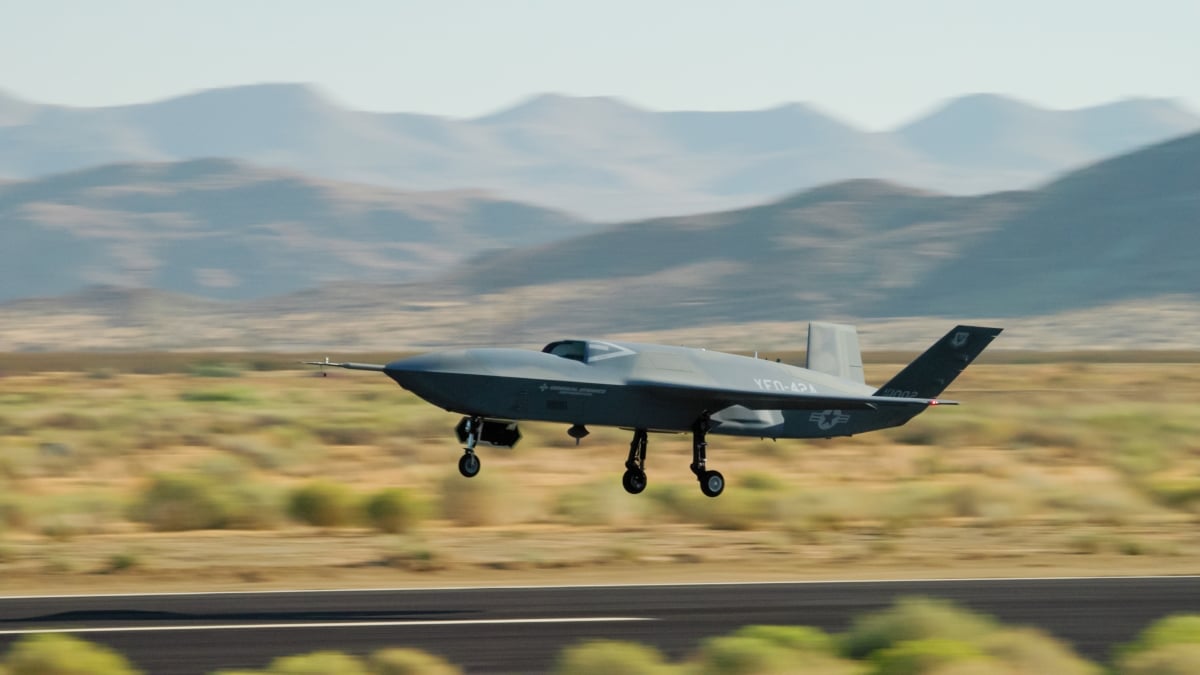
A General Atomics prototype built for the U.S. Air Force’s Collaborative Combat Aircraft, or CCA, program crashed in the California desert on April 6, 2026, shortly after takeoff, according to the company. No one was injured, but the mishap has led to a temporary halt in YFQ-42A flight testing while investigators examine what happened.
The crash involved one of General Atomics’ production-representative YFQ-42A aircraft, a design the company has dubbed Dark Merlin. The company said the incident occurred following takeoff from its company-owned airport at roughly 1 p.m. Pacific time. General Atomics operates Gray Butte Airport near Palmdale, California.
At this stage, the cause remains unclear. The company explicitly said it would be premature to speculate and that its focus is on collecting data and following a disciplined investigation process. The Air Force said it is aware of the incident and will follow standard aircraft mishap protocols.
Why the YFQ-42A matters
The YFQ-42A is part of the Air Force’s emerging CCA effort, a program intended to field drone wingmen that can operate alongside crewed combat aircraft. Those systems are expected to play a growing role in future air operations by extending reach, adding capacity, and taking on missions that would otherwise increase risk for manned platforms.
General Atomics is one of two major participants identified in the supplied report for the first round of the prototyping effort, alongside Anduril. That makes any test event involving the YFQ-42A significant beyond the single aircraft lost. Early flight-test programs are where companies validate airworthiness, performance, handling, mission systems integration, and the broader maturity of a design.
When a mishap occurs at this stage, the immediate effect is operational caution. The company said testing is paused temporarily and will resume when appropriate. In practical terms, that means investigators will need to determine whether the crash was caused by a one-off issue, a procedural breakdown, a subsystem failure, or a broader design concern.
Production-representative aircraft raise the stakes
One notable detail in the supplied account is that the aircraft was described as one of several production-representative YFQ-42A drones that fly regularly for testing. That suggests this was not an isolated experimental article at the very beginning of development, but part of a more mature testing campaign meant to reflect the configuration the Air Force could ultimately evaluate more seriously.
That does not mean the program is in crisis. Flight-test campaigns, especially for new military aircraft, are designed with the expectation that issues will surface. But the loss of a production-representative vehicle can still affect schedule confidence, test planning, and perceptions of technical readiness.
The fact that multiple examples of the YFQ-42A have been publicly revealed also points to a program moving through a visible phase of iteration. A pause, then, becomes less about public symbolism and more about ensuring the next flights produce useful data without compounding risk.
A contrast with the broader CCA race
The crash also lands in the context of a competitive and strategically important Air Force program. The report notes that rival company Anduril has recently begun carrying inert weapons in testing with its own YFQ-44A design. That detail matters because it underscores how quickly the CCA field is moving from concept discussions to concrete demonstrations.
Programs like CCA are meant to reshape air combat by pairing crewed aircraft with more affordable, adaptable, and potentially attritable autonomous or semi-autonomous systems. The Air Force is pursuing these aircraft because future conflicts may demand more distributed force packages and faster scaling than traditional fighter procurement allows.
In that environment, every test sortie carries outsized importance. Successful flights build momentum. Mishaps slow it, even when they are part of the normal risk envelope of aerospace development. General Atomics now faces the task of showing that the crash is understood, bounded, and fixable.
What happens next
The next phase is likely to be dominated by investigation rather than public demonstration. The company’s statement emphasizes safety, data gathering, and learning from the incident. That is standard language, but it also reflects the core reality of prototype programs: useful progress often depends on how quickly and rigorously teams can translate failure into improved design or procedure.
The absence of injuries is important. So is the company’s indication that established procedures and safeguards worked as intended. Those factors suggest the event, while serious, did not become a broader safety disaster for people on the ground or test personnel.
For the Air Force, the more consequential question is whether the mishap affects confidence in the timeline and viability of General Atomics’ offering. That answer will depend on findings that are not yet public. Until then, the most defensible conclusion is narrow: a key CCA prototype has been lost, testing is paused, and a highly visible drone combat program now enters a period of scrutiny.
A reminder of how military aviation programs mature
There is a temptation to read every prototype crash as either proof of failure or proof of nothing. The reality is more disciplined than either reaction. Prototype aircraft exist to expose weaknesses before a system moves deeper into procurement and operational planning. A mishap is costly, but it can also be informative if the underlying cause is identified and corrected.
That is the standard General Atomics and the Air Force will now be judged against. The YFQ-42A remains part of one of the Pentagon’s most consequential next-generation aviation efforts. For the moment, however, the program’s public story has shifted from promise to investigation.
This article is based on reporting by Breaking Defense. Read the original article.
Originally published on breakingdefense.com