The Last Percent Problem
Hawaii's ambitious goal of 100 percent renewable energy by 2045 faces a challenge common to all islands pursuing full electrification: what happens when the sun does not shine and the wind does not blow for extended periods? Solar and wind generation can be supplemented by battery storage for hours or even a day, but multi-day weather events that suppress renewable generation require a different solution. A new analysis argues that biomethane — methane produced from organic waste — could serve as a small but strategically critical backup for Oahu's fully electrified grid.
The analysis builds on a comprehensive energy system model that assumes Oahu has fully electrified its transportation, buildings, and industrial sectors while removing overseas aviation fuel, long-distance maritime bunkering, and military energy use from the island's energy balance. In this fully electrified scenario, the total energy demand is met almost entirely by solar, wind, and battery storage. Biomethane enters the picture not as a primary energy source but as a reliability reserve — a backup fuel that can power combustion turbines during rare but consequential periods when renewable generation is insufficient.
Why Islands Are Different
Continental grids can manage renewable variability through geographic diversity — when one region has cloudy, still weather, another region hundreds of miles away is likely to have sunshine or wind. Interconnected transmission networks allow power to flow from surplus regions to deficit regions, smoothing out the variability of any single location's renewable resources.
Islands do not have this luxury. Oahu's electricity system is electrically isolated, with no submarine cables connecting it to neighboring islands or the mainland. Every kilowatt-hour consumed on Oahu must be generated on Oahu or in immediately adjacent offshore waters. This isolation means that weather patterns affecting the entire island — such as a persistent cloud deck during the Kona wind season or an extended period of light winds — can suppress renewable generation island-wide with no geographic hedge available.
Battery storage can bridge gaps of several hours and is economical for daily cycling between peak solar generation and evening demand. However, the economics of battery storage deteriorate rapidly for multi-day storage requirements. Building enough battery capacity to cover a three-to-five-day low-generation event would be prohibitively expensive and would sit idle for the vast majority of the year — an enormous capital investment for a rarely used capability.
Biomethane as Strategic Reserve
This is where biomethane offers a compelling value proposition. Unlike batteries, which are expensive to build at scale and store energy that degrades over time, biomethane can be stored in conventional gas infrastructure — tanks and pipelines — at relatively low cost for extended periods. A modest biomethane reserve, sized to fuel existing combustion turbines for three to five days, would provide the grid reliability backstop needed to handle worst-case weather scenarios without requiring massive over-building of battery capacity.
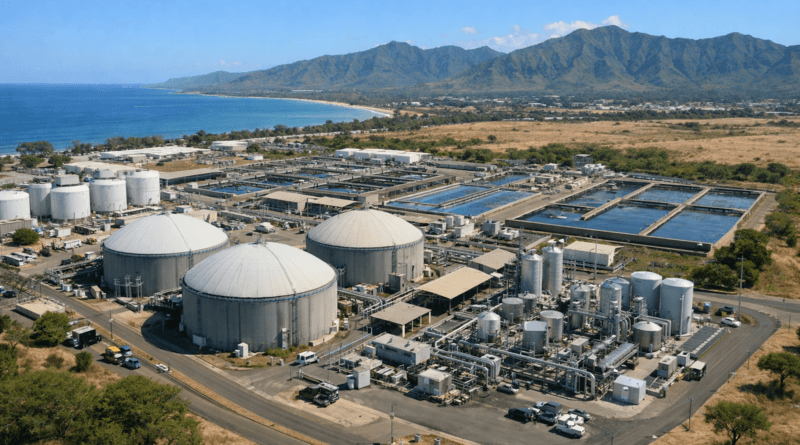
The biomethane itself would be produced from organic waste streams already generated on Oahu: food waste from hotels and restaurants, agricultural residues from the island's farms, wastewater treatment biosolids, and green waste from landscaping operations. Anaerobic digestion of these materials produces raw biogas, which is then upgraded to pipeline-quality biomethane through removal of carbon dioxide, hydrogen sulfide, and other impurities.
The analysis estimates that Oahu's organic waste streams could produce enough biomethane to maintain the proposed strategic reserve with regular replenishment. The production would be continuous, with biomethane accumulating in storage during normal periods when it is not needed and being drawn down during rare extended low-generation events. This continuous production-and-storage cycle means the reserve is self-replenishing without requiring external fuel imports.
Integration With the Renewable Grid
The proposed system would integrate biomethane with existing or upgraded combustion turbines already present on Oahu's grid. These turbines currently burn imported fossil natural gas and would be converted to use biomethane — a straightforward modification since biomethane is chemically identical to conventional natural gas. The turbines would operate only during grid emergencies, running for dozens of hours per year rather than the thousands of hours typical of baseload generators.
This low utilization rate is a feature, not a bug. The purpose of the biomethane reserve is not to generate a significant fraction of Oahu's annual electricity — that role belongs to solar and wind — but to provide a reliability guarantee that enables the grid to operate with very high renewable penetration without risking blackouts during unusual weather. The economic value comes from the reliability service, not from energy production.
The analysis compared the cost of a biomethane reliability reserve against alternative approaches including massive battery overbuild, demand curtailment programs, and imported hydrogen. Biomethane emerged as the most cost-effective option for multi-day reliability, primarily because it leverages existing combustion turbine infrastructure and conventional gas storage technology rather than requiring purpose-built facilities.
Environmental Considerations
Burning biomethane in combustion turbines does produce carbon dioxide at the point of combustion. However, the carbon in biomethane originates from recently captured atmospheric CO2 — the plants and organic materials that were digested to produce the gas absorbed carbon from the atmosphere during their growth. This closed carbon cycle means biomethane combustion is approximately carbon-neutral over its full lifecycle, unlike fossil natural gas which releases carbon that has been sequestered underground for millions of years.
Additionally, diverting organic waste from landfills to anaerobic digestion prevents the uncontrolled release of methane that would otherwise occur as waste decomposes. Since methane is roughly 80 times more potent than CO2 as a greenhouse gas over a 20-year timeframe, capturing and combusting it — even if CO2 is produced — represents a significant net climate benefit compared to allowing it to escape from landfills.
A Model for Other Islands
Oahu's situation is not unique. Island communities worldwide face similar challenges in achieving high renewable energy penetration while maintaining grid reliability. The biomethane reserve concept could be adapted to any island with sufficient organic waste streams and existing thermal generation infrastructure. Caribbean islands, Pacific island nations, and Mediterranean islands pursuing aggressive renewable targets could all benefit from similar analysis of locally produced biomethane as a strategic reliability resource.
The key insight is that achieving 100 percent renewable energy does not require eliminating all combustion — it requires eliminating fossil fuel combustion. A small amount of biomethane combustion, sized for reliability rather than energy, can provide the grid stability needed to support an otherwise fully renewable system at far lower cost than battery-only alternatives.
This article is based on reporting by CleanTechnica. Read the original article.