NASA turns a postflight visit into a signal about the next phase of Artemis
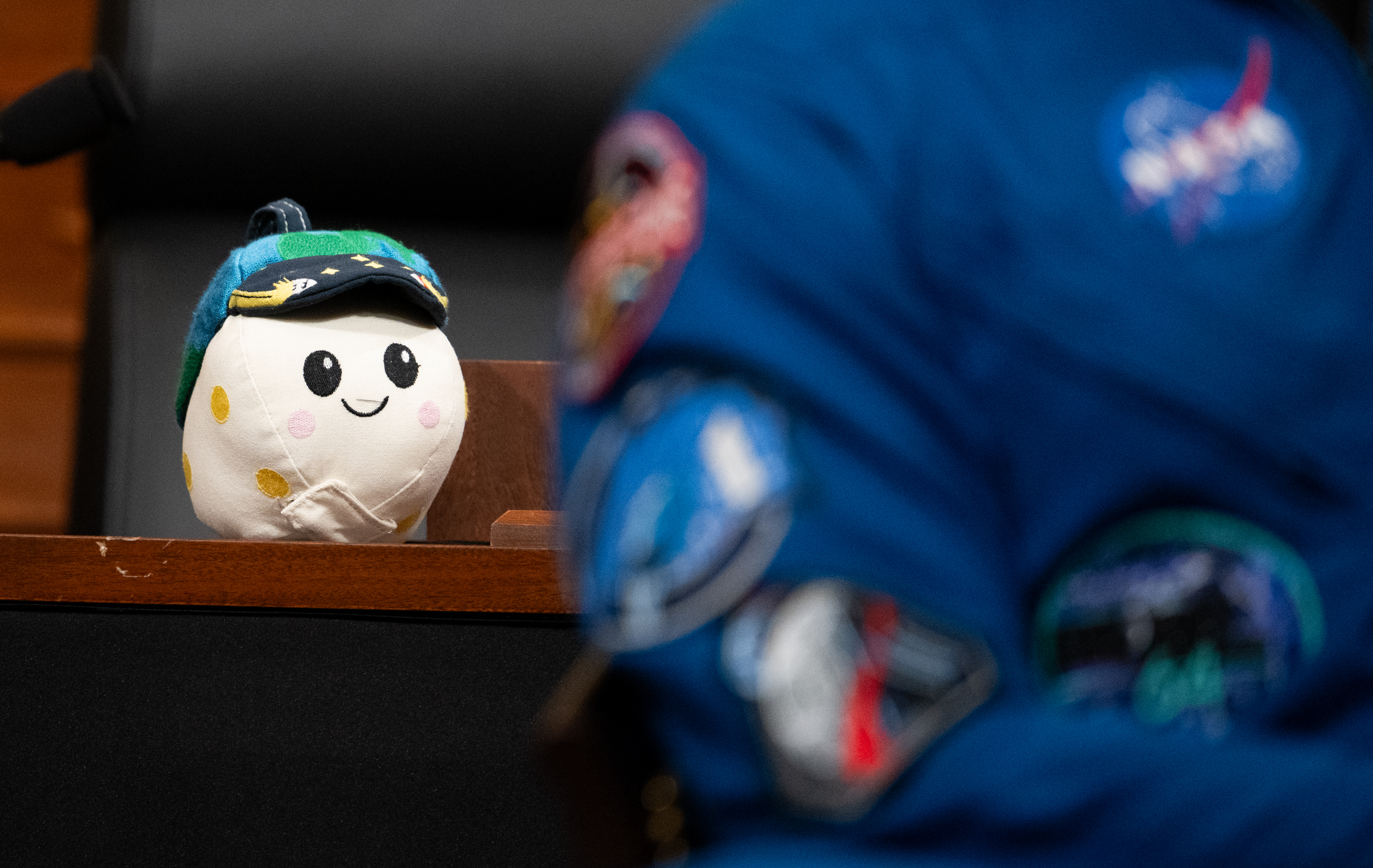
NASA’s latest Artemis II image release is modest on its face: a photograph from Washington showing “Rise,” the mission’s zero-gravity indicator, placed on the dais while the crew spoke with congressional staff on May 12, 2026. But the image carries more than ceremonial value. It ties together the agency’s recent human lunar mission, the public symbolism that surrounds it, and the continuing political work needed to sustain a long-duration exploration program.
The image article, published by NASA on May 13, identifies the crew as Reid Wiseman, Victor Glover, Christina Koch, and Canadian Space Agency astronaut Jeremy Hansen. It also places the event clearly in post-mission context. According to NASA, Artemis II took the four astronauts on a nearly 10-day journey around the Moon and back to Earth in April 2026. The Washington appearance came after that flight, as the astronauts met with congressional staff at the U.S. Capitol.
A small object at the center of a larger story
The most distinctive detail in the release is “Rise,” described by NASA as the Artemis II zero-gravity indicator. Such indicators are small objects carried aboard crewed space missions and used as a visible cue that the spacecraft has entered microgravity. They often become instantly recognizable mission symbols because they condense a technically complex journey into an object the public can easily remember.
In this case, NASA’s choice to foreground “Rise” in a Capitol setting suggests the agency understands the power of those symbols beyond the spacecraft itself. The object is no longer simply a mission accessory. In the image, it becomes part of the story NASA tells about Artemis after launch and landing are over. The lunar flight has ended, but the political, institutional, and cultural life of the mission is still active.
The source text does not provide a detailed explanation of why “Rise” was selected, nor does it describe the item’s design. It does establish that NASA considered it important enough to identify by name and feature prominently in a postflight setting. That alone is telling. Space agencies use visual shorthand carefully, and mission artifacts can help anchor broader narratives about national capability, international partnership, and continuity between one mission and the next.
Artemis II’s crew remains central to NASA’s message
NASA’s image article also underscores the composition of the Artemis II crew. The four astronauts named in the source text represent both NASA and the Canadian Space Agency. That matters because Artemis has consistently been framed not just as a U.S. effort, but as a multinational one. Even without broader policy detail in the supplied text, the presence of Hansen alongside his NASA crewmates reinforces that international structure.
The crew’s visit to congressional staff likewise highlights a basic reality of modern spaceflight: success in orbit or on a lunar trajectory does not remove the need for continued engagement on the ground. Human exploration programs depend on long timelines, recurring appropriations, and durable political support. A crew visit to Washington after a completed lunar mission therefore functions as more than celebration. It is part of the machinery that keeps an exploration architecture visible and legible to decision-makers.
The source does not quote the astronauts’ remarks, and it does not describe specific policy asks. It does, however, confirm the setting and the audience. NASA wanted the public to see the astronauts not only as fliers returning from a major mission, but also as representatives of an ongoing program speaking directly with congressional staff.
Why NASA publishes image articles like this
By itself, an image article can seem lightweight compared with launch coverage or mission results. Yet these brief releases often serve an important purpose. They document the life of a program between headline moments and preserve the connective tissue that links mission achievement to public institutions.
That is especially relevant for Artemis II because the mission, as described by NASA, was a nearly 10-day journey around the Moon and back. A flight of that scale is not only a technical exercise. It is also a public demonstration with lasting institutional consequences. NASA’s continued publication of crew imagery after the mission indicates that the agency is managing the narrative arc deliberately, showing not just where the astronauts went but how the mission lives on in public, political, and symbolic form.
The inclusion of a link to “more photos from the crew’s visit to the U.S. Capitol” reinforces that point. NASA is building a visual record of the crew’s postflight role. That suggests the agency sees value in documenting the transition from mission execution to mission advocacy and public engagement.
A quiet but meaningful space story
Not every important space story is a launch, landing, or budget fight. Sometimes the significance lies in how a space agency translates a major mission into a durable public narrative. NASA’s “Rise Goes to Washington” image article is a case in point. It captures a lunar crew after flight, places them in direct contact with congressional staff, and centers a small mission symbol that now stands in for a much larger achievement.
From the supplied text, the clearest conclusion is simple: Artemis II is still being actively presented as a living program, not a finished event. Its crew is visible. Its symbols are being reused. Its connection to policymakers is being documented. Those may sound like small details, but in long-horizon human spaceflight, small details often reveal how agencies sustain momentum after the applause fades.
For Developments Today, that makes this more than a photo note. It is a window into how NASA maintains continuity around Artemis after a successful lunar journey, and how the story of exploration is carried forward in rooms far from the spacecraft itself.
This article is based on reporting by NASA. Read the original article.
Originally published on nasa.gov