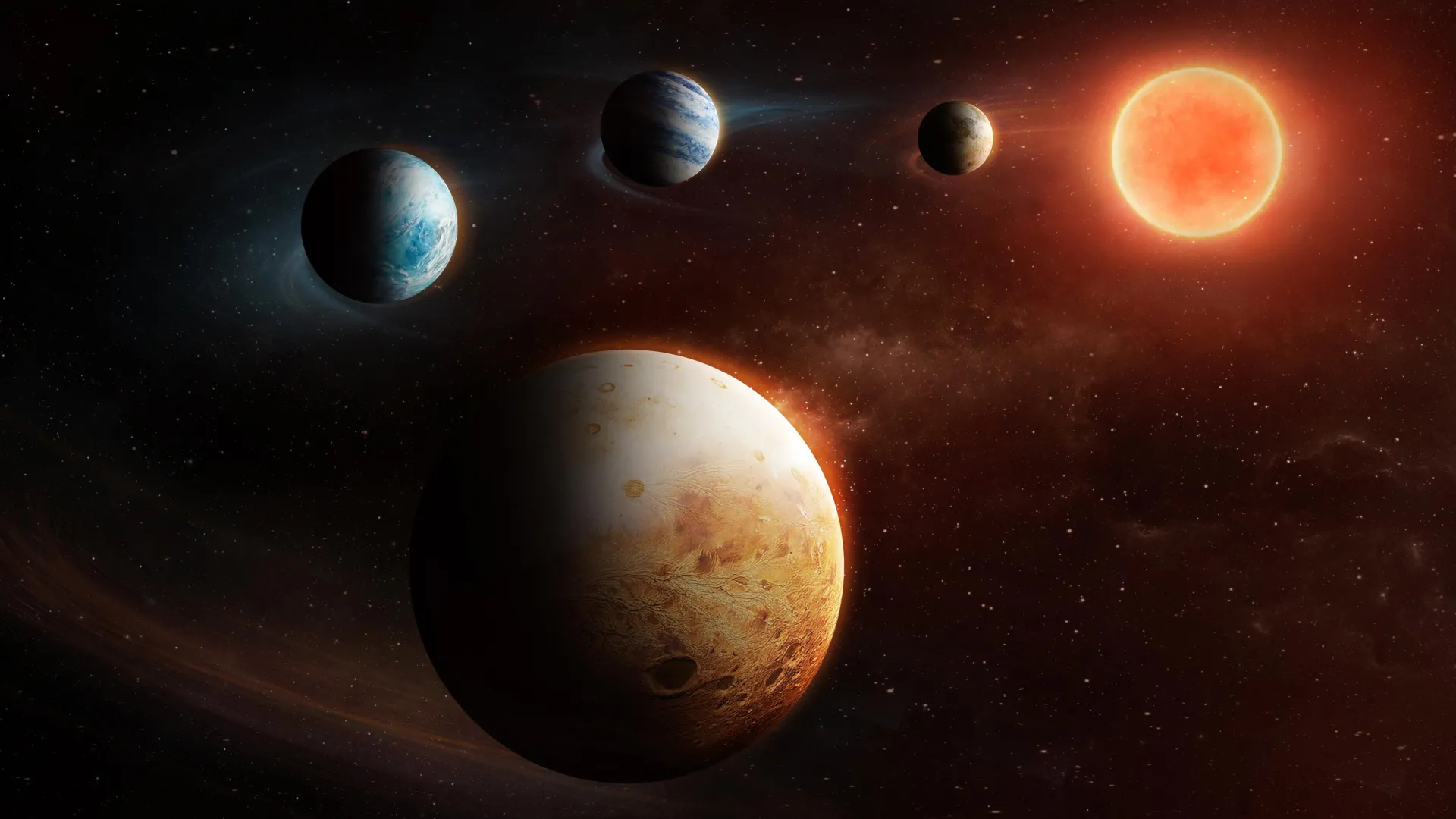
A Planet Where It Should Not Be
Astronomers have discovered a distant planetary system that defies one of the most established rules in planet formation theory. A rocky planet has been found orbiting in the outer reaches of its star system, a region where conventional models predict only gas giants should exist. The finding forces scientists to reconsider fundamental assumptions about how planets form and migrate within their stellar systems.
What Makes This Discovery Unusual
According to the standard core accretion model of planet formation, rocky planets like Earth form close to their parent stars where temperatures are high enough to prevent volatile gases from condensing. Gas giants like Jupiter and Saturn, by contrast, form beyond the "snow line" where water ice and other volatiles can accumulate, providing the extra mass needed to attract thick gaseous envelopes.
The newly discovered planet breaks this pattern decisively. Located well beyond its system's snow line, the planet has a composition consistent with a rocky world rather than a gas giant. Its orbital distance is comparable to where Jupiter sits in our own solar system, yet it lacks the massive gaseous atmosphere that formation models would predict for a body at that location.

Possible Explanations
Astronomers are exploring several hypotheses to explain the anomaly. One possibility is that the planet formed closer to its star and was flung outward through gravitational interactions with other bodies in the system. Another is that the planet formed in place but the protoplanetary disk in that region was unusually depleted in gas, preventing the accretion of a thick atmosphere despite the presence of solid material.
A third, more radical explanation suggests that current planet formation models may be incomplete. If rocky planets can form in the outer regions of stellar systems more readily than thought, the implications for the search for habitable worlds would be significant, expanding the zones where Earth-like planets might be found.
Broader Implications
The discovery adds to a growing body of evidence that planetary systems are far more diverse than our own solar system suggested. Each new anomalous system discovered pushes theorists to develop more flexible and comprehensive models of planet formation, ultimately improving our understanding of how worlds like Earth come to exist.
This article is based on reporting by ScienceDaily. Read the original article.

Originally published on sciencedaily.com