Scientific infrastructure becomes the subject
Particle physics usually reaches the public through discoveries, anomalies, and giant numbers. The latest Global Physics Photowalk winners tell a different story. Instead of leading with data or theory, the contest puts the physical spaces of science in view: cryostats, detectors, control rooms, industrial-scale machinery, and the people working inside them.
Quanta Magazine reports that the winning entries in the 2025 Global Physics Photowalk were selected from a collaboration of 16 particle physics laboratories spanning countries including the United States, France, Italy, and Japan. Amateur and professional photographers were invited into the labs to look for beauty in places built to study forces and particles that cannot be seen directly. The result is not just an art exercise. It is also a useful act of translation.
Modern physics depends on facilities that are visually dense, technically intimidating, and usually inaccessible to the public. They are where abstract questions about matter, force fields, and the origin of the universe become cables, chambers, vacuum systems, shielding, and painstaking human labor. A contest like this turns that hidden layer of science into something legible.
The winning image and why it stood out
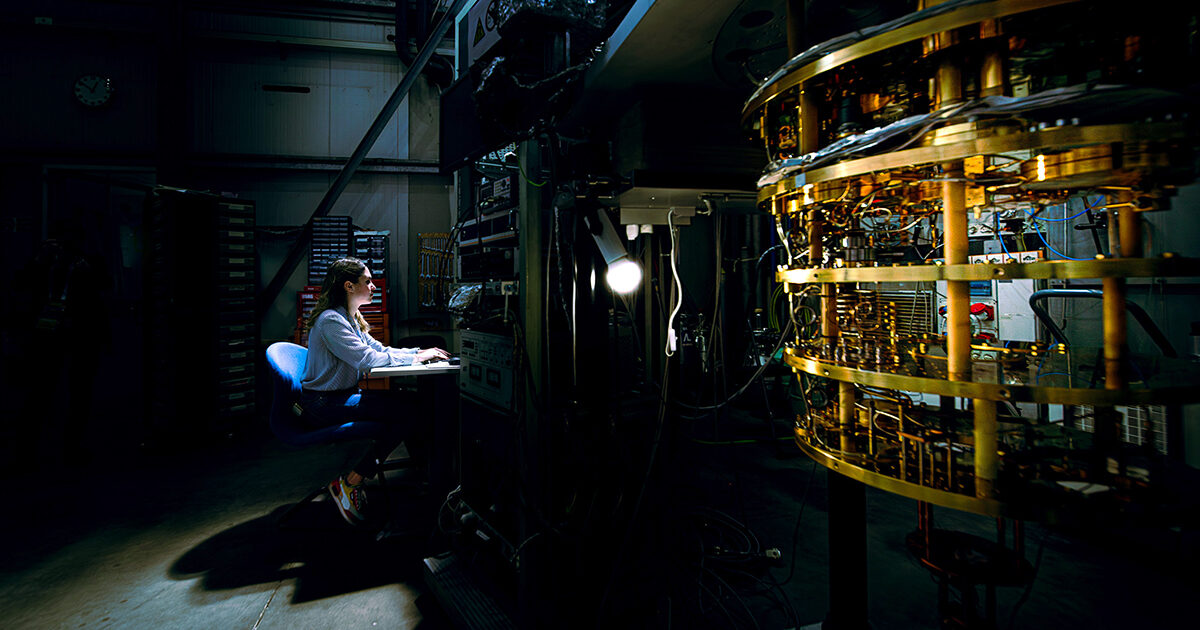
First place went to a photograph taken at the CryOgenic Laboratory for Detectors, or COLD, at INFN in Frascati, Italy. The image shows researcher Raffaella Donghia seated across from a golden cryostat used to cool materials to temperatures only a few thousandths of a degree above absolute zero. At those temperatures, scientists can search for dark matter, the unseen substance thought to help hold galaxies together.
The photographer, Marco Donghia, is a wedding photographer who entered the lab with some skepticism and then chose to alter the scene by turning off the lights and using artificial illumination. His stated goal was to create a more intimate world and to capture the relationship between humans and technology. That framing mattered. Rather than treating the apparatus as cold machinery, the image presents the lab as a place of deliberate, almost theatrical concentration.
The judges responded to that balance. Dmitri Denisov of Brookhaven National Laboratory, the only scientist on the panel, said he had worried his priorities might differ from those of artists and photographers, but was surprised by how easily strong scientific and visual judgment aligned. That detail says something broader about the contest: the most effective science images are not merely decorative. They reveal the character of the work.

What the photowalk says about contemporary science
There is a tendency to talk about frontier physics as if it happens mostly in equations, giant collaborations, or headline discoveries. The photowalk shifts attention back to material reality. These labs are places of maintenance, calibration, waiting, and repetitive precision. They are engineered environments built to make vanishingly small signals visible against enormous backgrounds of noise.
That makes them visually compelling for a reason deeper than aesthetics. Particle physics experiments often try to detect events that occur for fractions of a second or appear only as traces in highly instrumented systems. The machinery has to do most of the seeing. Photographs of that machinery, especially when they include the people who operate it, become a record of how much of modern science is infrastructure.
The contest also highlights the international and collaborative nature of the field. With 16 laboratories participating, the photowalk reflects a distributed research ecosystem rather than a single flagship institution. That matches the way particle physics now operates: through networks of facilities, specialists, and shared tools that cross national boundaries.
Why this matters beyond the gallery
- It gives the public access to spaces where high-energy and detector physics actually happen.
- It humanizes research by pairing complex equipment with the people who run it.
- It reframes laboratories as cultural as well as scientific sites.
The images do not replace the science. They provide another route into it. In an era when research is often experienced through quick headlines and simplified claims, that is useful. The Global Physics Photowalk reminds viewers that discovery also has a texture: metal, light, cold, scale, patience, and design. Those elements rarely make the paper abstract, but they are part of the truth of the work.
This article is based on reporting by Quanta Magazine. Read the original article.
Originally published on quantamagazine.org