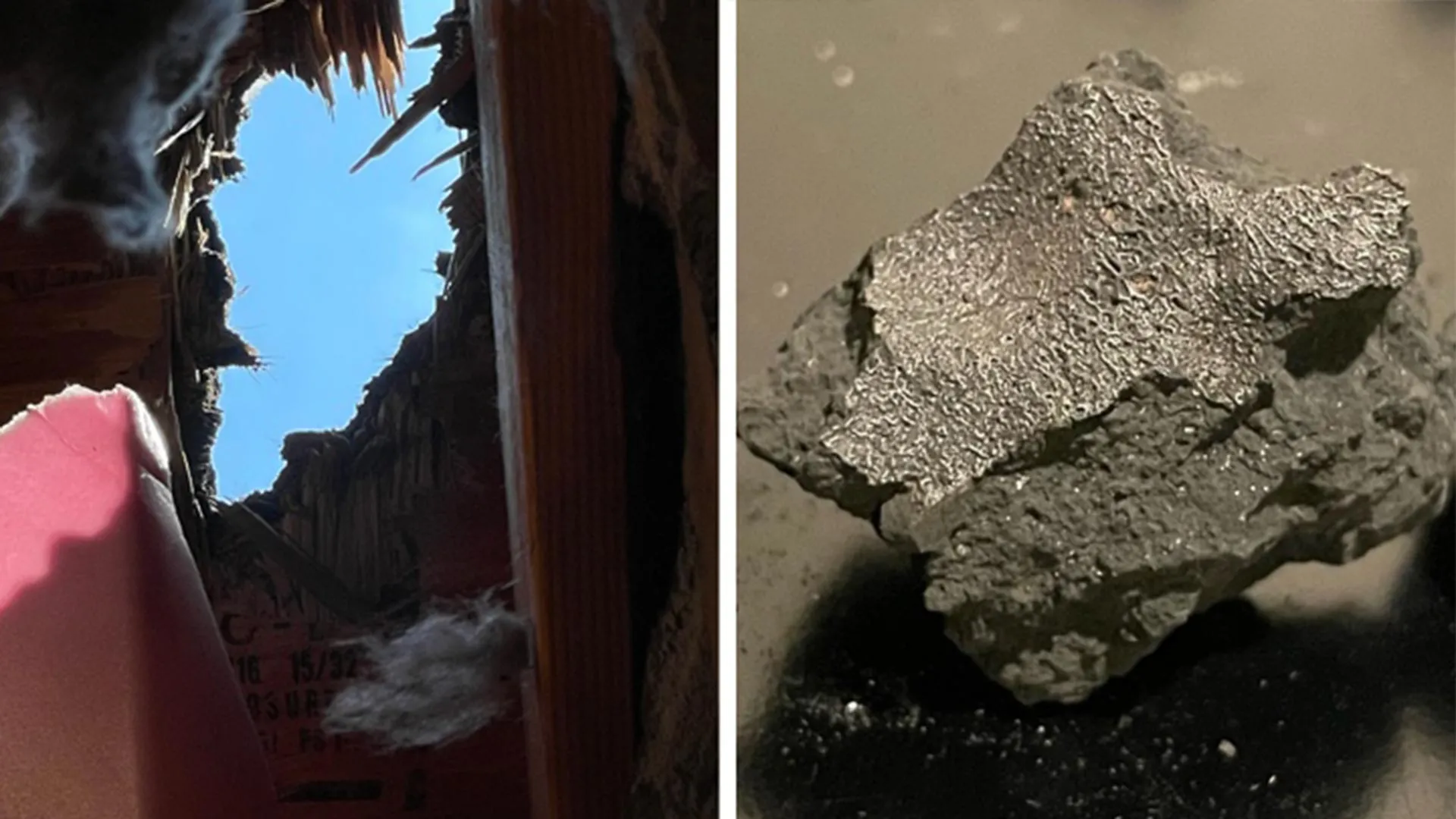
A house strike turned into a rare planetary science windfall
When a meteor streaked over the northeastern United States in broad daylight on July 16, 2024, it announced itself with a sonic boom and a trail visible across several states. Not long afterward, one fragment weighing more than two pounds punched through the roof of a home in Hillsborough, New Jersey. Two years later, researchers say that accident delivered something far more valuable than a dramatic story: a remarkably intact sample of a primitive asteroid that appears to preserve ancient salty chemistry, organic compounds, and amino acids.
According to the analysis reported by an international team in Science Advances, the Hillsborough meteorite records evidence that it once interacted with concentrated salty fluids near the surface of its parent asteroid. That finding matters because it points to chemical environments that may have helped generate or transport some of the ingredients associated with life on early Earth.
The meteorite is unusual not just because it landed in a suburban home, but because it was recovered quickly and studied with unusually strong contextual evidence. Researchers were able to connect eyewitness reports, camera footage, and radar observations to the fall itself, helping reconstruct where the rock came from and how it broke apart during its passage through the atmosphere.
From a bright fireball to a mapped debris trail
The incoming object was roughly the size of a heavy airline bag and entered Earth’s atmosphere at about 32,000 miles per hour, or 14.4 kilometers per second. The American Meteor Society received reports from 60 people across New York, New Jersey, Connecticut, Rhode Island, and Pennsylvania who saw the meteor. Another 16 people in New York and New Jersey reported feeling the associated shockwave.
That witness network was matched by instrumental records. Cameras in Northford, Connecticut, and Douglassville, Pennsylvania, along with a doorbell camera in Wayne, New Jersey, captured the meteor’s passage. Using those recordings, observers reconstructed its trajectory and traced its origin back to low in the asteroid belt.
The meteorite itself did not survive intact for long. Researchers said the object was fragile and fragmented quickly, vanishing from view at an altitude of about 22 miles, or 35 kilometers. Soon after, Doppler weather radar at Newark Airport briefly detected an elongated cloud of falling debris stretching from Staten Island into New Jersey. Hillsborough sat near the far end of that corridor, where larger pieces were expected to fall.
Only one meteorite was recovered, largely because it made its arrival impossible to miss. By crashing through a roof, it preserved both a chain of custody and a degree of freshness that can be hard to achieve when meteorites sit outdoors for extended periods. That immediacy reduces the risk of terrestrial contamination, which is especially important when scientists are studying delicate chemical traces.

A primitive asteroid with unexpected chemistry
The central scientific result is not merely that the meteorite contains organics. Primitive meteorites often attract interest for that reason. What stands out here is the reported evidence for concentrated salty fluids acting near the surface of the parent body, a process the researchers said had not previously been known from this type of proto-planetary world.
That suggests the parent asteroid was not chemically static. Instead, at some point in its history, water-rich brines or related fluids may have moved through parts of the rock and altered its minerals. Such alteration can create environments where molecules are concentrated, transformed, or preserved. In origin-of-life research, concentration matters: diffuse ingredients are less useful than ingredients that have been brought together under conditions that enable more complex chemistry.
The team also reported organic compounds and amino acids in the material. Amino acids are widely known as building blocks of proteins in living systems, though their presence in meteorites does not indicate life. What it does indicate is that space rocks can carry chemically relevant ingredients formed without biology. Each well-preserved sample helps researchers test how common such chemistry was in the early solar system and whether asteroid delivery could have contributed materially to Earth’s prebiotic inventory.
The Hillsborough sample is particularly valuable because it appears to preserve near-surface material from a primitive asteroid. That matters for a simple reason: surface environments can experience distinctive thermal cycling, exposure, and fluid interactions. If concentrated salty activity occurred there, it broadens the range of places where chemically interesting processes may have operated on small bodies.
Why this matters beyond one spectacular fall
Scientists have long debated how much of early Earth’s inventory of organic material may have been delivered from space. Meteorites are one of the best physical records available for that question because they are surviving fragments of much older bodies that formed during the solar system’s infancy. But not all meteorites are equal. Weathering on Earth can alter or erase the very signatures researchers most want to study.
That is why fresh falls are so important. The Hillsborough meteorite combines rapid recovery with a well-observed trajectory and a direct connection to a primitive asteroid source region. In practice, that gives planetary scientists a cleaner laboratory for studying how early small bodies stored water, salts, and organic chemistry.
The findings also fit into a broader shift in planetary science, where asteroids are increasingly viewed as chemically diverse worlds rather than inert rubble. Space missions have already shown that small bodies can preserve complex histories of heating, hydration, and alteration. A meteorite like this provides a ground-truth sample that can be cut, measured, and compared directly against spacecraft observations and laboratory models.
There is also a practical lesson in how these discoveries happen. The combination of citizen reports, distributed cameras, consumer devices like doorbell cameras, and weather radar created a reconstruction pipeline that would have been far harder to assemble a generation ago. That means future meteorite falls may be documented with greater precision, improving the odds of finding scientifically valuable fragments quickly.
For now, the Hillsborough meteorite stands as a reminder that some of the best clues to the solar system’s earliest chemistry do not arrive through billion-dollar missions alone. Sometimes they come uninvited, through a suburban roof, carrying a record of salt, stone, and organics from a world that existed long before Earth became habitable.
This article is based on reporting by Science Daily. Read the original article.

Originally published on sciencedaily.com