Bennu is proving less uniform than scientists expected
A new study of material returned from asteroid Bennu suggests that the object’s internal chemistry is organized in a surprisingly uneven way. According to a report summarizing research published in the Proceedings of the National Academy of Sciences, scientists identified three distinct chemical regions within a Bennu sample, with organic compounds and minerals grouped into separate nanoscale domains rather than evenly mixed throughout the material.
The result adds complexity to a familiar idea in planetary science. Bennu is already known as a carbon-rich asteroid and an important target for understanding the early Solar System. But the new finding indicates that the effects of liquid water on its parent body were not distributed uniformly. Instead, alteration appears to have happened in localized ways, leaving behind a patchwork of chemically distinct micro-environments.
Why the Bennu samples matter
The value of the Bennu samples begins with their preservation. NASA’s OSIRIS-REx mission collected the material directly from the asteroid and returned it to Earth in September 2023 under sealed, controlled conditions. That means researchers can examine primitive Solar System matter that was not exposed to Earth’s atmosphere before analysis.
Such samples are rare and scientifically powerful because they act as a record of processes that operated billions of years ago. Bennu itself is thought to be a rubble-pile asteroid composed of fragments from a larger parent body. Studying its material can therefore reveal not only Bennu’s own history, but the chemical environment inside the older body from which its pieces originated.
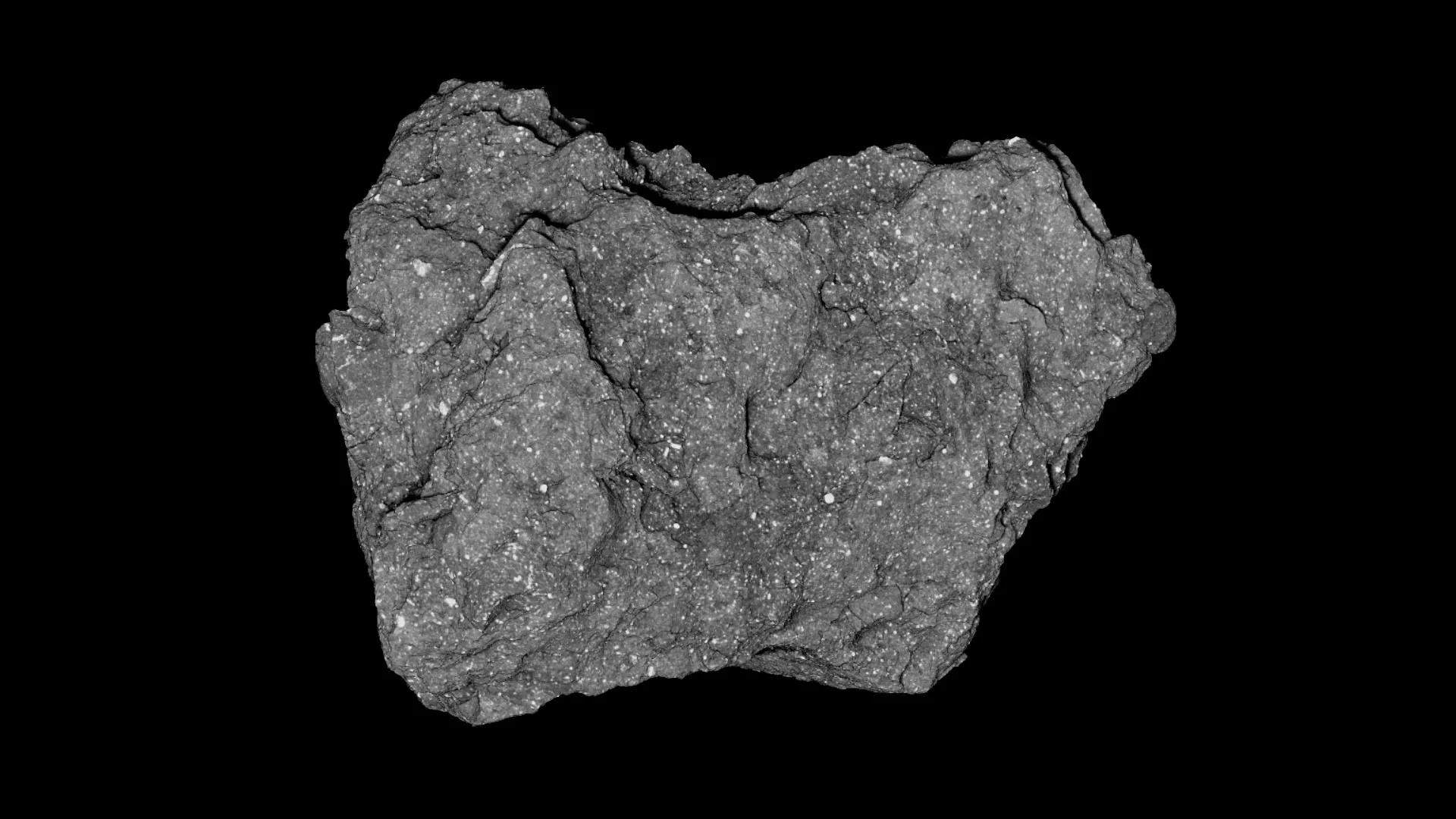
The new study focused on a specific sample labeled OREX-800066-3. By examining it at extremely small scales, the researchers were able to detect structural and chemical differences that would be invisible in bulk measurements. That matters because early Solar System alteration often occurred through interactions among minerals, fluids, and organics at microscopic and nanoscopic interfaces.

A nanoscale map of ancient water activity
The team used nanoscale infrared spectroscopy and Raman spectroscopy to probe the sample down to around 20 nanometers. Those methods identify compounds by how they interact with light, allowing scientists to map chemistry at scales far smaller than human vision can resolve.
At that resolution, the Bennu particle did not look chemically blended. Instead, the report says it separated into three region types, each reflecting different combinations of organic material and minerals shaped by past water-related processes. That finding implies that water-driven alteration was not a single, uniform event washing through the material in the same way everywhere. It was more selective and locally variable.
This is a notable shift in interpretation. When scientists model water-rock interaction in small bodies, they often begin with broad categories: altered versus unaltered, wet versus dry, more primitive versus more processed. Bennu’s patchwork chemistry suggests those categories may hide important fine-scale histories. Two spots in the same particle may record meaningfully different alteration conditions.
Clues for prebiotic chemistry
The study is also significant because of what survived. The report notes that delicate organic molecules remained present despite the asteroid’s complex aqueous history. That matters for astrobiology because it bears on how life-related chemical ingredients can persist in space even when parent bodies undergo episodes of alteration.
Organic molecules in carbonaceous asteroids are not life themselves, but they are relevant to the chemistry from which life can emerge. If such compounds can endure localized water activity rather than being uniformly destroyed or transformed, that expands the range of environments in which prebiotic ingredients might accumulate and survive over long timescales.
Bennu therefore remains important not only as an asteroid sample-return success, but as a natural laboratory for testing how early Solar System chemistry organized itself. The new results imply that the answer may depend heavily on scale. What looks like one kind of material from a distance may actually contain multiple chemical neighborhoods with different histories.

What this changes for planetary science
The broader significance of the study lies in interpretation. If Bennu’s chemistry is heterogeneous at the nanoscale, researchers may need to be cautious about treating returned asteroid samples as chemically averaged records. Fine-grained variation could hold key evidence about fluid movement, mineral transformation, and the preservation of carbon-bearing molecules.
That does not diminish the value of broad compositional studies. It sharpens them. Bulk measurements can still tell scientists what classes of materials are present, but nanoscale work can show how those materials are arranged and how they interacted through time. In small-body science, that arrangement may carry as much historical meaning as the ingredients themselves.
The OSIRIS-REx sample collection is still early in its scientific life, and Bennu is likely to yield many more results across mineralogy, geochemistry, and organic chemistry. This study suggests one likely theme of that work: the asteroid is not a simple, homogeneous relic. It is a layered chemical archive shaped by localized processes that left behind a highly uneven record.
What the new report shows
- Bennu sample material contains three distinct chemical region types at very small scales.
- The pattern suggests water altered the asteroid’s parent material in localized ways rather than uniformly.
- Organic compounds survived alongside mineral changes, offering clues for how prebiotic ingredients persist in space.
- The sample analyzed was returned by NASA’s OSIRIS-REx mission in September 2023.
For planetary scientists, that combination is especially compelling. Bennu is not just preserving ancient material. It is preserving structure in that material, and structure is often where history hides.
This article is based on reporting by Science Daily. Read the original article.
Originally published on sciencedaily.com