Stones That Shouldn't Be There
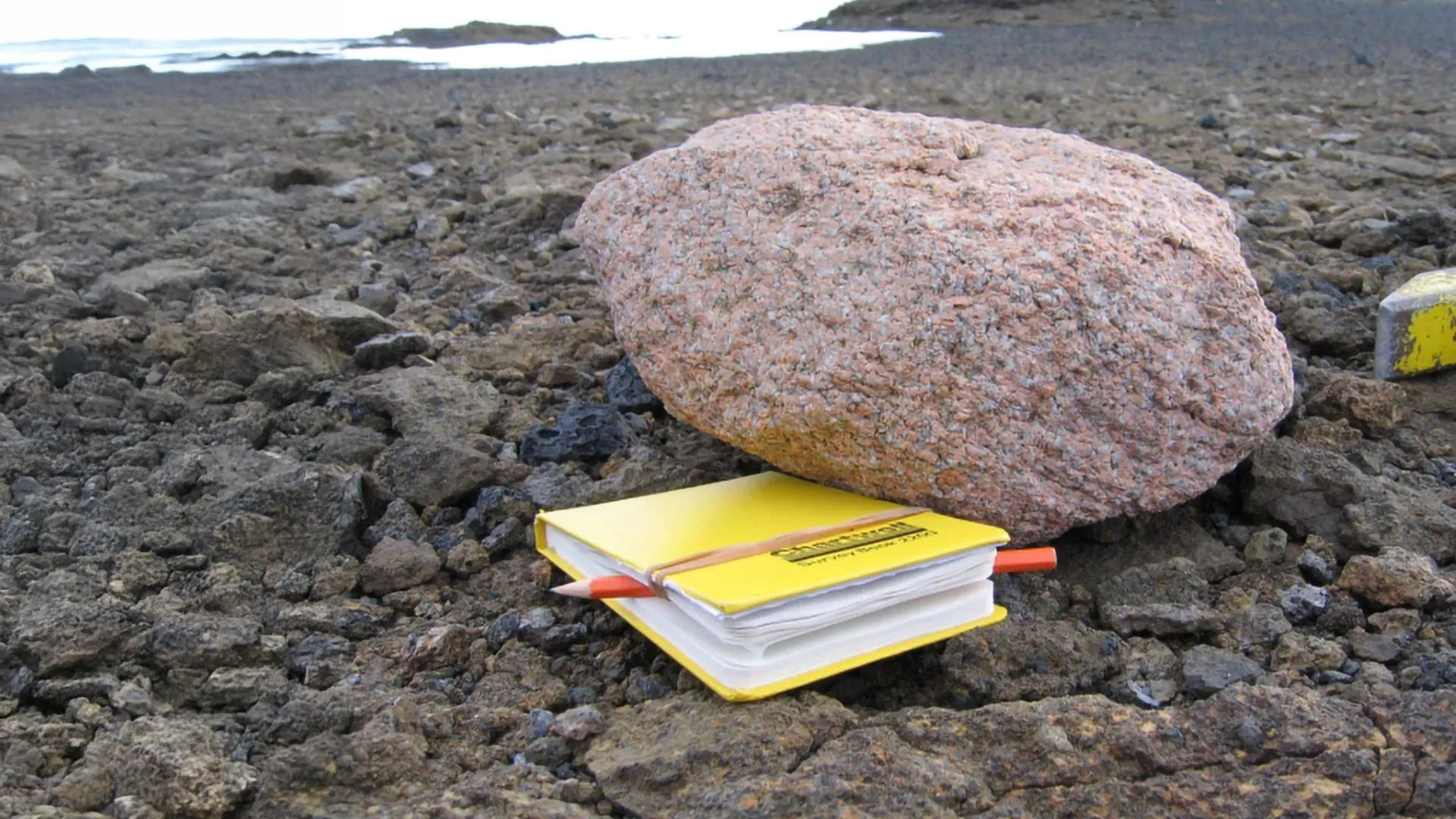
For decades, geologists working in Antarctica's Hudson Mountains had noticed something peculiar: clusters of pink granite boulders sitting atop the region's typical dark volcanic rock. Granite and volcanic basalt form through entirely different geological processes, and the presence of granite in an area dominated by volcanic terrain raised questions that nobody had fully answered. A new study has now solved the mystery — and in doing so, has revealed a geological structure of extraordinary scale hidden beneath one of Antarctica's most important glaciers.
The research, published in a leading geoscience journal by a team of British and American geologists, used a combination of rock age dating and airborne gravity surveys to connect the surface boulders to their source: a massive granite body, or pluton, buried kilometers beneath Pine Island Glacier and stretching nearly 100 kilometers across at its widest point.
Dating the Rocks
The key to unlocking the mystery was radiometric dating of the pink granite boulders. The team applied uranium-lead dating to zircon crystals within the granite, placing the formation of the granite in the Jurassic period, roughly 170 million years ago — when Antarctica was part of the supercontinent Gondwana and experiencing widespread igneous activity associated with its eventual break-up.
Jurassic granite formation in Antarctica is not unusual in itself. What made these results significant was what the dating implied about the boulders' journey to the surface. The boulders were not formed locally from surface volcanic activity — they were eroded from depth and transported upward over geological time by glacial dynamics, emerging at the surface as Pine Island Glacier's fluctuating ice sheets alternately advanced and retreated across the underlying bedrock.

Airborne Gravity Surveys Reveal the Hidden Mass
Once the radiometric dates suggested the boulders had a deep buried source, the team turned to airborne geophysical surveys conducted over Pine Island Glacier to find it. Gravity surveys measure subtle variations in the Earth's gravitational field caused by differences in the density of rock below the surface. Granite, being less dense than the surrounding volcanic and metamorphic rock that characterizes much of West Antarctica's bedrock, produces a distinctive gravity signature that stands out in careful measurements.
The survey data revealed a pronounced gravity anomaly extending beneath Pine Island Glacier — consistent with the presence of a large granite body. By modeling the anomaly's shape and magnitude, the researchers estimated the buried mass to be approximately 100 kilometers wide and 7 kilometers thick in its deepest section, representing one of the largest uncharted geological structures discovered in Antarctica in recent decades.
Why This Discovery Matters for Ice Sheet Science
The revelation of a large granite pluton beneath Pine Island Glacier is not merely a geological curiosity. It has direct implications for understanding the glacier's behavior and its contribution to sea level rise. Pine Island Glacier is one of the fastest-changing glaciers in Antarctica and a major focus of concern for ice sheet stability. Its dynamics are influenced by the bedrock it flows over — the shape, composition, and thermal properties of the rock beneath the ice all affect how the glacier moves and melts.
Granite can harbor higher concentrations of naturally radioactive elements like uranium and thorium, which generate heat through radioactive decay. Even modest additional heat from a large granite body could influence basal melting rates beneath the glacier — the process by which the bottom of the ice sheet melts in contact with bedrock, lubricating the glacier's flow toward the ocean.

Implications for Ice Sheet Modeling
Current models of the West Antarctic Ice Sheet's response to climate change rely on assumptions about basal geology constrained by sparse measurements in one of the most inaccessible environments on Earth. The discovery of a previously unknown geological feature of this scale beneath Pine Island Glacier means that existing models may need revision to account for its thermal and physical influence on ice dynamics.
This does not necessarily mean the glacier's behavior is more alarming than current projections suggest — the granite body could also provide a stabilizing influence under some scenarios. What the discovery emphasizes is how much remains unknown about the geological substrate of Antarctic glaciers and how consequential that substrate is for understanding the ice sheet's future.
This article is based on reporting by Science Daily. Read the original article.
Originally published on sciencedaily.com