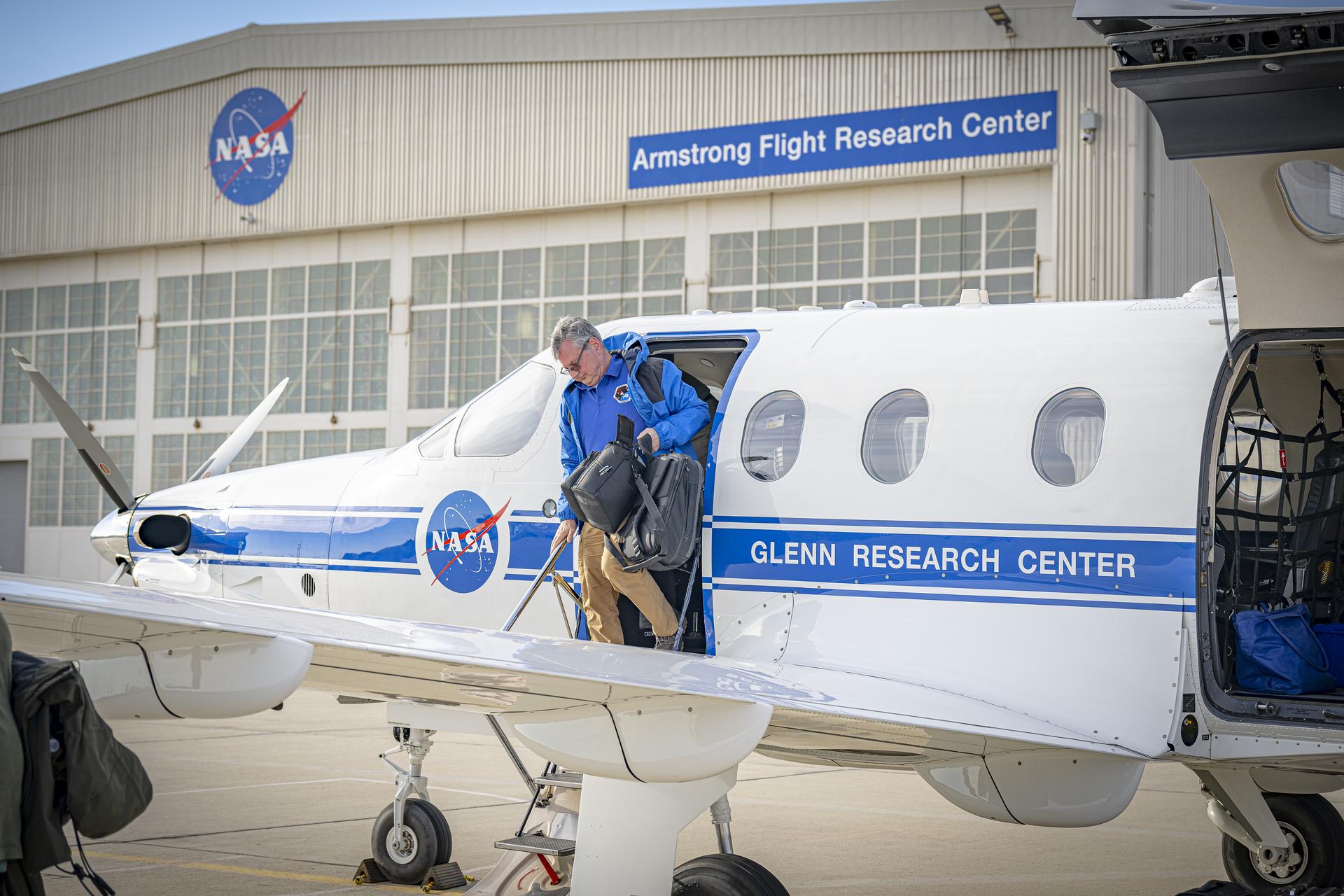
NASA is turning a specialized aircraft into a broader research workhorse
NASA has relocated one of its Pilatus PC-12 aircraft to Armstrong Flight Research Center in Edwards, California, in a move designed to strengthen flight research support across the agency. According to NASA, the aircraft, tail number 606, was originally acquired in 2022 by Glenn Research Center in Cleveland for advanced technology development. It will continue to support Glenn’s work, but its new base at Armstrong is intended to widen its role and make it available for a broader set of research efforts.
On the surface, shifting a single turboprop aircraft from one NASA center to another may look like a routine logistics decision. In practice, the move signals something more deliberate. NASA is treating the PC-12 as a flexible airborne test platform, one that can support multiple research programs rather than remain closely tied to a single center. That matters because flight research increasingly depends on adaptable aircraft that can host instruments, relay communications, and support experiments in varied environments without the cost and complexity of larger platforms.
The agency framed the change in exactly those terms. NASA Armstrong said it is proficient in supporting a deployed-aircraft concept, where an aircraft can be sent to another part of the country or the world to complete a specific mission. Darren Cole, capabilities manager for the Flight Demonstrations and Capabilities project at Armstrong, said that is precisely how the center plans to use the PC-12 as it continues a wide range of flight research.
A smaller aircraft with an outsized role
The PC-12 has already built a useful record during its years supporting NASA Glenn. NASA said the aircraft has contributed to advanced communications research, including a relay experiment involving the International Space Station. Using a portable laser terminal, the PC-12 sent a 4K video stream that was relayed through a ground network and a satellite to the station, which was then able to send information back. NASA said the system helped effectively penetrate cloud coverage.
That detail offers a window into why this aircraft matters. The PC-12 is not being used simply as transport. It is serving as a flying node in experiments that test how data moves between air, ground, and space systems. In this case, the aircraft supported a communications pathway linked to the ISS while also helping demonstrate a method of maintaining connectivity through cloud-obscured conditions. For an agency working across aeronautics, satellite communications, and future space operations, that kind of airborne laboratory has strategic value.
The aircraft has also been used in a very different research area: studying surveillance systems that could support the air traffic demands of future air taxis operating in cities. That work places the PC-12 inside another major NASA priority, the development of enabling technologies for advanced air mobility. Urban air taxi concepts depend on much more than aircraft design. They require sensing, coordination, and traffic-management capabilities robust enough to handle dense and dynamic low-altitude operations. A testbed aircraft can help NASA examine those systems in realistic conditions.
Why Armstrong is a logical new home
Armstrong Flight Research Center has long been associated with airborne experimentation, flight demonstrations, and the practical work of turning research ideas into test missions. Housing the PC-12 there gives NASA a base with operational experience in deploying aircraft to support distinct projects as they arise. NASA’s own description emphasized that point directly: the aircraft can continue supporting Glenn while also expanding the agency’s broader flight research capability.
That dual-use role is important. It means the move is not a transfer away from Glenn’s interests but an effort to make one asset do more. Glenn still benefits from the platform it acquired, while Armstrong provides the infrastructure and operating model to use that same aircraft for agency-wide needs. In effect, NASA appears to be increasing the utilization value of the PC-12 by placing it where mission support can be more widely coordinated.
This kind of internal repositioning often reveals how research organizations are adapting to budget pressure, technical complexity, and the need to move faster. Rather than stand up a new dedicated platform for every emerging area of work, NASA can rely on a proven aircraft with an existing track record. That creates a more modular research posture. The same airframe can support communications experiments, surveillance studies, and other future demonstrations, depending on mission demand.
Research infrastructure matters as much as marquee missions
Large public attention tends to go to crewed lunar missions, flagship telescopes, or planetary science breakthroughs. But the quieter infrastructure behind those efforts often determines how quickly new capabilities are validated. Aircraft like the PC-12 belong to that less visible layer of aerospace progress. They are tools for experimentation, not headline destinations in themselves. Yet they help NASA close the gap between concept and operation by putting hardware and ideas into real flight conditions.
The agency’s summary makes that clear through example rather than slogan. Over four years of service at Glenn, the aircraft proved useful in both communications relay work and studies relevant to future air taxi systems. Those are not trivial sidelines. They sit in two areas where NASA has substantial long-term interests: resilient communications and future aviation systems. Repositioning the aircraft to Armstrong suggests NASA wants to make that experimental flexibility easier to access across multiple programs.
It also speaks to a broader institutional pattern. Research agencies are under pressure to show they can do more with existing assets while still enabling ambitious projects. A movable, multi-role aircraft fits that pattern well. NASA does not need to reinvent the platform each time. It needs to keep it mission-ready, instrument-capable, and operationally available to the teams that can use it.
What the move may signal next
NASA did not announce a single marquee mission tied to the PC-12’s relocation. Instead, it highlighted capability: the plane will continue supporting Glenn and help expand research support across the agency. That framing suggests the most important outcome may be optionality. Armstrong can host, deploy, and integrate the aircraft into different projects as requirements emerge. In research terms, that flexibility can be more valuable than dedicating an airframe too narrowly.
The significance of the move, then, is not just geographic. NASA is repositioning a proven experimental aircraft inside a center built around flight testing, with the explicit aim of broadening its usefulness. That is a practical step, but also a revealing one. It shows how the agency is building capacity for the less glamorous but essential work of validating technologies in the air before they become part of larger systems.
As NASA pursues more ambitious aviation and space goals, aircraft like the PC-12 will remain part of the connective tissue that links early-stage ideas to operational results. Moving tail number 606 to Armstrong is a reminder that research progress often depends on making existing tools more available, more mobile, and more tightly integrated with the missions that need them.
This article is based on reporting by NASA. Read the original article.