The Hidden Bottleneck
The clean energy transition faces a problem that solar panels and wind turbines cannot solve: the power grid itself. Renewable energy projects are being delayed or curtailed across the globe because the transmission infrastructure needed to deliver their electricity to consumers is inadequate. Building new high-voltage transmission lines takes a decade or more in most jurisdictions, creating a bottleneck that threatens to slow decarbonization regardless of how cheaply renewable energy can be generated.
A class of technologies that rarely makes headlines is helping to address this crisis without requiring new transmission corridors. Grid control devices — sophisticated power electronics and mechanical systems that manage how electricity flows through existing transmission networks — can unlock significant additional capacity on infrastructure that is already built. These technologies represent one of the fastest and most cost-effective ways to expand grid capacity while new lines are planned and constructed.
Why Existing Lines Are Underused
Most transmission lines operate well below their theoretical capacity most of the time. This underutilization is not an accident but a consequence of how power systems are operated. Grid operators must maintain safety margins to handle unexpected events — a sudden generator trip, a transmission line fault, or a rapid change in demand. These contingency margins can consume 20 to 40 percent of a line's rated capacity, leaving significant headroom that is reserved but rarely used.
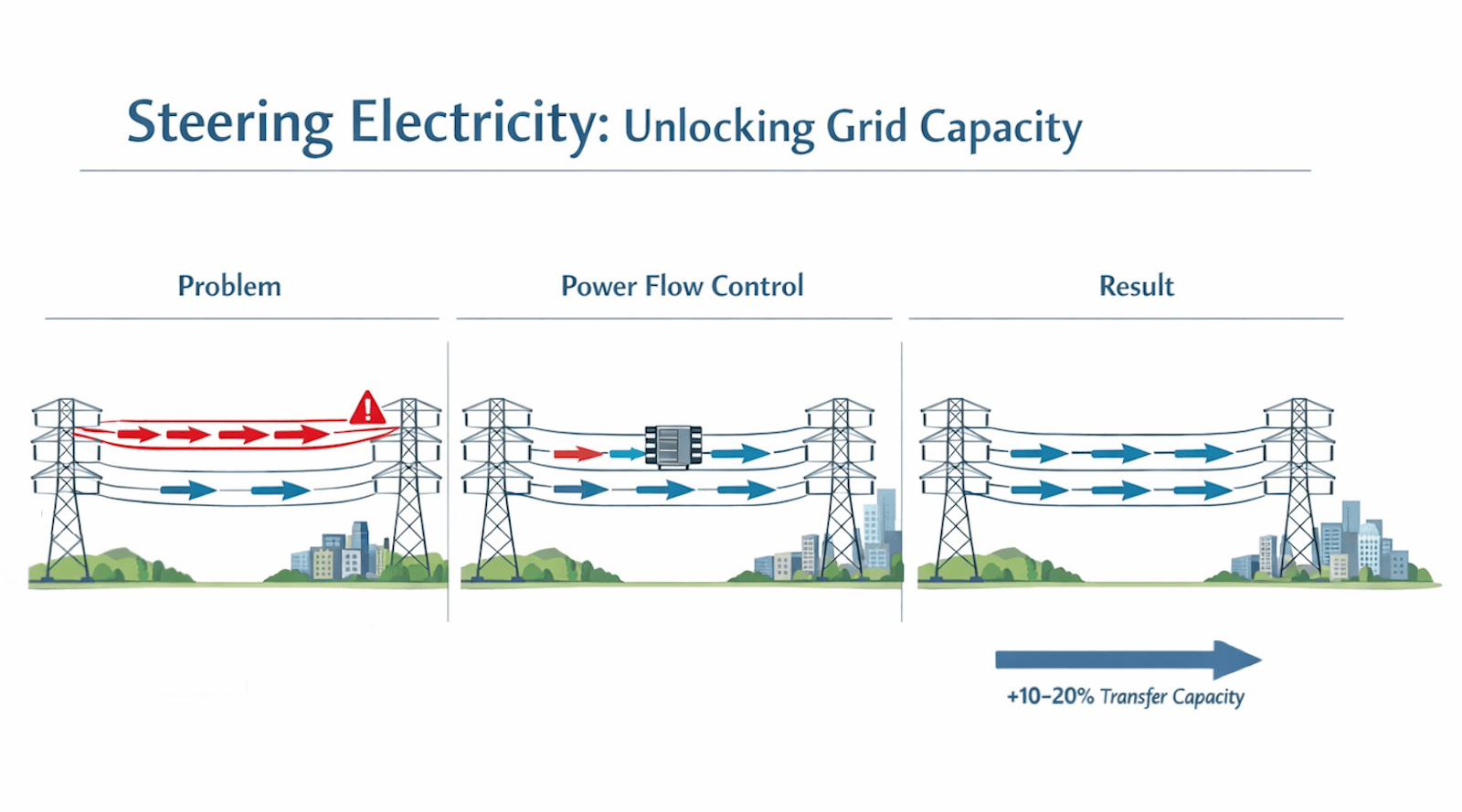
Additionally, electricity follows the path of least resistance, not necessarily the path that grid operators would prefer. When power flows concentrate on certain lines while others remain lightly loaded, the heavily loaded lines become bottlenecks that limit the total amount of power the grid can transmit. This uneven distribution means that the aggregate capacity of the transmission system is often limited by a small number of congested corridors, even when the overall system has spare capacity available.
Grid control devices address both of these issues. They can redirect power flows from congested lines to underutilized ones, and they can reduce the contingency margins needed by providing faster, more precise responses to grid disturbances. The result is more usable capacity from existing infrastructure — capacity that can be unlocked in months rather than the years or decades required for new line construction.
Types of Grid Control Devices
The family of grid control technologies encompasses several distinct device types, each addressing different aspects of power flow management. Flexible AC Transmission Systems, known as FACTS devices, use power electronics to control voltage, impedance, and phase angle on transmission lines. By adjusting these parameters, FACTS devices can increase or decrease the power flowing through specific lines, effectively steering electricity through the network.
Static VAR compensators and static synchronous compensators manage reactive power — the component of electrical power that does not perform useful work but is necessary to maintain voltage levels across the grid. By providing reactive power locally, these devices allow transmission lines to carry more active (useful) power without violating voltage limits.
Phase-shifting transformers use electromagnetic principles to alter the effective impedance of transmission paths, redirecting power flows from overloaded corridors to parallel paths with available capacity. These devices have been used in power systems for decades but are experiencing renewed interest as grid congestion worsens.
Dynamic line rating systems take a different approach entirely. Rather than controlling power flows, they monitor real-time weather conditions — wind speed, ambient temperature, solar radiation — along transmission corridors to calculate the actual thermal capacity of the lines at any given moment. On windy or cool days, lines can safely carry significantly more power than their static ratings indicate. Dynamic ratings unlock this hidden capacity by adjusting operating limits in real time based on actual conditions rather than worst-case assumptions.
Real-World Impact
Utilities and grid operators that have deployed these technologies report significant capacity gains. Dynamic line rating systems have demonstrated capacity increases of 10 to 30 percent on the corridors where they are deployed, with the largest gains occurring during the cool, windy conditions that correlate with high wind energy production — precisely when additional transmission capacity is most needed.
FACTS devices and power flow controllers have achieved comparable results in congestion relief, enabling grid operators to accommodate new renewable energy connections that would otherwise require expensive network upgrades or would be delayed until new lines could be built. The economic value of these deployments is substantial: each megawatt of additional transmission capacity unlocked by grid control devices avoids the need for transmission investment that can cost millions of dollars per megawatt-mile for new construction.
The deployment timeline is another major advantage. While a new transmission line requires environmental review, permitting, land acquisition, and construction spanning 7 to 15 years, most grid control devices can be specified, manufactured, and installed within 12 to 24 months. For a power system facing immediate congestion constraints and interconnection queues stretching years into the future, this speed advantage is enormously valuable.
Barriers to Adoption
Despite their advantages, grid control devices remain underdeployed relative to their potential. Regulatory frameworks in many jurisdictions were designed around the traditional model of building new transmission infrastructure, which creates a capital investment that utilities earn regulated returns on. Grid control devices that defer or avoid new construction may actually reduce a utility's opportunity to earn returns, creating a financial disincentive for adoption.
Technical barriers also exist. Integrating advanced power electronics into legacy grid control systems requires sophisticated modeling, communication infrastructure, and operator training. Grid operators accustomed to managing power flows through traditional means — adjusting generator output and opening or closing circuit breakers — must develop new operational practices to take full advantage of FACTS devices and dynamic ratings.
A Bridge Technology
Grid control devices are not a permanent substitute for new transmission infrastructure. As the electricity system continues to electrify transportation, heating, and industrial processes, total demand will grow substantially, eventually requiring expanded physical infrastructure. However, as a bridge technology that can deliver additional capacity quickly and cost-effectively while new lines are being planned and built, grid control devices are an indispensable tool for maintaining the pace of the clean energy transition.
This article is based on reporting by CleanTechnica. Read the original article.