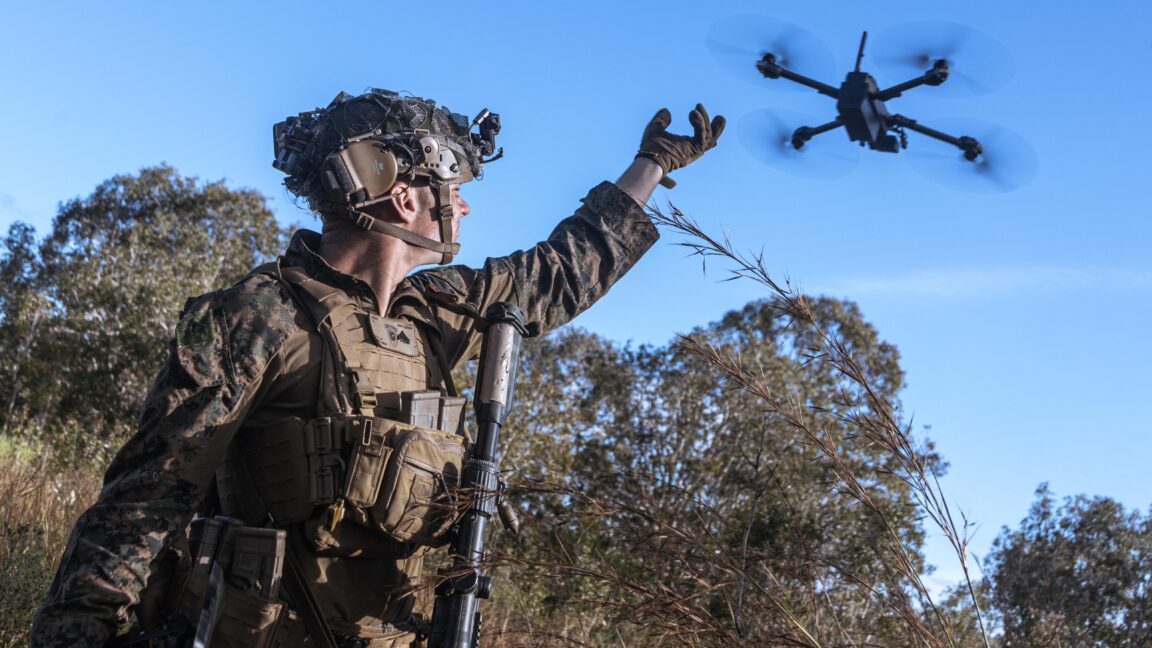
The Pentagon is asking for an unprecedented surge in drone spending
The U.S. Department of Defense is seeking what officials describe as the largest investment in drone warfare and counter-drone technology in American history. Inside the Pentagon’s proposed fiscal 2027 budget, the department wants $53.6 billion for production and procurement of drones, operator training, logistics, and defenses against hostile unmanned systems.
According to the source report, that figure sits under the Defense Autonomous Warfare Group, or DAWG, an organization established in late 2025. The unit received about $226 million in fiscal 2026. The leap to more than $53 billion one year later illustrates how quickly autonomous systems are moving from experimental and supplemental roles into the center of U.S. force planning.
The scale is large enough to be geopolitically notable on its own. Ars Technica reports that the proposed spending on drone and autonomous warfare technologies would surpass most countries’ entire defense budgets and place it among the top 10 military spending levels in the world, ahead of nations including Ukraine, South Korea, and Israel.
What the money is meant to buy
The funding request covers far more than small battlefield quadcopters. Pentagon officials say the money would be used to expand U.S. production and procurement of unmanned systems, train operators, establish the logistics network required to sustain deployments, and broaden counter-drone defenses across more military sites.
The source report also identifies another $20.6 billion tied to one-way attack drones and the U.S. Air Force’s Collaborative Combat Aircraft program. That effort is building drone prototypes designed to team with human-piloted fighters. Some of that funding would also support systems to defeat small drones and the Navy’s Boeing MQ-25, the carrier-based unmanned aircraft intended for aerial refueling missions.
Taken together, the request spans several layers of unmanned warfare: expendable attack systems, autonomous aircraft supporting crewed fighters, logistics and sustainment, and defenses against the same class of threat.
This breadth matters. It suggests the Pentagon is not simply buying more drones. It is attempting to institutionalize a full autonomous warfare ecosystem, from manufacturing and deployment to integration and protection.

The institutional signal is as important as the number
One revealing detail in the report is the role of DAWG itself. Pentagon official Jules Hurst described the group as a pathfinder working directly with companies, testing systems and orchestration tools for autonomy, and providing live feedback.
That description implies a procurement model designed for speed and iterative development rather than only traditional long-cycle acquisition. If that approach holds, it could reduce the gap between commercial innovation and operational adoption, especially in software-heavy autonomous systems where battlefield relevance depends on fast updates.
The request therefore points to a broader bureaucratic shift inside the Pentagon. Autonomous warfare is no longer being treated as a scattered portfolio across programs of record. It is being organized around a dedicated group with budget authority and a mandate to integrate technologies quickly.
Why now
The timing reflects the rapid military lessons drawn from recent conflicts and exercises, where drones have become central to reconnaissance, strike, targeting, and attrition. Even without citing a single war as the sole driver, the budget request clearly assumes that unmanned systems and counter-drone measures are now foundational rather than optional.
That assumption affects every branch of the military. For the Air Force, collaborative combat aircraft suggest a future in which crewed jets operate alongside unmanned wingmen. For the Navy, systems like the MQ-25 expand carrier reach. For base defense and forward operations, counter-drone systems are becoming as essential as conventional air defense at smaller scales.
The logistics component is especially important. Buying drones is easier than sustaining them. Training operators, replacing airframes, securing supply chains, managing software, and integrating command systems all determine whether a large fleet becomes useful capability or expensive inventory.
The Pentagon’s request appears to acknowledge that reality by pairing procurement with training and sustainment infrastructure.

A military budget line with global strategic consequences
When a single category of defense spending rivals the entire budgets of many nations, it sends a signal beyond Washington. Allies may see an invitation to align procurement and doctrine more closely with U.S. autonomous systems. Competitors may read it as evidence that the United States intends to dominate the industrial and operational base for drone warfare.
It could also reshape defense markets. A $53.6 billion push would create enormous demand for drone manufacturers, autonomy software providers, component suppliers, communications networks, training systems, and counter-drone firms. Much of the future competition may be less about who has the first prototype than who can produce, upgrade, and sustain unmanned fleets at scale.
The budget request also indicates that the Pentagon sees autonomous warfare as both an offensive and defensive necessity. The same technologies that extend strike and reconnaissance capacity are proliferating widely enough that defending against them has become its own massive mission area.
The risks behind the expansion
For all its strategic logic, a surge of this size also raises execution questions. The move from $226 million to more than $53 billion in one year is enormous. Industrial capacity, software integration, testing, doctrine, and oversight would all need to expand accordingly.
There is also the question of whether rapid procurement can keep pace with fast-changing technology. Drones and autonomy systems evolve much faster than traditional aircraft programs. A procurement model that locks in specific platforms too early could leave the Pentagon spending heavily on systems that are outdated sooner than expected.
The source report does not resolve those concerns, but it shows the department is willing to accept them in pursuit of scale. That alone is consequential.

A clear statement about the future of war
The proposed fiscal 2027 drone budget is more than a headline-grabbing figure. It is a declaration about how the Pentagon thinks future combat will work. Autonomous systems are being funded not as a specialized adjunct, but as a core layer of military power spanning strike missions, surveillance, logistics, force multiplication, and base defense.
If Congress approves anything close to the request, the United States will be making one of its strongest bets yet that the next phase of military advantage depends on who can build, field, and defend against drones at massive scale. The budget does not end the debate over autonomous warfare. But it makes one point unmistakable: for the Pentagon, that future is no longer hypothetical.
This article is based on reporting by Ars Technica. Read the original article.
Originally published on arstechnica.com


