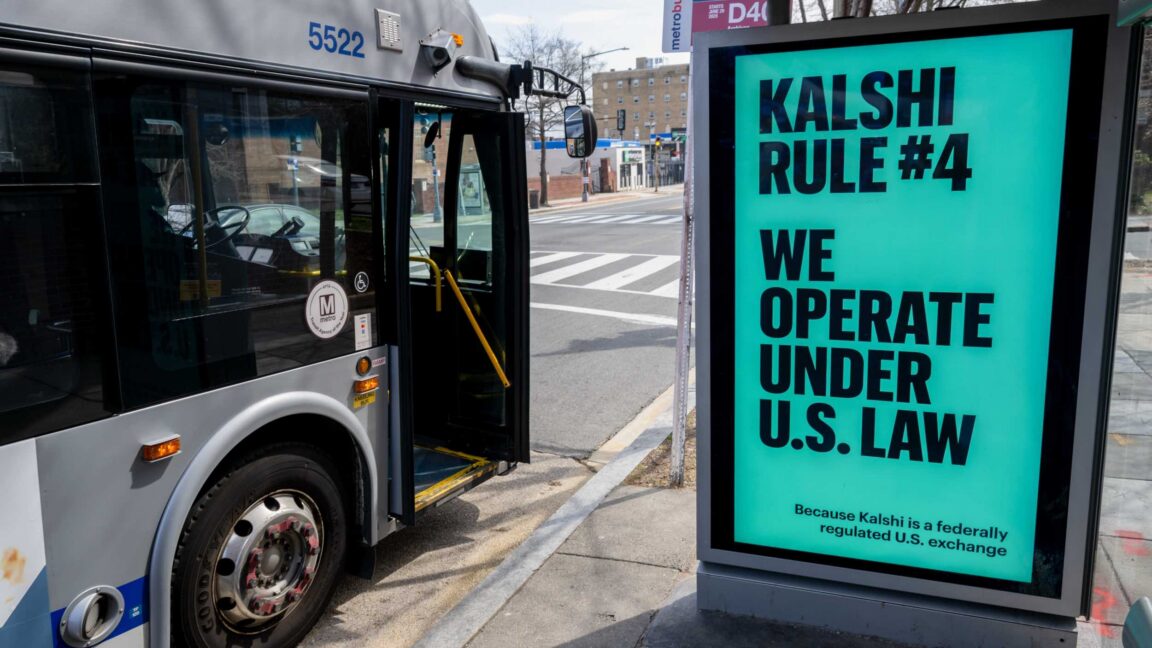
Ninth Circuit Hands Kalshi a Major Defeat
A federal appeals court has ruled that Nevada can enforce its gaming laws against Kalshi’s sports-event contracts, dealing a significant blow to the prediction-market company’s effort to position sports wagering as a federally regulated financial product rather than state-regulated gambling. The decision adds weight to a widening legal fight over whether event contracts tied to sports outcomes belong under commodities law, gambling law, or some unsettled combination of both.
According to the supplied source text, a unanimous three-judge panel of the U.S. Court of Appeals for the 9th Circuit rejected Kalshi’s argument that the federal Commodity Exchange Act preempts Nevada’s authority. The case centered on whether the company’s sports-related contracts should be treated as swaps overseen exclusively by the Commodity Futures Trading Commission, or whether Nevada can treat them as gambling subject to state licensing and enforcement.
The ruling is important because it cuts directly into the legal theory that has helped prediction markets push into sports. If states can classify those products as gambling despite federal market designation, then nationwide expansion becomes far more difficult. It also raises the stakes of a growing conflict between federal regulators, state gaming authorities, and a new class of companies trying to blur the line between derivatives trading and sports betting.
The Core Legal Question
Kalshi argued that its contracts are lawful products offered on a designated contract market and therefore fall under exclusive federal oversight. Nevada took the opposite view, contending that a bet on a sports outcome remains gambling regardless of whether it is packaged with market terminology. The 9th Circuit sided with Nevada.
The source text quotes Judge Ryan Nelson describing Kalshi as advertising itself as the first app for legal sports betting in all 50 states, a line that appears to have weakened the company’s effort to characterize the product as something fundamentally different from wagering. As activity on the platform grew, the Nevada Gaming Control Board sent a cease-and-desist letter asserting that Kalshi was violating state gaming laws and regulations.
Kalshi then sought injunctive relief, arguing that Nevada should be blocked from enforcement because the Commodity Futures Trading Commission has exclusive authority over its sports event contracts. The appeals court affirmed the lower court order that allowed Nevada to proceed.
In practical terms, the ruling says the state does not have to accept a relabeling exercise. Calling a sports wager a swap or an event contract is not enough, on its own, to strip Nevada of its traditional regulatory role.

Why the Decision Matters Beyond Nevada
The immediate impact is on Kalshi’s ability to offer the disputed products in Nevada. The broader impact is on the shape of the national market. Prediction-market firms and trading platforms have increasingly tested products that look and behave like bets on real-world outcomes, including sports. Those offerings appeal to companies because financial-market frameworks can appear more scalable than negotiating state-by-state gambling approvals.
But the source text makes clear that the 9th Circuit’s ruling does not settle the matter nationwide. In fact, it sharpens the conflict. Ars Technica reports that the 9th Circuit decision conflicts with a 3rd Circuit ruling in a case involving New Jersey, where judges found that sports wagers on prediction markets are swaps. That split between federal circuits materially increases the chances of Supreme Court review.
When federal appeals courts interpret the same legal question differently, the result is legal fragmentation. Companies can win in one region and lose in another. Regulators can issue contradictory guidance. Investors and partners face uncertainty about what business model is actually durable. For a company trying to build national liquidity and consumer trust, that is a serious operational problem.
A Regulatory Clash With Larger Implications
The case also reveals a deeper policy dispute about who should control emerging event-based markets. State gaming regulators view sports-outcome products as straightforward gambling and argue that they should comply with established licensing, consumer-protection, and enforcement structures. Prediction-market companies emphasize federal market oversight and the language of derivatives, suggesting a different regulatory pathway.
The distinction is not semantic. Gambling law and commodities law reflect different assumptions about risk, disclosure, market integrity, and consumer access. A product approved in one system may face very different rules in the other. The outcome affects who can offer the contracts, where they can be sold, what safeguards apply, and how disputes are resolved.
The source material also notes a political layer. While the Trump administration is described as trying to help prediction markets avoid state regulation, the 9th Circuit panel of Trump-appointed judges still ruled against Kalshi. That detail suggests the legal question is proving more resistant to political alignment than some market participants may have expected.

What Comes Next
For now, Nevada’s position has been reinforced: prediction markets offering sports-event contracts can be treated as gambling under state law. The Nevada Gaming Control Board said the court emphatically rejected the view that the Commodity Exchange Act blocks application of Nevada’s gaming laws to sports-event contracts offered by Kalshi, Crypto.com, and Robinhood. Nevada Governor Joe Lombardo similarly said that prediction markets offering sports-event contracts constitute gambling and must comply with the state’s regulatory framework.
The likely next step is continued litigation, whether through further appeals or eventual Supreme Court involvement. The circuit split makes that outcome more plausible. Until there is a definitive national answer, companies operating in this space will have to manage a patchwork landscape in which identical products may be viewed as legitimate financial contracts in one jurisdiction and unlawful gambling in another.
That uncertainty is likely to slow the normalization of sports-linked prediction products, at least in the near term. It may also force companies to choose between narrower, state-compliant operations and more aggressive legal challenges built around federal preemption. Either way, the 9th Circuit ruling is a substantial setback for the idea that sports betting can simply be repackaged as market infrastructure and escape state gaming law.
This article is based on reporting by Ars Technica. Read the original article.
Originally published on arstechnica.com


