A leadership move tied to a changing space market
Jim Bridenstine, the former NASA administrator and onetime naval aviator and member of Congress, has taken over as chief executive of Quantum Space, a Maryland-based company focused on maneuverable spacecraft for defense and cislunar operations. The appointment is more than an executive reshuffle. It reflects how quickly the commercial space sector is aligning itself with military demand for mobility, surveillance, and logistics beyond traditional Earth orbit missions.
Bridenstine’s own framing makes that clear. In the source reporting on his appointment, he said national security space is a priority for the company. That is a notable emphasis at a moment when military planners are increasingly focused on how to operate across a broader range of orbital regimes, from low-Earth orbit to geostationary orbit and out toward the Moon. The old commercial space playbook centered heavily on launch, communications, and Earth observation. The next phase is expanding toward in-space movement and servicing as strategic capabilities in their own right.
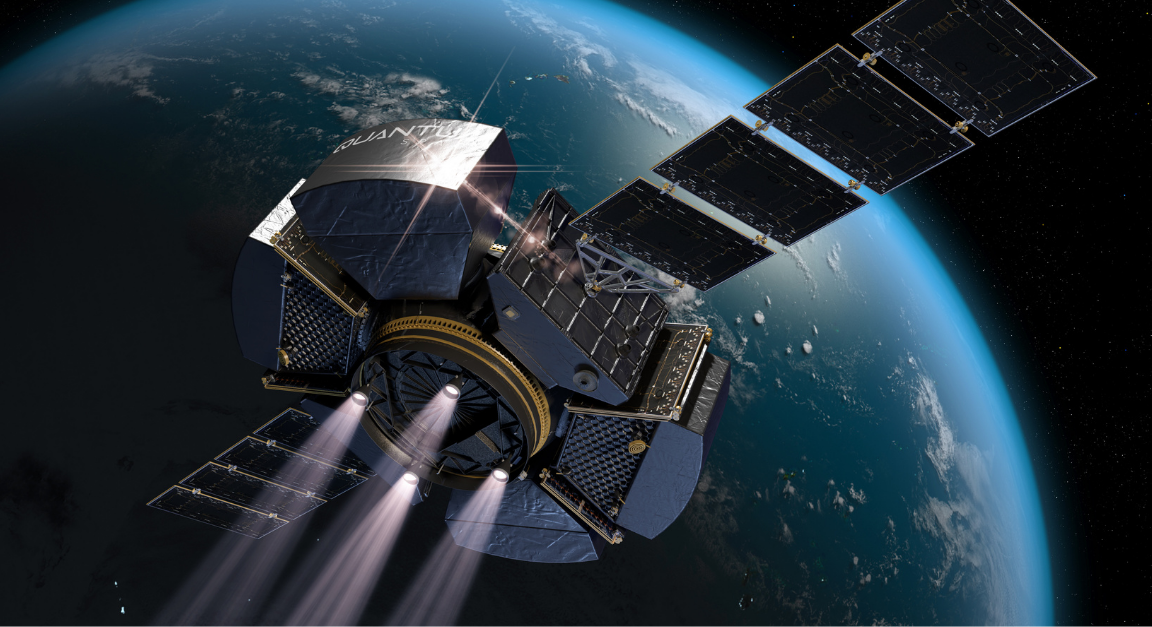
The Ranger spacecraft is built around mobility
Quantum Space’s flagship platform is called Ranger. Before its solar panels are deployed, the spacecraft is described as being about the size of a Volkswagen Beetle. Its purpose is not to sit in a fixed orbital slot performing a narrow task. Instead, Ranger is being designed for high maneuverability across multiple operating environments, including low-Earth orbit, geostationary orbit, and cislunar space.
That mission profile is backed by a large onboard propellant load. Ranger is expected to carry 4,000 kilograms of hydrazine, enabling rapid maneuvering. Bridenstine characterized the spacecraft as high-energy, with fuel that can be burned quickly when missions require aggressive movement. Just as important, the platform is intended not only to be refueled but also to refuel other spacecraft. That points to a long-term vision in which orbital logistics becomes a meaningful part of space infrastructure, especially for defense missions that cannot rely on static positioning or one-time deployment.
The company also says Ranger incorporates a proprietary multi-mode technology that allows it to switch between high-thrust maneuvering and high-efficiency operations. In plain terms, that suggests a vehicle optimized both for rapid repositioning and for endurance, a combination that could make it more adaptable across military and civil mission sets.

Why the Pentagon cares about maneuvering in space
The strategic case for a spacecraft like Ranger is tied to a changing threat environment and a widening operational map. In-space maneuvering has become more valuable as governments think less about space as a set of isolated orbital lanes and more as a contested domain where assets may need to move, inspect, reposition, persist, or respond. A spacecraft with substantial propellant reserves and refueling potential could be relevant for surveillance, servicing, mission support, and space domain awareness.
Bridenstine said the US Space Force is interested in new capabilities for maneuvering in space, and Quantum Space is clearly positioning Ranger to meet that demand. The context provided in the report underscores why companies are leaning in. President Donald Trump’s fiscal-year 2027 budget request reportedly calls for Space Force funding to increase by roughly 80 percent to $71 billion. Even budget requests can change during the appropriations process, but the direction of travel is unmistakable: defense space is attracting serious attention and money.
That level of expected investment creates a strong incentive for commercial operators to build platforms that serve military needs without being limited to a single niche mission. The value proposition is increasingly about versatility. A spacecraft that can move quickly, operate efficiently, and support other spacecraft may fit multiple procurement priorities at once.
Existing contracts show where the company is aiming
Quantum Space is not pitching Ranger in the abstract. The company is already connected to several defense-related programs that hint at the breadth of missions it wants to support. One is the Defense Advanced Research Projects Agency’s LASSO program, which seeks spacecraft capable of flying in very low orbit around the Moon, potentially as low as 10 kilometers above the surface, in order to characterize concentrations of water.
That is a technically demanding assignment. Very low lunar orbit requires precision and endurance, and it points to a future in which cislunar space is not just a scientific frontier but also an operational zone with strategic relevance. Water mapping near the Moon has implications for exploration, resource planning, and sustained off-Earth activity.
Quantum Space is also involved in the Air Force Research Laboratory’s Oracle-P program to build space situational awareness spacecraft in cislunar space. Space situational awareness has long been essential in Earth orbit; extending that capability outward reflects a growing expectation that spacecraft traffic, monitoring, and oversight will matter far beyond the geostationary belt.
In addition, the company is one of 14 competitors in the $6.2 billion Andromeda program focused on surveillance and reconnaissance satellites. Taken together, those programs show a company targeting the intersection of military intelligence, orbital mobility, and deep-space operations rather than a single vehicle for a single customer.
Bridenstine’s appointment brings policy and defense credibility
Leadership matters in a market like this because the barriers are not only technical. They are also political, budgetary, and institutional. Bridenstine brings a rare combination of credentials: military aviation experience, congressional service on the Armed Services Committee, and a stint running NASA. For a company pitching advanced spacecraft to national security buyers, that combination offers fluency in both operational priorities and Washington decision-making.
His appointment also suggests that companies in the sector increasingly value executives who can translate between commercial engineering programs and government mission frameworks. Space firms working near defense procurement need more than launch ambition or elegant spacecraft concepts. They need leadership that can align product strategy with real program demand, funding cycles, and national security doctrine.
A sign of where the space economy is heading
Quantum Space’s new leadership and its Ranger spacecraft point to a larger shift in the space economy. For years, commercial space growth was often described through launch cadence, satellite constellations, and private exploration narratives. Those still matter, but another layer is now becoming more prominent: infrastructure for movement, servicing, and strategic operations in contested and extended orbital environments.
If Ranger performs as Quantum Space intends, it could fit a future in which spacecraft are expected to move dynamically, support one another, and operate across Earth orbit and cislunar space with far more flexibility than legacy platforms. That is a future with clear military implications, but not only military ones. The same basic capabilities that enable defense maneuvering can also support exploration, inspection, and persistent presence farther from Earth.
Bridenstine’s arrival does not guarantee Quantum Space will dominate that market. But it does place a politically connected, defense-literate space figure at the center of a company building for one of the most strategically important segments of the next space cycle. In that sense, the appointment is less about one executive and more about the shape of the industry now forming around him.
This article is based on reporting by Ars Technica. Read the original article.

Originally published on arstechnica.com