Speaker Height: The Overlooked Placement Variable
When people set up a home sound system, most of the attention goes to left and right. The speakers get spread apart, toed in, and measured against the screen or the main chair. But there is a third axis that often gets ignored: height. The distance between your speakers and your ears, and specifically how far above ear level they sit, shapes what you hear. The core point here is straightforward: too much height makes dialogue and fine details sound less direct. That loss of directness is not a minor audiophile complaint. It changes how intelligible speech is and how much texture you perceive in music, films, and games.
Why Directness Matters in Home Audio
Directness describes sound that travels straight from the speaker to the listener without bouncing off the ceiling, walls, or floor first. That direct path is what anchors a voice to a face on screen or an instrument to a spot in the stereo image. When speakers are placed high, the direct path from driver to ear becomes steeper. The sound still arrives, but it arrives from above. The brain uses timing and angle cues to localize sound and separate the primary signal from room reflections. A steep downward angle makes the main signal feel less anchored, and it can blend more with reflected energy. The result, as the source notes, is that dialogue and fine details lose their immediacy.
What Counts as Too High?
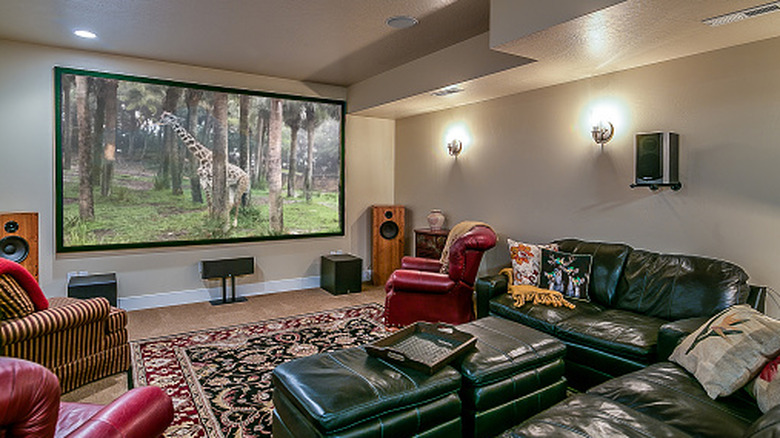
There is no single number that applies to every room. Ceiling height, seat distance, speaker design, and mounting options all vary. The practical benchmark is the vertical relationship between the speaker and your ears when you sit in the main listening position. Many stereo and home theater setups aim for the high-frequency driver, often called the tweeter, to sit at roughly ear height. When speakers are mounted far above that line, such as high on a wall or close to the ceiling, the listening angle becomes distinctly downward. That is the point where height starts to work against clarity.
Two factors can make the problem worse. First, the higher the speaker, the sharper the downward angle. Second, the farther you sit from the speaker, the more that angle flattens over distance, but early reflections from the ceiling and upper walls can still reach the listener from above. The combination can make the soundstage feel detached from the screen or the performance.
The Dialogue Problem
Dialogue is the most demanding content in most home systems. Human speech depends on a wide range of frequencies, from low fundamentals that give a voice weight to high-frequency consonants that make words intelligible. When speakers sit above ear level, those higher frequencies are often the first to suffer. The direct sound is aimed over the listener rather than at the ears, and speech intelligibility can drop. Viewers often respond by turning up the volume, but that raises the whole mix, including effects and music, without restoring the lost directness.
The source makes the key point clearly: too much height makes dialogue and fine details sound less direct. In practice, that can mean a conversation on screen feels as though it is happening slightly above the action, or as if a layer of haze sits between the actor and the listener. Fine details, the small cues that make a performance feel present, recede as well.
Fine Details and High Frequencies
Fine details live in the high frequencies. The shimmer of a cymbal, the breath before a sung line, the texture of a bowed string, and the crisp edge of a consonant all depend on top-end energy. High frequencies are more directional than bass. They beam forward from the tweeter in a relatively narrow pattern compared with low frequencies. If the speaker sits above ear level, the listener is off-axis in the vertical plane. The further off-axis you are, the more the top end rolls off. That is why detail can become less vivid when speakers are mounted too high. The information does not vanish entirely, but it becomes less direct and less distinct.

Height in the Context of the Whole Room
Height does not act alone. Distance, toe-in, furniture, and reflective surfaces all influence the final result. But height is one of the few placement choices that can be corrected relatively easily, and it has an outsized effect on dialogue. A speaker that is too high can make a well-chosen system sound mediocre, while a modest speaker at the right height can outperform expectations. That is why the question of how high is too high is worth asking before you drill holes or buy mounts.
Practical Ways to Find the Right Height
- Start at ear level. Sit in your main listening position and check where the high-frequency driver points. If it aims over your head, the speaker is likely too high for direct dialogue and detail.
- Angle downward if mounting high. A slight downward tilt can aim the speaker toward the listener. It will not fully recreate an ear-level placement, but it can reduce the off-axis loss.
- Test with dialogue-heavy content. News broadcasts, interviews, and dialogue-driven films expose the problem quickly. If you strain to follow speech, height may be part of the cause.
- Move your seat temporarily. Raising or lowering your ears relative to the speaker can confirm whether the vertical angle is the issue. A cushion or a lower chair can be a useful experiment.
- Use a temporary setup first. Before committing to a wall mount or ceiling bracket, place the speakers on boxes or stands at different heights. Listen for changes in directness and detail.
![These are my favorite iPhone 18 Pro & Pro Max cases so far [Video] - 9to5Mac](https://9to5mac.com/wp-content/uploads/sites/6/2026/09/Cases.jpg?quality=82&strip=all&resize=1200,628)
When High Placement Is Unavoidable
Sometimes the room dictates the height. A small space, a screen position, or a safety concern may leave no practical alternative to mounting speakers above ear level. In those cases, accept that dialogue and fine detail may be less direct, and compensate where you can. Aim the speakers toward the listening position, keep the main seat as close to the vertical axis as possible, and avoid pushing the speakers all the way to the ceiling. A downward tilt can help, but it cannot fully restore the directness of an ear-level placement.
The Bottom Line
Speaker height is not a minor detail. Too much height makes dialogue and fine details sound less direct. If your system sounds clear but oddly distant, especially during speech, check where the speakers sit relative to your ears. Lowering them or angling them down can restore the directness that makes a home sound system feel immediate and intelligible. The best height is the one that puts the important frequencies on a straight path to the listener.
This article is based on reporting by Engadget. Read the original article.
Originally published on engadget.com