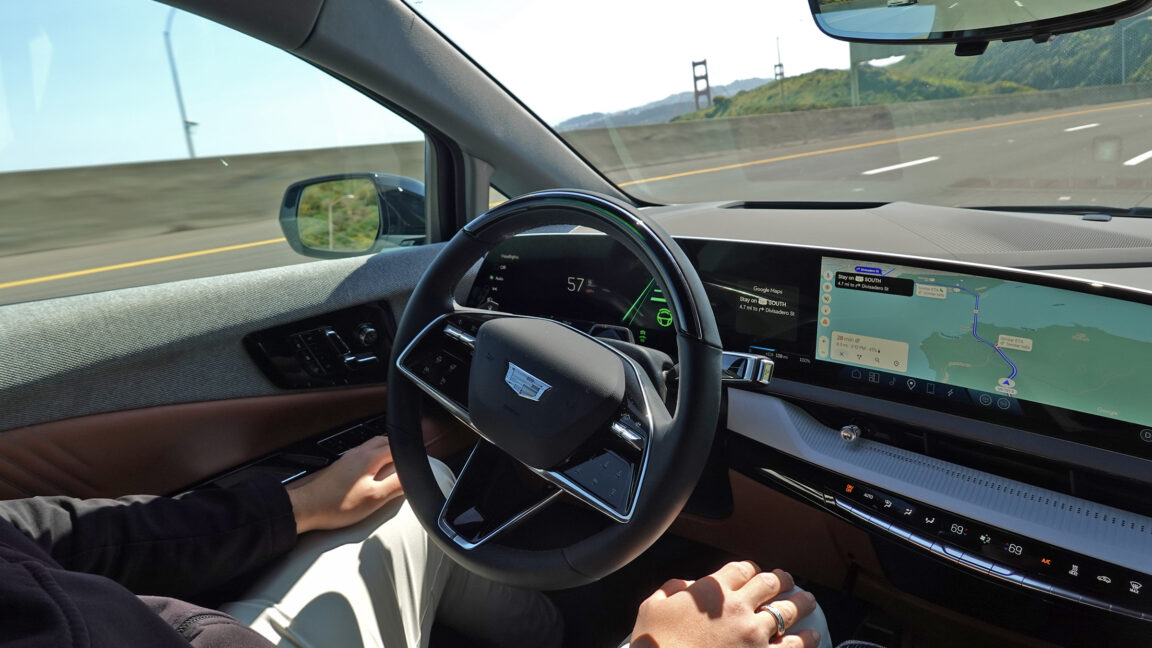
A milestone for assisted driving, not autonomous driving
General Motors says its Super Cruise system has now surpassed 1 billion driven miles across almost 750,000 vehicles in the United States and Canada. The number is large enough to mark more than a company milestone. It is also evidence that a carefully constrained model of hands-free driving assistance has found a durable customer base nearly a decade after its debut.
Super Cruise first appeared in the Cadillac CT6 in 2017. From the beginning, GM took a narrower approach than some rivals. Rather than allowing hands-free operation on any road, the automaker geofenced the system to restricted-access highways that had already been lidar-scanned and high-definition mapped. It also built in a driver-facing infrared camera to monitor the driver’s gaze and require attention to the road.
That architecture matters because the system is designed around a specific bargain: reduced workload for the driver, but not transfer of responsibility away from the driver. In that sense, the billion-mile figure says as much about product design discipline as it does about scale.
Why the number stands out
Driver-assistance systems often generate more heat than light because comparisons with full self-driving technology can blur basic differences in capability and risk. Super Cruise is explicitly limited. It is a hands-free, eyes-on system for mapped highways, not a general-purpose autonomous platform. Yet those limits may also be part of why it has matured into a widely used feature rather than a perpetual beta experiment.
GM says usage is growing quickly. According to the company statistics cited in the source text, the system doubled year over year and reached 7.1 million hours of active use in 2025. Over that same period, drivers used Super Cruise for 485.9 million miles across 28.7 million trips. More than half of Super Cruise-enabled drivers use it weekly or daily, GM says, and the average trip involved 17 miles and 24 minutes of active use.
Those figures suggest Super Cruise has moved beyond novelty. A system that drivers return to daily is behaving less like a showroom demonstration and more like an embedded part of routine mobility.

The mapped-road strategy has expanded dramatically
When the system was first tested in 2018, it worked on more than 160,000 miles of road. GM now says the mapped network has expanded to nearly 700,000 miles of highways. That increase is critical because usability for a geofenced driver-assistance product depends directly on coverage. A system that works beautifully but rarely activates is hard to turn into a habit. A system that drivers can access on more of their regular routes has a much better chance of becoming sticky.
GM’s Rashed Haq, vice president of autonomous vehicles, tied the system’s adoption to what he called the “toothbrush test,” arguing that once customers use it, they keep returning to it repeatedly. He also said renewal rates are close to 40% among GM owners with Super Cruise. The subscription is free for the first three years and then tied to an active OnStar subscription.
That renewal figure does not by itself settle the long-term economics of assisted-driving subscriptions, but it does indicate willingness among a meaningful share of users to keep paying once an introductory period ends. In a market where many software-defined vehicle features still struggle to prove their staying power, that is notable.
A different model from Tesla’s FSD
The source text explicitly contrasts GM’s approach with Tesla’s Full Self-Driving system. Tesla’s FSD can be used on all roads and, according to Tesla, surpassed 8.4 billion miles earlier this year with roughly half of those miles accumulated in 2025 alone. Tesla also reportedly has about 1.3 million active subscriptions.
The comparison is useful, but not because the products are directly interchangeable. They are built on different operating assumptions. GM restricts where the system can be used and layers in gaze monitoring to preserve continuous driver attention. Tesla’s broader deployment model aims for a wider operating domain. That means raw mileage alone is not a clean measure of quality or safety across the two approaches.
What GM’s milestone does show is that there is a substantial market for a more bounded system that offers convenience without claiming universal applicability. In other words, the path to real-world scale in assisted driving may not require solving every road type at once.

What this says about the state of the market
The billion-mile mark arrives during a period when the automotive industry is trying to separate advanced driver assistance from the overpromises that often surrounded self-driving hype in the late 2010s. Super Cruise is interesting because it represents a commercially viable middle ground. It delivers something tangible, it is operationally restricted, and customers appear to understand what it is for.
That may be one of the most important lessons in the milestone. Automotive automation does not have to arrive as a sudden leap from manual driving to robotaxis. It can also spread through narrowly defined systems that solve a recurring use case well enough to earn daily behavior.
The geofenced-highway model also has a strategic advantage inside regulation and public acceptance debates. A limited system can be tested, monitored, and improved within a known envelope. That does not eliminate risk, but it reduces the mismatch between marketing language and operating reality that has often plagued the category.
The broader significance
GM has been working on a more advanced version of Super Cruise, according to the source text, and the company’s next moves will determine whether the billion-mile achievement remains a headline or becomes a foundation. For now, the milestone signals that highway-focused, attention-monitored hands-free assistance has crossed into mass-market use at a scale that was not obvious when the system launched in a single Cadillac sedan in 2017.
The strongest takeaway is not that hands-free driving has been solved. It has not. The stronger takeaway is that constrained automation, if designed around clear operational boundaries and reinforced with driver monitoring, can accumulate both scale and user loyalty. In a field often dominated by all-or-nothing narratives, that is a meaningful development.
This article is based on reporting by Ars Technica. Read the original article.

Originally published on arstechnica.com