A neighborhood-scale answer to hyperscale demand
The AI buildout has largely been defined by giant projects: massive campuses, heavy utility demands, long permitting cycles, and public backlash over noise, land use, and electricity consumption. A new proposal from startup SPAN points in a very different direction. Instead of concentrating compute in warehouse-sized facilities, the company wants to distribute data center hardware across housing developments, installing compact AI nodes alongside homes.
According to Ars Technica, SPAN has already begun pilot testing and is preparing for a 100-home trial run this year. The proposition is unusual but direct. Homeowners would host a nearby node and, in return, receive subsidized electricity and internet access along with backup batteries.
If it works, the approach would not replace the hyperscale model used to train the largest AI systems. SPAN’s vision is aimed more at inference and related workloads such as cloud gaming and content streaming. But it represents a serious attempt to solve a pressing problem in the AI economy: demand for compute is rising faster than traditional infrastructure can be built.
What SPAN is actually proposing
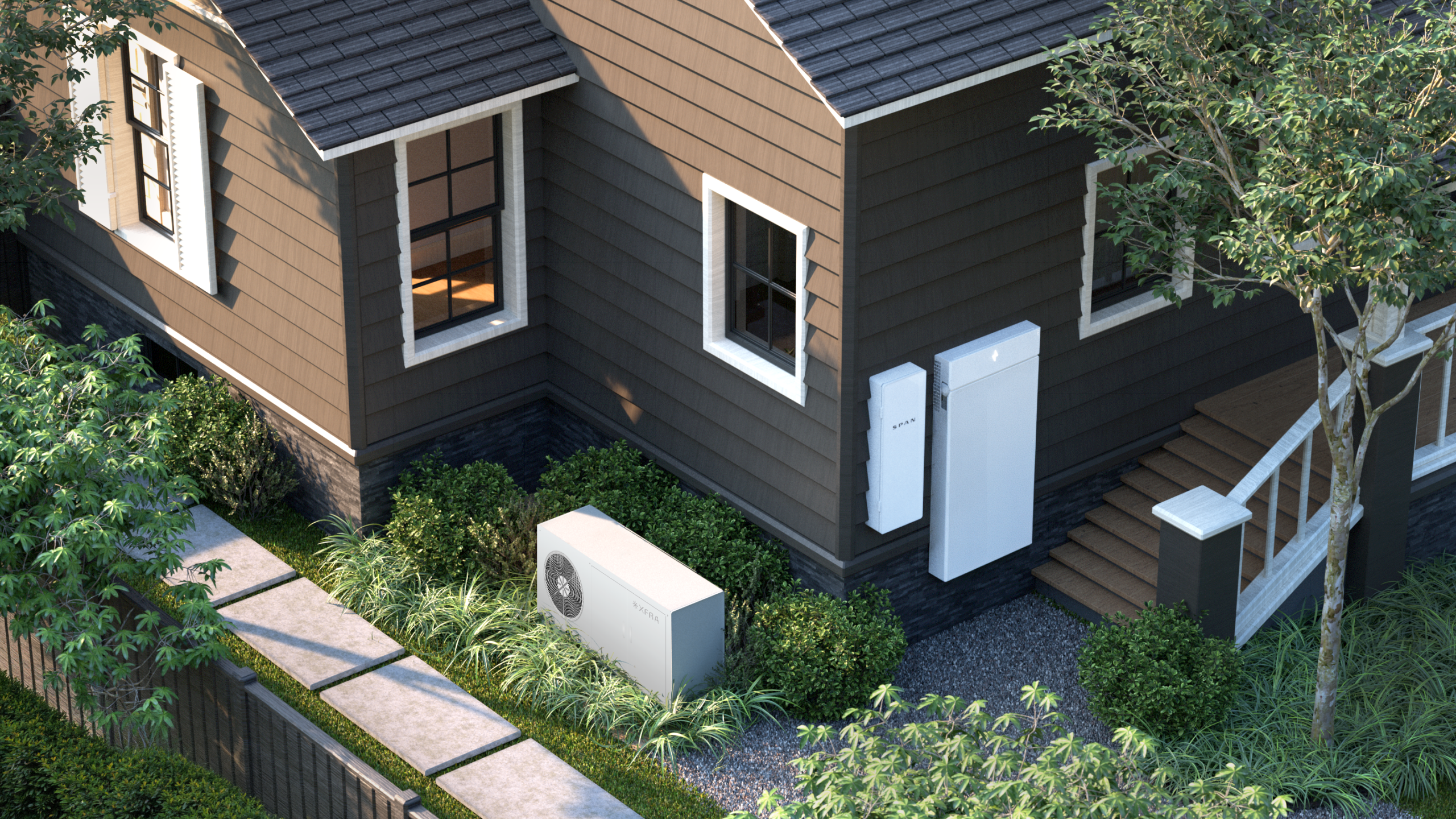
The company’s system centers on what it calls XFRA nodes, described as liquid-cooled units containing Nvidia RTX Pro 6000 Blackwell Server Edition GPUs and operating with minimal noise. Rather than clustering those systems inside a single industrial facility, SPAN wants to spread them across thousands of residential-adjacent installations.
The idea is to tap excess household power capacity and use it to scale compute more quickly and at lower cost than a conventional data center build. SPAN told CNBC it could deploy 8,000 XFRA units at five times lower cost than building a typical 100-megawatt data center with equivalent compute capacity.
The company says that starting in 2027 it plans to scale to 80,000 XFRA nodes across the United States and provide more than 1 gigawatt of distributed compute. That is an ambitious figure, but it reveals the size of the opportunity SPAN sees: not a niche energy gadget for smart homes, but a new layer of digital infrastructure embedded in the built environment.
Why this idea may appeal to communities
Traditional data centers have become increasingly controversial in many communities. Residents and local officials often object to noise, visual impact, water use, and the strain placed on local grids. SPAN is explicitly positioning its model as an alternative that could avoid some of those pain points.
Company executive Chris Lander told Ars that the residential system is intended to be quiet and discreet while making energy more affordable for hosts and the surrounding community. The argument is not merely technical. It is political. If communities resist large centralized facilities, a distributed model may face less immediate opposition, particularly if it comes bundled with household benefits.
The offer of backup batteries is especially notable. In markets where resilience and home energy management already matter, a data-center-adjacent installation could be marketed not only as a tech infrastructure project but as an upgrade to residential energy security.
The limits of the model
SPAN is not claiming these distributed nodes can replace the huge centralized facilities being built by companies such as Google and Microsoft. The workloads are different. Training frontier AI models remains a hyperscale business because it requires tightly coordinated, extremely dense compute environments. SPAN’s network is framed instead as suitable for inference and other applications where geographic distribution and incremental deployment may be more useful.
That makes the concept more plausible. It is easier to imagine a scattered network serving lower-latency or less synchronization-heavy tasks than replacing the core of the modern AI cloud. Even so, major questions remain.
Residential hosting creates new operational and regulatory complexities. Utilities, local permitting, maintenance, safety, insurance, network reliability, and community acceptance all become distributed problems rather than centralized ones. The homeowner experience may be attractive on paper, but it depends on the equipment being quiet, unobtrusive, and consistently worth the trade.
The initial push will focus on newly constructed homes, with SPAN paying for and operating the necessary equipment. The company has also floated retrofits for existing homes and larger configurations for commercial customers, according to the source report. That suggests the residential buildout may be only the first phase of a broader distributed-compute strategy.
Why this matters for the next phase of AI infrastructure
The bigger story is that AI demand is now forcing experimentation far outside the usual data center playbook. When compute becomes both strategically valuable and physically constrained, companies start searching for underused capacity in unexpected places. SPAN’s proposal is one of the clearest examples yet.
It also reflects a wider convergence between energy systems and computing systems. The node is not just a server box. It sits beside a smart panel and a backup battery. That makes the household part of a larger infrastructure network in which electricity, resilience, and digital services are linked more tightly than before.
Whether this model scales will depend on economics, reliability, and public tolerance. But the concept is significant even before those answers arrive. It shows how the AI boom is beginning to reshape not just software and semiconductor roadmaps, but the physical layout of neighborhoods and homes. The future compute buildout may not be confined to faraway campuses. Some of it may end up at the edge of the driveway.
This article is based on reporting by Ars Technica. Read the original article.
Originally published on arstechnica.com