Engineering Quantum Properties by Design
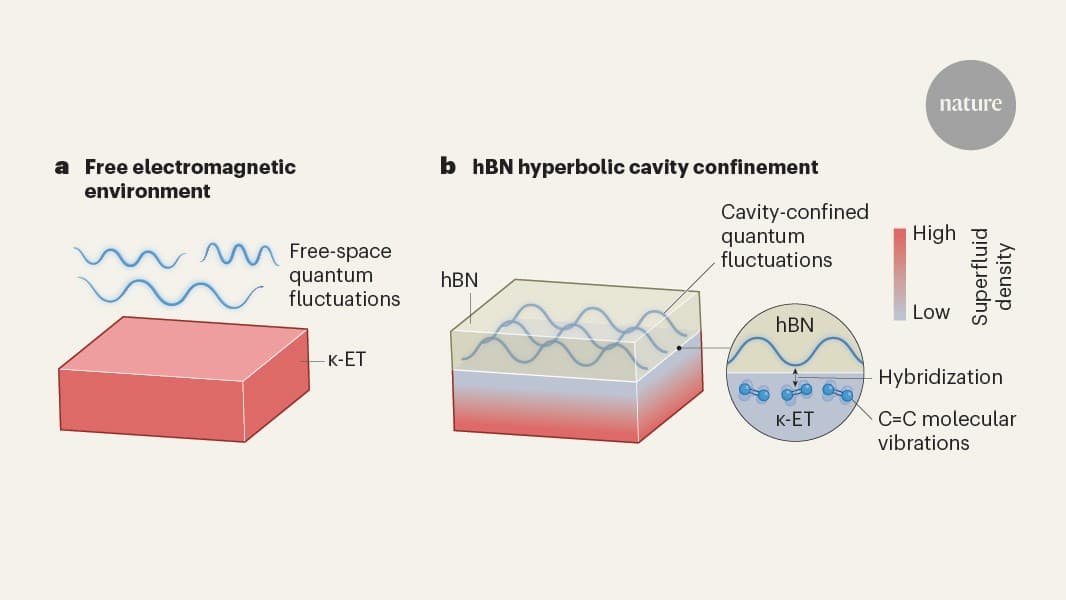
For the first time, physicists have demonstrated that a material's superconductivity can be altered simply by coupling it to a built-in light-confining cavity — without applying any external light, pressure, or magnetic field. The achievement, published in Nature, represents a fundamentally new approach to materials engineering where quantum properties are controlled not by changing the material itself but by modifying the electromagnetic environment in which it exists.
The research, led by Itai Keren at Columbia University, shows that carefully bonding a superconductor to a structure that confines electromagnetic fluctuations can measurably change when and how the material transitions to its superconducting state. The result opens a new chapter in condensed matter physics — one where the vacuum itself becomes a design parameter for engineering material properties.
What Is a Light-Confining Cavity
A cavity in physics refers to any structure that confines electromagnetic radiation within a bounded region. The most familiar example is a laser cavity — two mirrors facing each other that trap light bouncing between them. At the quantum level, even an empty cavity contains electromagnetic fluctuations known as vacuum fluctuations, a consequence of the quantum uncertainty principle.
These vacuum fluctuations are not merely theoretical abstractions. They produce measurable physical effects including the Casimir force between closely spaced plates and the Lamb shift in atomic energy levels. Physicists have long theorized that vacuum fluctuations inside a carefully designed cavity might also influence the properties of materials placed within it — effectively using the cavity's electromagnetic environment to modify the material's quantum behavior.
Previous experiments have demonstrated that external light pumped into cavities can temporarily modify material properties, but these effects disappear when the light source is turned off. The Columbia team's breakthrough was achieving a lasting modification using only the cavity's intrinsic vacuum fluctuations — requiring no external energy input whatsoever.
The Experimental Approach
The researchers constructed their system by sandwiching a thin superconducting film between carefully chosen materials that function as mirrors at the relevant electromagnetic frequencies. The resulting structure forms a planar microcavity — a flat, solid-state device that confines electromagnetic fluctuations within the superconducting layer.
The critical design challenge was engineering the cavity so that its confined electromagnetic modes — the specific patterns and frequencies of vacuum fluctuation it supports — overlap with the energy scales relevant to superconductivity in the target material. This required precise control over the cavity's thickness, the reflectivity of the confining layers, and the coupling between the cavity modes and the electrons in the superconductor.
By fabricating multiple devices with systematically varied cavity geometries, the team could map how changes in the electromagnetic environment affected the superconducting transition. Each device was cooled to cryogenic temperatures and its electrical resistance measured as a function of temperature to determine the critical temperature — the temperature below which the material becomes superconducting.
Results and Significance
The measurements revealed clear shifts in the superconducting critical temperature that correlated with the cavity geometry. Devices where the cavity modes were tuned to resonate with the relevant energy scale in the superconductor showed measurable changes in transition temperature compared to control samples without cavity confinement. The effect persisted without any external light or energy input, confirming that vacuum fluctuations alone were responsible.
The magnitude of the critical temperature shift was modest — a fraction of a kelvin — but its scientific significance is substantial. It demonstrates a proof of principle that has been debated theoretically for over a decade: that engineering the electromagnetic vacuum around a material can alter its macroscopic quantum properties. This represents a qualitatively new tool in the materials scientist's toolkit, distinct from traditional approaches that modify materials through chemical doping, mechanical strain, or applied fields.
The theoretical framework underlying the experiment draws on cavity quantum electrodynamics, a field that studies how quantum systems behave inside electromagnetic cavities. While cavity QED effects on individual atoms and molecules are well-established, demonstrating similar effects on the collective quantum behavior of electrons in a solid represents a significant extension of the framework to condensed matter physics.
Implications for Materials Design
The most exciting implication of the work is the possibility of designing material properties by engineering their electromagnetic environment rather than their chemical composition. Traditional materials science achieves desired properties by changing what a material is made of — substituting atoms, introducing defects, or adjusting stoichiometry. Cavity-based engineering offers a complementary approach: keeping the material the same while changing the space around it.
This could be particularly powerful for properties that are difficult to tune through conventional means. Superconductivity, magnetism, and other collective quantum phenomena emerge from the complex interactions of enormous numbers of electrons. Small changes in these interactions — including those induced by modified vacuum fluctuations — can tip the balance between competing quantum states, potentially stabilizing desired properties that are otherwise difficult to achieve.
Researchers in the field are already speculating about combining cavity engineering with traditional materials design to access regions of the quantum phase diagram that neither approach can reach alone. A material that is near but not quite at a superconducting or magnetic transition might be pushed over the threshold by appropriate cavity confinement, enabling properties that the bare material cannot achieve.
Challenges and Future Directions
Scaling the effect to produce larger critical temperature shifts is the most immediate challenge. The current experiments demonstrate the principle but produce changes too small for practical applications. Theoretical models suggest that stronger effects may be achievable with different cavity geometries, higher-quality factor cavities, or materials where the relevant electronic energy scales better match achievable cavity modes.
The researchers also plan to investigate whether cavity confinement can influence other quantum phases beyond superconductivity. Magnetic order, charge density waves, and topological electronic states are all candidates for cavity-modified behavior. Each represents a different manifestation of collective electron physics that might respond to engineered vacuum fluctuations in distinct and potentially useful ways.
The work establishes Columbia University's group at the frontier of an emerging field that sits at the intersection of quantum optics, condensed matter physics, and materials science. As cavity fabrication techniques improve and theoretical understanding deepens, the ability to engineer material properties through their electromagnetic environment may become as fundamental to materials design as chemical composition and crystal structure are today.
This article is based on reporting by Phys.org. Read the original article.