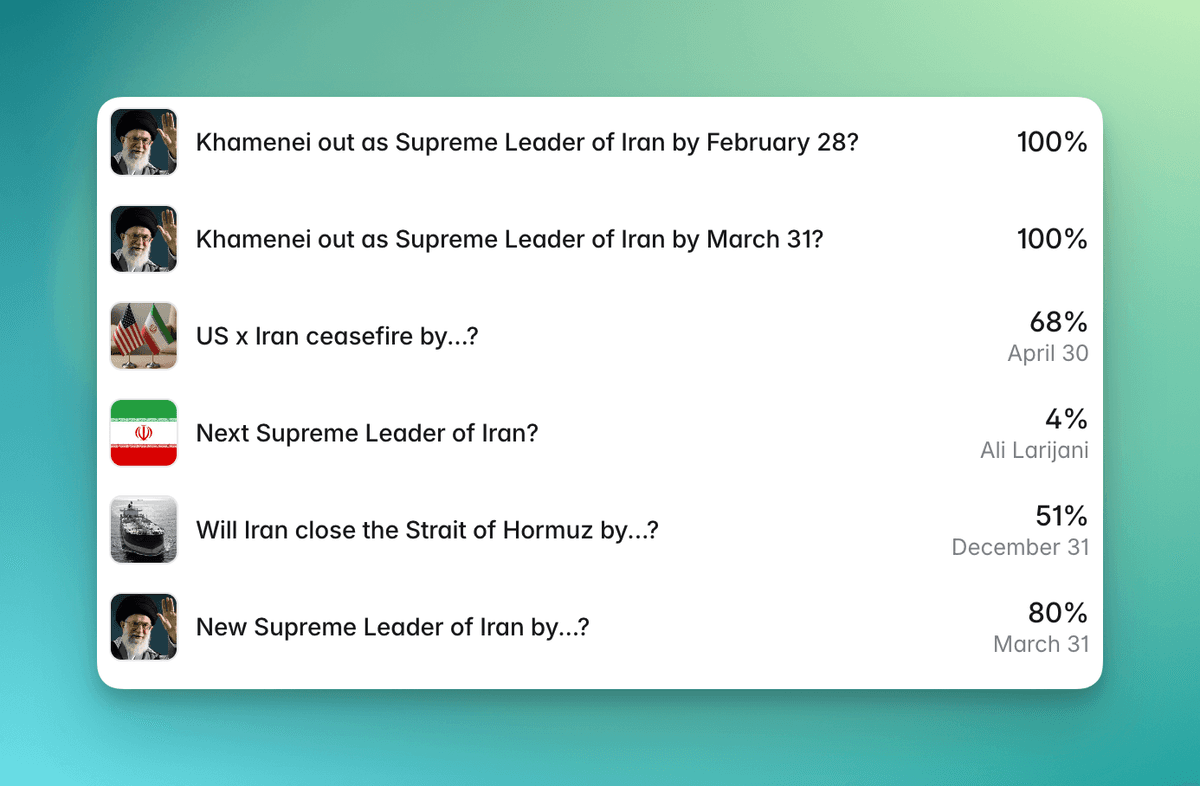
Gambling on Geopolitics
As military operations escalated between the United States, Israel, and Iran, prediction markets Kalshi and Polymarket saw millions of dollars wagered on the conflict's outcomes. The front page of Polymarket featured a bet asking whether the Iranian regime would fall by June 30, priced at 41 percent probability. On Kalshi, more than 54 million dollars was spent on a market asking whether Iran's Supreme Leader Ali Khamenei would be removed from power.
The spectacle of ordinary people placing financial bets on war outcomes, regime change, and by extension the lives and deaths of millions has ignited a fierce debate about the ethical boundaries of prediction markets — and whether the gambling industry's rapid expansion into every domain of human activity has reached a point of no return.
The Mechanics of War Betting
Prediction markets function by allowing users to buy and sell shares in the outcome of future events. If you believe Iran's government will fall, you buy "yes" shares; if it does, you receive a dollar per share. If it does not, your shares expire worthless. The market price reflects the crowd's aggregated probability estimate for the event.
Proponents argue these markets produce valuable information — that the wisdom of crowds, backed by real financial stakes, generates more accurate forecasts than polls, pundits, or intelligence agencies. This argument has gained traction in academic circles, and prediction markets have been used to forecast elections, economic indicators, and technology milestones.
However, applying the same mechanism to armed conflicts raises fundamentally different ethical questions. When the "event" being predicted involves missile strikes, civilian casualties, and the potential collapse of a nation-state, the clinical language of probability and market mechanics takes on a grotesque quality that even some market proponents find uncomfortable.
The Death Profit Problem
Kalshi's CEO Tarek Mansour attempted to address the most obvious criticism — that his platform allows people to profit from death — through a series of posts explaining the company's rules. According to Mansour, Kalshi does not list markets "directly tied to death." When market outcomes might involve someone's death, the company designs rules to prevent direct profit from that event.
The specific mechanism works as follows: if a leader whose tenure is the subject of a bet dies, the market resolves at the last traded price before the death, rather than paying out to those who bet the leader would leave power. In theory, this means no one profits specifically from the death itself — only from having correctly predicted instability before the death occurred.
Critics argue this distinction is meaningless sophistry. A bet on regime change during an active bombing campaign is inherently a bet on violence and its consequences. The fact that the payout calculation excludes the precise moment of death does not change the fundamental nature of the wager. People are still financially incentivized to root for — or at worst, contribute to — destabilization and conflict.
From Sports Betting to Everything Betting
The emergence of prediction markets on geopolitical events did not happen in a vacuum. It represents the logical endpoint of a decade-long expansion of legalized gambling in the United States. Companies like DraftKings and FanDuel spent enormous sums lobbying state legislatures to legalize sports betting apps, fundamentally altering the relationship between entertainment and gambling.
Once sports betting was normalized and integrated into major league broadcasts and media coverage, the infrastructure and cultural acceptance existed for betting on virtually anything. Polymarket and Kalshi took the DraftKings model and extended it to politics, economics, and world events. Users can now bet on which countries Iran will launch missiles against on the same app they use to bet on basketball games or Academy Award winners.
The business model is extraordinarily effective at extracting money from users. Prediction markets combine the addictive dopamine mechanics of gambling with the intellectual appeal of being "right" about world events. For many users, the ability to put money on their geopolitical analysis feels more sophisticated than sports betting, even though the psychological and financial dynamics are identical.
Regulatory Gaps
The rapid growth of prediction markets has outpaced regulatory frameworks. The Commodity Futures Trading Commission, which has nominal oversight of prediction markets, has taken an inconsistent approach — allowing some markets while challenging others. The agency has not established clear rules about which events are appropriate subjects for financial speculation.
This regulatory vacuum means companies like Kalshi and Polymarket largely self-regulate, setting their own policies about which markets to list and how to handle ethically sensitive outcomes. Given that these companies' revenue depends on trading volume, the financial incentive is to list the most attention-grabbing, controversial markets possible — precisely the markets that raise the most ethical concerns.
International regulators have been more aggressive. Several European jurisdictions have moved to restrict prediction markets on political and military events, arguing that they can distort democratic processes and create perverse incentives. However, cryptocurrency-based platforms like Polymarket operate in a regulatory gray zone that makes enforcement difficult.
The Normalization Problem
Perhaps the most troubling aspect of war prediction markets is what they reveal about normalization. The fact that millions of dollars can be wagered on a military conflict while that conflict is producing real casualties suggests that a significant segment of the population has become so detached from the consequences of war that it registers primarily as a spectacle to be gambled upon.
This detachment is amplified by the same digital platforms that host the prediction markets. Social media turns war footage — real and AI-generated — into engagement content. Prediction markets turn military outcomes into financial instruments. Together, they create an ecosystem where armed conflict is consumed and monetized at every level, with little friction between the reality of violence and its commodification.
This article is based on reporting by 404 Media. Read the original article.