Listening for the threat
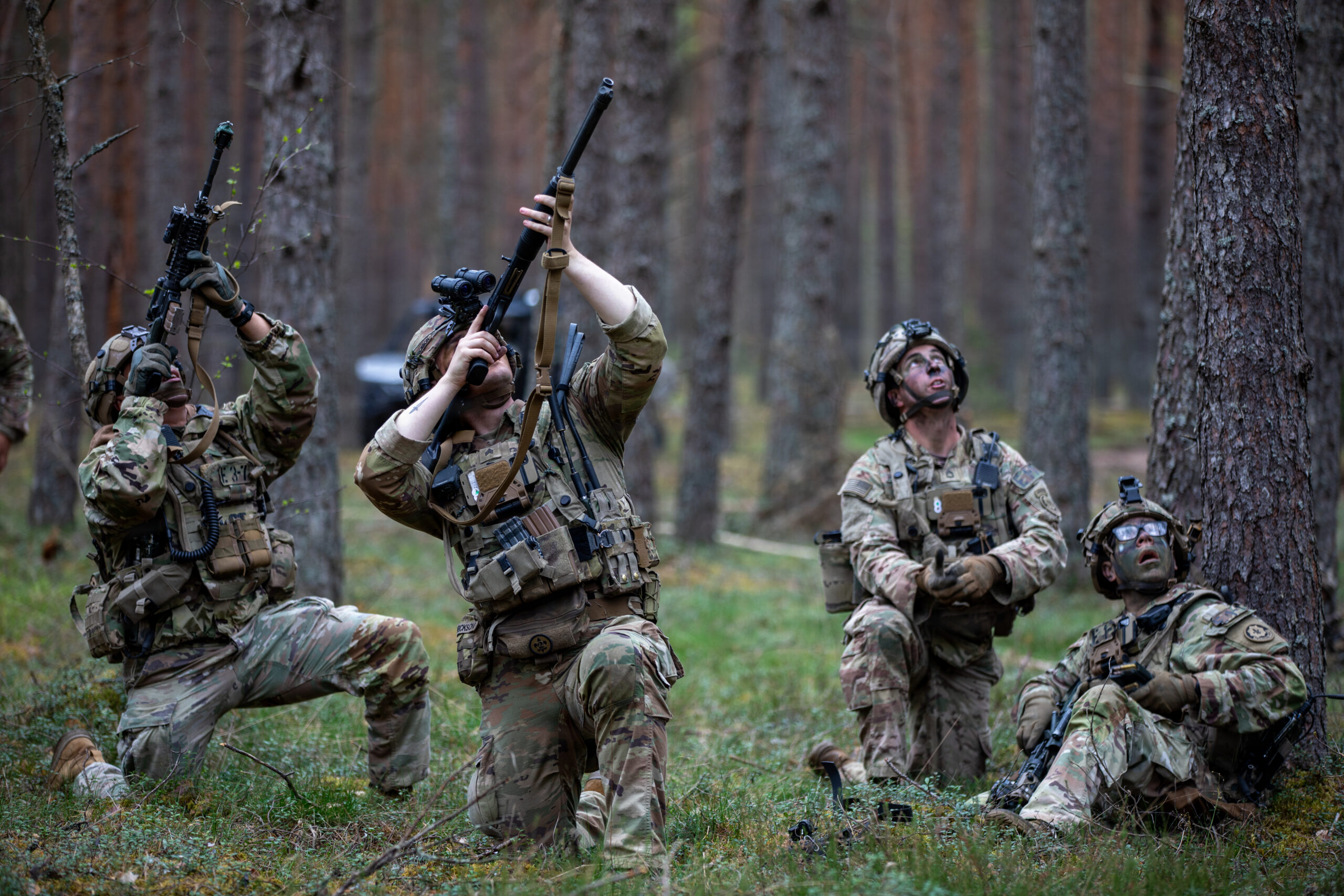
US soldiers are being trained to recognize drones by sound during field exercises, a sign of how quickly battlefield air threats are reshaping basic infantry habits. At the recent US-led Project FlyTrap 5.0 exercise in Lithuania, troops practiced spotting, tracking, and defeating low-cost unmanned aerial systems while also learning to distinguish the noises different drones make overhead.
The exercise ran during the first two weeks of May and reflected lessons drawn from Ukraine, where drone saturation has changed what soldiers need to notice, and how fast they need to react. In this environment, scanning the horizon is no longer enough. Troops are being taught to watch the sky and to interpret what they hear before a visual identification is even possible.
Field knowledge ahead of formal doctrine
Sgt. 1st Class Tyler Harrington, a platoon sergeant with the 2nd Cavalry Regiment who led counter-drone tactics during the exercise, described the shift in practical terms during a May 14 media roundtable. Soldiers, he said, now have to scan upward as well as outward, and they must learn whether a sound suggests a reconnaissance drone or a one-way attack system headed in their direction.
Harrington said the Army has not yet formally folded audio drone training into its standard curriculum. Even so, Project FlyTrap appears to be functioning as an early proving ground for the concept. That matters because sound can offer warning when visibility is limited, when drones are masked by terrain, or when small aircraft are difficult to see until they are already close.
According to Harrington, some one-way attack drones produce a higher, faster buzz, while reconnaissance systems can sound flatter and appear higher in the sky. That is not a complete detection method, but it is a practical cue that can help troops make faster decisions under pressure.
Ukraine’s influence on NATO training
The approach mirrors battlefield experience from Ukraine. Breaking Defense cited earlier reporting that Ukrainian forces were able to identify Russian Shahed drones and decoys by sound. It also cited findings from the CBA Initiatives Center, a Ukraine-based think tank, which argued that recruits now need muscle memory for the sound of approaching drones and must react immediately when alerted.
That is a notable change in how modern combat skills are defined. For years, counter-drone conversations focused on radars, electronic warfare, and kinetic interceptors. What FlyTrap highlights is the return of a simpler but essential layer: the individual soldier’s senses. In a crowded electromagnetic environment, the first alert may come from a human ear rather than a sensor network.
Why this matters now
The emphasis on low-cost drones is especially significant. Cheap unmanned aircraft are forcing militaries to prepare for more frequent aerial contact at lower levels and at shorter ranges. That raises the value of any method that improves speed of recognition, even if it is informal or approximate.
Project FlyTrap 5.0 also suggests that counter-drone readiness is broadening from specialized teams to regular units. If soldiers on patrol are expected to detect and classify threats in real time, then recognition skills by sight and sound become part of everyday survivability rather than niche expertise.
The result is a small but telling shift in military training. As drone warfare spreads, troops are being taught that the sky now has a signature. Learning to hear it correctly may become as important as learning to see it.
This article is based on reporting by Breaking Defense. Read the original article.

Originally published on breakingdefense.com