A procurement decision with doctrinal implications
Turkey’s decision to buy 100 expendable unmanned surface vessels for its navy is more than a straightforward procurement move. It is a signal that swarm concepts in naval warfare are advancing from experimental systems and exhibition-floor prototypes toward organized acquisition and operational planning. The purchase, overseen by Turkey’s Secretariat of Defense Industries, points to a military institution trying to integrate low-profile, precision-strike surface drones into a broader maritime doctrine.
According to the source report, the procurement decision was taken in February by the Defense Industry Executive Committee, Turkey’s top defense procurement and industrial-policy body. The systems will be produced by three separate teams: Aselsan with Ares Shipyard, STM with Yonca Shipyard, and Havelsan with Sefine Shipyard. That division alone is telling. Rather than betting on a single design, Turkey appears to be building an industrial and operational base for a category of expendable naval weapons.
The quantities cited in the report are 40 units for Aselsan, 32 for STM, and 32 for Havelsan, though the article notes that the total may need adjustment to align with a four-drone swarm doctrine. That detail matters because it shows the acquisition is being shaped not just by inventory numbers, but by the tactical unit size envisioned for deployment.
What these systems are built to do
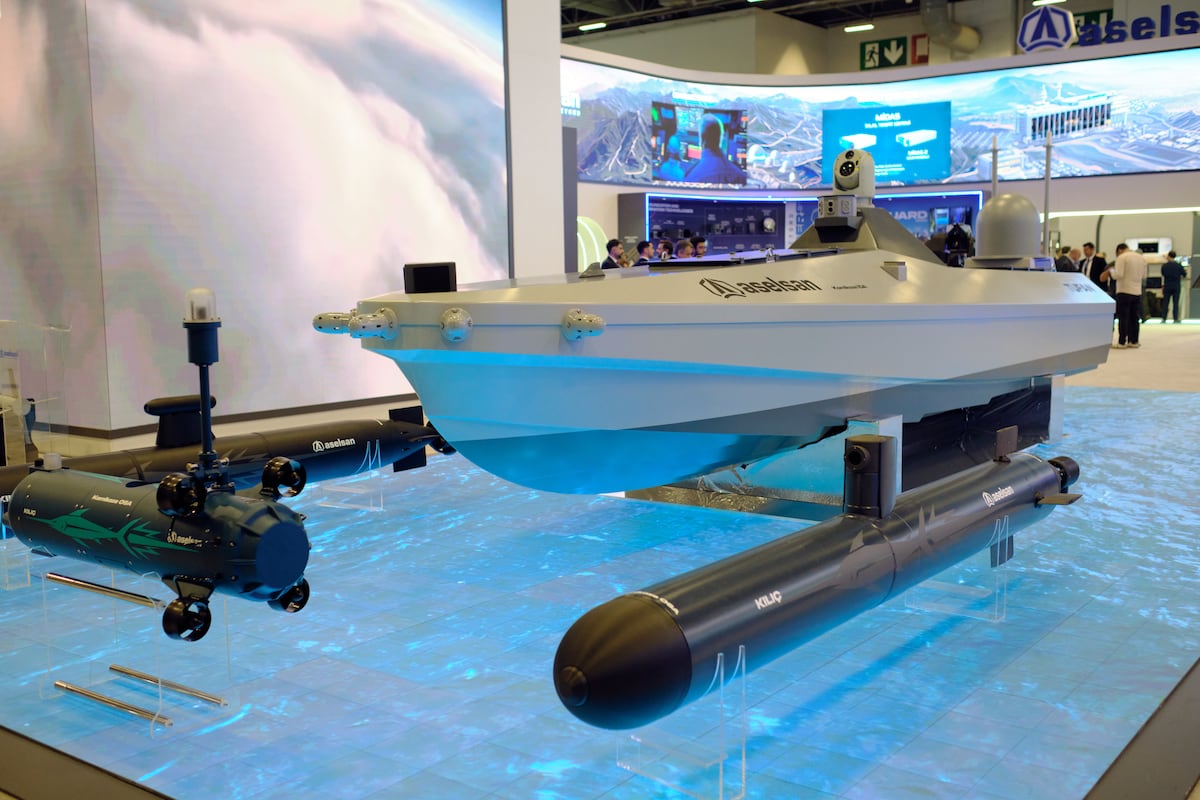
The vehicles described in the report are not general-purpose patrol craft. They are expendable precision-strike platforms designed for attacks against maritime and coastal targets. Aselsan and Ares Shipyard’s Tufan is said to be 8 meters long and 1.8 meters wide, carrying a high-explosive payload equivalent to one Mk 82 bomb. STM and Yonca Shipyard’s Yaktu is smaller, at 5.8 meters in length with a displacement of 1.7 tons, and is framed as serving asymmetric maritime requirements from port protection to open-sea strike missions.
Both systems are designed with compact, low-profile hulls to reduce radar and visual detectability. They support line-of-sight and satellite communications, allowing them to operate inside a networked command structure rather than as isolated one-off drones. Most important, they are described as supporting swarm architecture, meaning multiple units can operate cooperatively, share data in real time, and allocate tasks autonomously during missions.
That combination of expendability, low observability, connectivity, and cooperative behavior explains why these platforms are strategically interesting. A single small surface drone may be limited. A coordinated wave of them is a different problem for defenders.
Why swarms are attractive to navies
Swarm concepts appeal because they can complicate the economics and geometry of defense. A navy defending a ship or coastal target may be forced to spend expensive munitions and sensor attention against multiple incoming surface threats that are small, fast, and comparatively cheap. Even if many are intercepted, the defender absorbs pressure simply by having to detect, classify, and engage a large number of targets under time constraints.
For the attacker, expendability changes the equation. Systems do not have to survive to be useful. They only need to reach a target area, cooperate effectively enough to saturate defenses, and deliver an explosive payload. That makes them particularly relevant for coastal environments, chokepoints, and contested littorals where larger manned vessels face growing risk.
The Turkish procurement suggests that this logic is now strong enough to support fleet-level purchasing. That matters because doctrines often become real only when budgets and production lines appear behind them. Buying 100 units indicates more than curiosity. It suggests anticipated operational use.
Industrial strategy and tactical experimentation
There is also an industrial dimension to the program. By spreading production across three provider teams, Turkey is creating room for variation, competition, and learning. Different hull sizes, payload approaches, and mission concepts can be explored without committing the entire program to one architecture. That could accelerate iteration as the navy tests what actually works in exercises and operational planning.
It also strengthens domestic defense manufacturing ties between electronics firms and shipyards. In unmanned naval systems, success depends on more than the boat itself. Sensors, communications links, autonomy functions, and doctrine all have to align. A multi-team program can help build that ecosystem.
The announced systems were unveiled at SAHA Expo 2026, a reminder that defense exhibitions are increasingly serving as transition points from concept display to practical procurement. In this case, the reported purchase suggests the Turkish military is not waiting for a distant future to operationalize the idea.
A wider shift in naval warfare
Turkey is not the only military studying unmanned maritime systems, but this procurement stands out because of its scale and its explicit link to swarm attacks. It reflects a broader shift in which surface warfare is becoming more distributed, more software-dependent, and potentially more attritable. Small platforms that can share data and allocate tasks autonomously fit neatly into that trajectory.
The larger implication is that naval planners may need to think less in terms of ship-versus-ship encounters and more in terms of layered engagements involving networks of crewed and uncrewed systems. Expendable surface drones will not replace major warships, but they can change how sea denial, coastal strike, and fleet defense are approached.
Turkey’s order is therefore best read as both acquisition and message. It says that swarm warfare at sea is maturing from theory into procurement reality. Once that happens, the next questions are not whether such systems matter, but how quickly other navies adapt to defend against them or field comparable capabilities of their own.
This article is based on reporting by Defense News. Read the original article.
Originally published on defensenews.com