New imagery, sharper questions
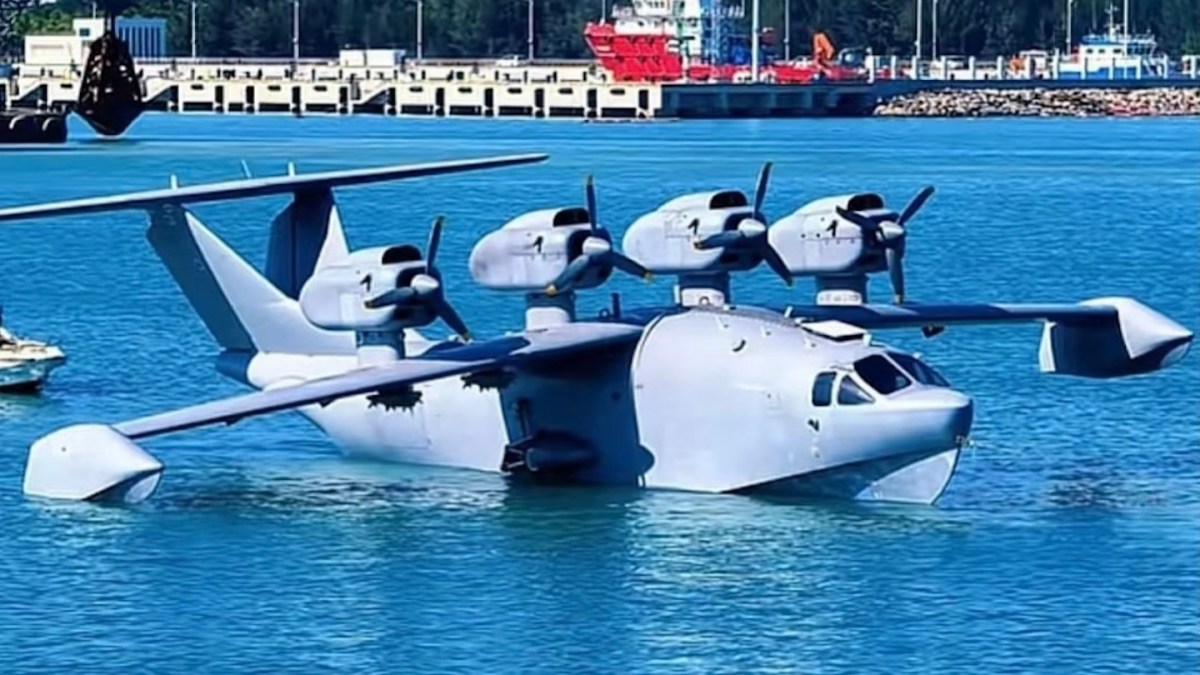
China’s unusual wing-in-ground effect craft known informally as the “Bohai Sea Monster” has reappeared in new images, and the details are more revealing than before. According to The War Zone, the latest views show what appear to be underwing hardpoints fitted with shackles, suggesting the aircraft may be designed to carry and release external stores.
That does not by itself confirm a specific weapon or mission set. But it does materially strengthen the case that the craft is not just a transport or experimental platform. If the hardpoints are operational, the vehicle could support a range of payloads, from sensors and fuel tanks to air-launched drones or offensive munitions.
An unusual platform
The aircraft was first identified in June 2025 and quickly drew attention because of its wing-in-ground effect configuration, flying-boat hull, and joined V-tail. Wing-in-ground craft operate close to the surface, using the aerodynamic cushion formed between the wing and the water or ground to improve efficiency. That concept has long appealed to militaries because it can combine speed, payload potential, and a relatively low operating altitude.
The new images also appear to settle a propulsion question that had remained open. Earlier assessments had left room for speculation that the aircraft might use turbofans or even a hybrid-electric arrangement. The latest pictures instead indicate four turboprop engines, each driving a three-bladed propeller.
Why hardpoints matter
The biggest change in the discussion comes from what is visible under the wings. The War Zone notes two apparent hardpoints beneath each wing, with hardware that looks suited to releasing stores rather than simply carrying fixed equipment. That distinction matters. External fuel tanks and sensor pods remain possible, but shackles imply a design that expects payload separation in flight.
Even then, the mission picture is still open. Search-and-rescue payloads are theoretically possible. So are drones. But the report argues that the military paint scheme and broader PLA doctrine make an armed role plausible. At a minimum, the reappearance of the craft suggests the program has advanced beyond a one-off sighting and is continuing to mature.
Why China might want it
A wing-in-ground craft sits in an awkward but potentially useful space between boat and aircraft. It could be valuable for maritime patrol, logistics across coastal zones, rapid deployment around islands, or operations where low altitude and sea-skimming transit are advantageous. If armed, it could also become a flexible platform for releasing drones or conducting strike-related missions over littoral areas.
The fact that the aircraft was seen on the Bohai Sea remains relevant. That region is close to important Chinese naval and industrial zones, making it a logical place for experimentation with new maritime aviation concepts. The larger strategic question is whether this specific design remains a niche demonstrator or becomes a template for a broader family of vehicles.
What the new sighting really changes
The latest imagery does not answer every question around performance, range, endurance, sensors, or doctrine. But it does move the conversation from novelty toward function. The original fascination around the Bohai Sea Monster centered on its shape. The current interest is about what China wants that shape to do.
If the hardpoints are what they appear to be, this is no longer just an odd coastal aircraft. It is an experimental platform with clearer signs of a kinetic or at least payload-releasing role, and that makes it worth watching closely as China continues to test unconventional military systems.
This article is based on reporting by twz.com. Read the original article.
Originally published on twz.com