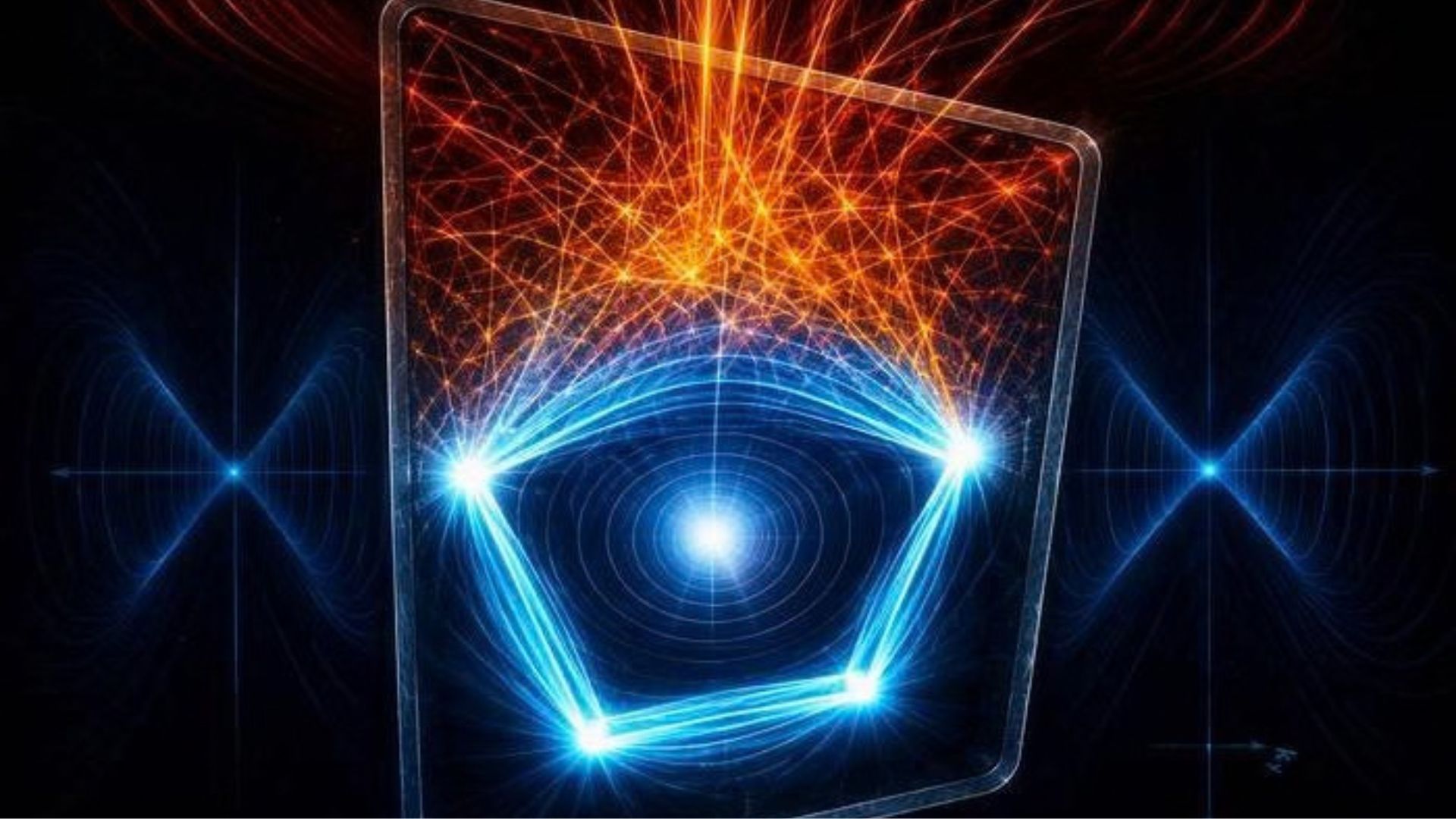
Light and sound rarely cooperate with the people trying to use them. Push a beam of light through fog, or send an acoustic pulse into a tangle of microscopic structures, and the signal quickly breaks apart into a chaotic spray of scattered energy. That scattering is a quiet obstacle to precision measurement, imaging and communication — and it is exactly the problem a newly described approach claims to address.
According to reports on the discovery, scientists have found a way to guide both light and sound waves through complex spaces without letting them dissolve into disorder. The work centers on hyperbolic materials, a specialized class of engineered media whose unusual properties allow waves to behave in ways ordinary materials cannot. The potential payoff, researchers suggest, reaches as far as highly sensitive biosensors capable of detecting vanishingly small traces of biological material.
Why Scattering Undermines Precision
When a wave enters a disordered medium, it does not simply continue on its path. It ricochets off every irregularity it encounters, splitting into countless secondary waves that travel in different directions and interfere with one another. The original signal becomes a blurred, noisy version of itself, carrying far less useful information than it did at the start.
This is more than a nuisance. In imaging, scattering limits how deep a system can see and how sharp the resulting picture can be. In communications, it degrades signal integrity. In sensing, it drowns out the faint signals that matter most — the ones produced by tiny concentrations of a target molecule, a subtle change in a surface, or a minute shift in a biological sample.
Conventional strategies tend to fight scattering rather than eliminate it. Researchers boost power, average many measurements together, or apply computational corrections after the fact. Each approach has costs, and none of them fundamentally prevents the wave from breaking apart in the first place.
- Scattering spreads a wave's energy across many directions, reducing signal strength.
- Interference between scattered components creates noise that masks weak signals.
- Compensation techniques add complexity, cost or measurement time.
- In biological sensing, background noise can hide the very signal a detector is built to find.

What Makes Hyperbolic Materials Different
Hyperbolic materials get their name from the shape of the mathematical surfaces that describe how waves propagate inside them. In an ordinary medium, waves spread outward in a roughly spherical or elliptical pattern. In a hyperbolic medium, the allowed directions of propagation open up into a much broader, unbounded set, which changes the rules for how energy moves.
A question of direction
Because those rules differ so sharply from those of everyday materials, hyperbolic media can support wave behavior that would otherwise be forbidden — including the ability to carry energy along preferred channels rather than letting it radiate away in every direction. That directional control is central to the new results, which describe waves being guided through complicated environments instead of scattering chaotically within them.
Notably, the reported work extends this behavior to sound as well as light. Light and sound are physically distinct phenomena — one electromagnetic, one mechanical — but both obey wave equations, and both suffer from scattering in complex media. A framework that constrains both suggests the underlying mechanism is about the geometry and structure of the material itself, not a trick specific to one type of wave.
Guiding Waves Instead of Fighting Them
The conceptual shift here is from damage control to design. Rather than accepting that a wave will bounce unpredictably and then trying to reconstruct what happened, the approach shapes the medium so that the wave follows a more orderly path from the start. By redirecting energy into controlled channels, much of the information that scattering would normally destroy is preserved.

If that holds up under real-world conditions, the implications ripple outward. Imaging systems could resolve finer detail in turbid surroundings. Acoustic devices could deliver cleaner signals in cluttered environments. Communication links could maintain coherence across media that currently degrade them. Each of these applications depends on the same fundamental advantage: fewer stray waves, more signal.

The Path Toward Ultrasensitive Biosensors
The most immediate application highlighted in the reports is biosensing. Biosensors work by detecting a physical or chemical change caused by a target — a protein, a nucleic acid, a pathogen marker — and converting it into a measurable signal. Their usefulness rises and falls with sensitivity, because clinically meaningful signals often come from very low concentrations.
Sensing at the edge of detection
Scattering sets a floor beneath which a sensor cannot reliably distinguish signal from noise. If hyperbolic materials can suppress that scattering and concentrate wave energy where it is needed, the floor drops. A detector built on this principle could, in theory, register smaller amounts of a target while producing fewer false readings from background interference.
That prospect is why the discovery has drawn attention beyond pure physics. Highly sensitive detection underpins much of modern diagnostics, environmental monitoring and food safety testing — fields where catching a faint signal early can change outcomes.
- Improved signal-to-noise ratios could allow detection at lower concentrations.
- Cleaner wave transport may reduce reliance on bulky amplification hardware.
- Dual light-and-sound capabilities could enable sensing modalities that combine optical and acoustic readouts.
- Smaller, simpler sensing devices become more plausible when scattering is managed by design.
Engineering Hurdles Still in the Way
As with most early-stage materials research, the gap between a promising demonstration and a manufacturable product is wide. Hyperbolic behavior typically depends on carefully engineered structures, often at scales smaller than the wavelength being manipulated, which places heavy demands on fabrication precision.
There are also open questions about how these materials behave outside ideal conditions. Real biological samples are messy, variable and often wet — an environment very different from a controlled laboratory setting. Losses, in which energy is absorbed rather than guided, can erode the very advantages the approach is meant to deliver. Scaling a proof of concept into something reproducible, affordable and robust enough for routine use is a substantial engineering program in its own right.

The Bigger Picture
What makes this line of work notable is not a single application but the underlying idea: that the chaotic scattering of waves in complex spaces can be addressed at the level of material design rather than corrected after the fact. If that idea continues to hold, it points toward a future in which light and sound are steered through difficult environments with far greater discipline than they are today.
For now, the results stand as an early but meaningful step. They connect a class of exotic engineered media to a concrete practical goal — sensing the nearly undetectable — and they suggest that the same principle may apply across very different kinds of waves. Turning that principle into dependable instruments will take years of refinement, but the direction of travel is clear: instead of chasing scattered waves after they have dispersed, engineers may soon be able to keep them on course from the beginning.
This article is based on reporting by Interesting Engineering. Read the original article.
Originally published on interestingengineering.com