Britain is moving quickly to close an artillery gap with a very different kind of system
The British Army has ordered 72 Remote Controlled Howitzer 155 systems mounted on Boxer armored vehicles, turning to a compact but heavily armed design as it rebuilds land-based firepower. The purchase matters for two reasons at once: it addresses an immediate capability shortfall after Britain sent its AS90 self-propelled howitzers to Ukraine, and it signals a broader shift toward more automated artillery platforms built for speed, mobility, and reduced crew exposure.
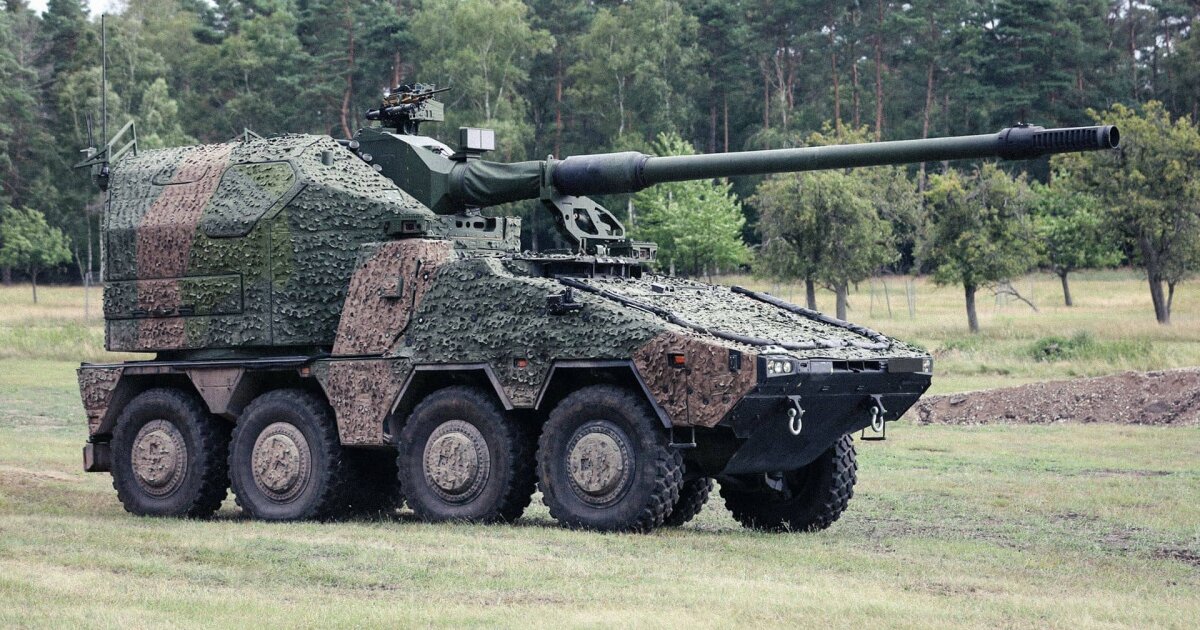
Visually, the RCH 155 looks unusual. The source text describes a remotely operated turret that appears outsized relative to the Boxer 8x8 vehicle beneath it, almost like a ship gun mounted on a much smaller chassis. But the apparent imbalance is part of the concept. Rather than relying on a conventional manned turret and tracked vehicle, the system packages a large-caliber gun with a wheeled armored platform and an unmanned turret that can rotate 360 degrees.
Why Britain needs a replacement now
The order follows a decision by the British government to send its entire inventory of 68 AS90 155 mm tracked self-propelled howitzers to Ukraine. According to the source, that left the Army without its previous artillery fleet while also accelerating the need for a successor. The AS90 was already slated for retirement by 2030, but donating the systems brought the gap forward in a much more immediate way.
That context is important because Britain has been criticized before for disposing of key military equipment before replacements were fully in place. The article frames the new order against that pattern, suggesting that artillery had become another area where capability risk could not be allowed to linger. In that sense, the RCH 155 is not just a modernization program. It is a corrective response to an operational absence.

What makes the RCH 155 different
The most notable feature in the supplied text is the unmanned, remote-controlled turret. That architecture changes the relationship between the crew and the weapon. By separating operators from the gun system itself, the design aims to improve crew protection while preserving heavy artillery reach. It also fits a wider military trend toward remote operation, automation, and the shrinking of exposed manpower at the point of fire.
Mounting the gun on the Boxer platform adds another layer to the concept. Wheeled vehicles generally offer different mobility and sustainment tradeoffs than tracked systems. While the source text does not provide a full technical comparison, the implication is that the British Army is accepting a nontraditional profile in exchange for a more modern and flexible artillery package suited to current geopolitical demands.
The system is built through a joint venture between KNDS and Rheinmetall, two major European defense firms. That industrial structure matters because it places the British Army’s replacement effort inside a broader European defense manufacturing ecosystem, one that has gained urgency as the war in Ukraine reshapes procurement priorities across NATO members.
An artillery story shaped by the war in Ukraine
Even though the order is about Britain’s own inventory, the war in Ukraine sits at the center of the story. British support for Ukraine directly reduced domestic artillery holdings, and the same conflict has pushed European militaries to reassess stockpiles, readiness, and the survivability of legacy platforms. Systems that once looked adequate for slower procurement cycles now face pressure from a battlefield environment defined by speed, precision, and constant adaptation.
The RCH 155 fits that environment as a system designed for mobile fire support with a high level of automation. The source material presents it as part of a significant shift in mobile artillery rather than a one-for-one swap for an older gun. That framing is important. Britain is not just replacing a depleted fleet; it is choosing a different operating model.
The broader innovation signal
Defense procurement is often conservative, especially around artillery, where reliability and logistics can outweigh novelty. That is what makes the British decision notable. A platform that looks unconventional is being adopted not despite its unconventional design but because that design reflects changing battlefield assumptions.
An unmanned turret reduces exposure. A wheeled chassis can offer different mobility and maintenance characteristics. A remote-controlled system suggests tighter integration with modern command-and-control practices. Each piece on its own is incremental. Combined, they point toward a redefinition of what a frontline artillery vehicle should look like.
There is also a psychological dimension. The source text emphasizes just how disproportionate the weapon appears on its chassis. That unusual silhouette underscores a broader truth about modern military innovation: legacy visual expectations can obscure functional logic. Systems optimized for contemporary warfare may look strange precisely because they are no longer organized around older crew, platform, and armor conventions.
From capability gap to modernization test
The British Army’s order for 72 RCH 155 systems does not by itself settle the question of how future artillery forces should be structured. But it does show that urgency is accelerating choices that might once have taken longer to mature. Britain had an artillery shortfall to fix. It chose a system that also advances automation, remote operation, and a more modern concept of mobile firepower.
That makes this more than a replacement purchase. It is a practical test of whether heavily automated, unmanned-turret artillery can move from striking concept to dependable field capability. Other armies will be watching closely, because the same pressures now facing Britain are spreading across Europe.
This article is based on reporting by New Atlas. Read the original article.
Originally published on newatlas.com