A more specific way to read TROP2
Researchers have developed and validated a computational pathology biomarker that could help identify which people with advanced nonsquamous non-small-cell lung cancer are more likely to benefit from datopotamab deruxtecan, an antibody-drug conjugate also known as Dato-DXd.
The work, published in Nature Medicine, focuses on trophoblast cell surface antigen 2, or TROP2. TROP2 is the target of Dato-DXd, but conventional visual scoring of TROP2 staining by pathologists has not predicted response to TROP2-directed antibody-drug conjugates in non-small-cell lung cancer. That gap is important: a target can be present in a tumour without a simple yes-or-no assessment of its expression revealing whether a treatment aimed at that target will work.
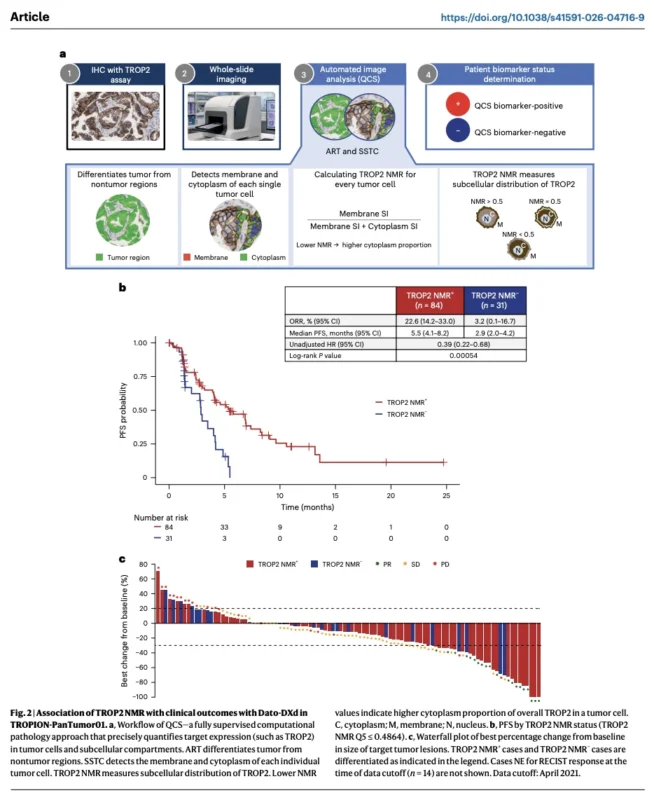
The new approach does not simply measure how much TROP2 is present. It evaluates where the protein appears within individual tumour cells. The researchers call their method TROP2 quantitative continuous scoring, or QCS, a fully supervised computational pathology approach applied to immunohistochemistry-stained slides.
Using QCS, the team quantified TROP2 in the membrane and the cytoplasm of individual non-small-cell lung cancer cells. From those measurements, they developed the normalized membrane ratio, or NMR: the amount of TROP2 at the cell membrane relative to the combined amount at the membrane and in the cytoplasm.
Why location may matter
Antibody-drug conjugates are designed to bind a surface target and deliver a linked drug payload. The study’s central hypothesis is therefore biologically practical as well as computational: TROP2 located at the tumour-cell membrane may carry different predictive value than TROP2 measured without regard to its subcellular location.
That distinction is what the NMR attempts to capture. Rather than relying on a pathologist’s conventional visual score, the system turns staining patterns into continuous quantitative measurements at the level of cells and cellular components. The result is a biomarker that is intended to distinguish samples classified as NMR-positive from those classified as NMR-negative.
The measure was first developed in the biomarker-evaluable population of the TROPION-PanTumor01 study, which included 115 patients with advanced non-small-cell lung cancer. The researchers then optimized and validated an NMR cut-point in the biomarker-evaluable population of the TROPION-Lung01 trial.
The validation analysis involved 352 biomarker-evaluable patients. Its primary intended-use population was patients with nonsquamous non-small-cell lung cancer who did not have actionable genomic alterations, a group of 221 patients.

Longer progression-free survival in the NMR-positive group
Among patients treated with Dato-DXd, progression-free survival was longer for those with NMR-positive samples than for those with NMR-negative samples. Median progression-free survival was 7.2 months in the NMR-positive group and 4.0 months in the NMR-negative group.
The reported hazard ratio was 0.40, with a 95% confidence interval of 0.25 to 0.64. In this analysis, that association indicates a substantially lower risk of disease progression or death over the study period for the NMR-positive group treated with Dato-DXd compared with the NMR-negative group.
The comparison with docetaxel, a separate treatment arm, is a key part of the finding. In patients treated with docetaxel, median progression-free survival was 4.1 months for the NMR-positive group and 4.4 months for the NMR-negative group. The hazard ratio in that treatment group was 0.94, with a 95% confidence interval of 0.59 to 1.49.
In other words, the NMR grouping was associated with a difference in outcome for Dato-DXd but not with a corresponding difference for docetaxel in the reported analysis. The study reported a treatment-by-biomarker-status interaction P value of 0.0098, supporting the interpretation that the relationship between NMR status and progression-free survival differed between the two treatments.
A potential predictive biomarker, not just a prognostic signal
That treatment-specific pattern is why the researchers describe TROP2 NMR as a potential predictive biomarker for Dato-DXd. A prognostic marker is associated with outcome regardless of treatment; a predictive marker is useful because it may indicate a differing likelihood of benefit from a particular therapy.
The distinction matters for treatment development. If validated for clinical use, a predictive biomarker could help move selection beyond broad TROP2 expression assessments that have not reliably predicted response in this setting. It could also give clinicians and patients a more evidence-based way to weigh a TROP2-directed antibody-drug conjugate against other options.
For now, the study presents a validated analytical approach and an association with clinical outcomes from trial populations. It does not establish that every patient with an NMR-positive tumour will benefit, or that NMR-negative patients cannot benefit. Nor does it replace the broader clinical assessment needed to determine treatment choice.

Computational pathology moves from image review to treatment selection
The study also illustrates a wider direction for digital pathology. Immunohistochemistry has long been central to oncology, but visual interpretation can compress a complex tissue pattern into broad categories. Computational methods can instead quantify staining continuously, identify individual cells and separate cellular compartments such as membrane and cytoplasm.
In this case, the added detail appears to be consequential. The researchers found that conventional pathologist assessment of TROP2 expression did not predict response to TROP2-directed antibody-drug conjugates in non-small-cell lung cancer. Their NMR method was designed specifically to extract information that conventional scoring misses.
The next question is how such a biomarker would perform across routine clinical practice and future studies. The current results establish a clear rationale for further clinical development: in the reported trial analysis, membrane-normalized TROP2 expression separated outcomes for Dato-DXd while showing no equivalent separation for docetaxel.
For a disease in which treatment decisions increasingly depend on molecular and pathological detail, that is a meaningful step. It suggests that not only the presence of a drug target, but also its cellular placement, may help determine whether a targeted therapy is likely to deliver benefit.
This article is based on reporting by Nature Medicine. Read the original article.
Originally published on nature.com


