Nature Medicine publishes an addendum to a colon cancer study
Nature Medicine has issued an addendum to a research paper on the origins of colorectal cancer. The notice, published online on 9 October 2026 and registered under DOI 10.1038/s41591-026-04736-5, attaches to a study titled "Aberrant epithelial GREM1 expression initiates colonic tumorigenesis from cells outside the stem cell niche."
The addendum is the only new element in the record. It does not replace the original paper; it supplements it. For laboratories that have spent years building on the study's central claim — that tumours can be seeded by cells sitting outside the stem cell niche rather than by stem cells themselves — the notice is a prompt to re-read the methods, the figures and any newly attached material before the next experiment is designed.
What an addendum means in the scientific record
Publishers use a small vocabulary of post-publication notices, and each carries a different implication for how much weight a reader should place on the underlying paper.
- Correction (erratum) — fixes an error affecting the published text or figures without disturbing the study's overall conclusion.
- Addendum — adds information, analysis or clarification that was absent from the original article, typically supplied by the authors themselves.
- Editorial expression of concern — flags unresolved questions about reliability while an investigation proceeds.
- Retraction — withdraws the paper because its findings can no longer be relied upon.
An addendum sits at the gentlest end of that spectrum. On its face, it does not dispute the findings. It is also not an automatic clean bill of health: addenda are sometimes issued because reviewers, readers or the authors identified something material that should have appeared in the paper the first time around.

The claim at the heart of the original paper
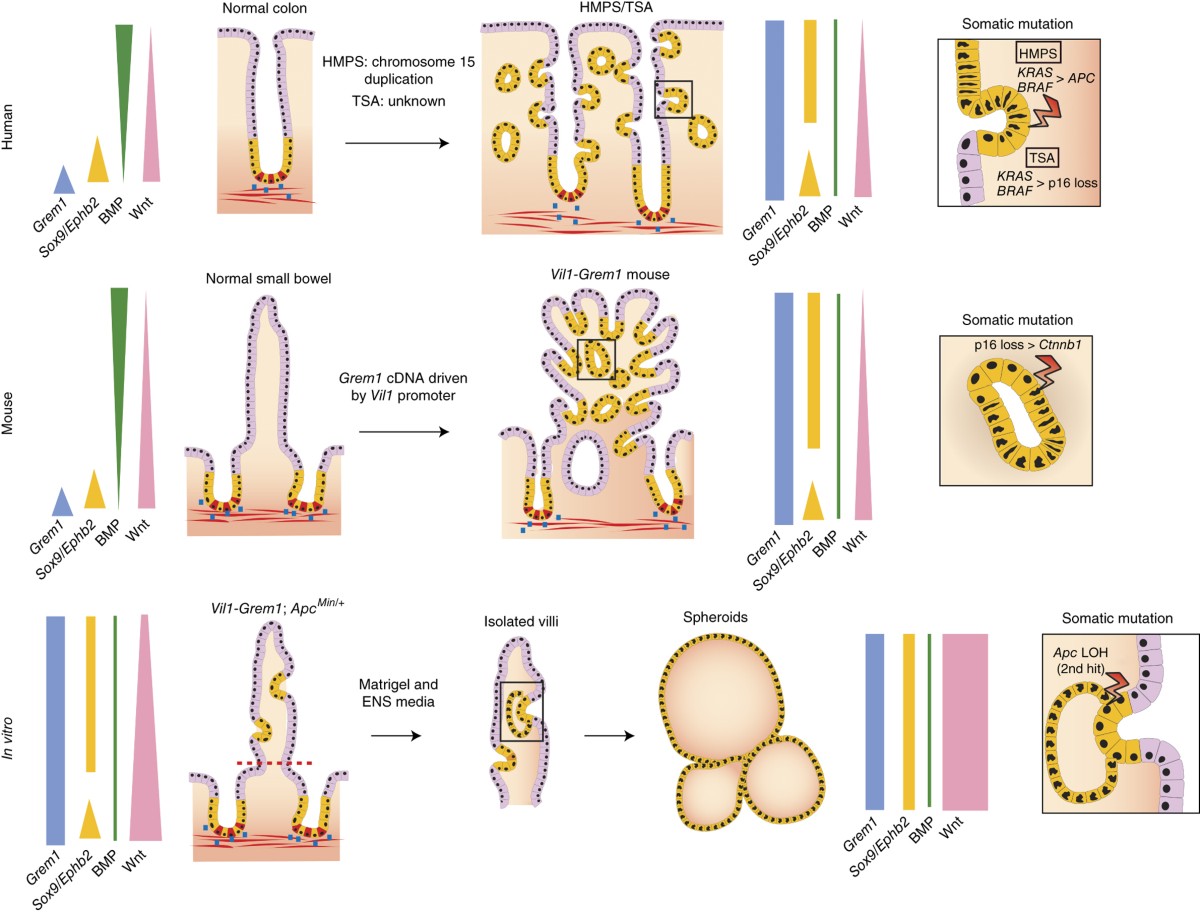
The title of the study makes a specific and, in cancer biology, a deliberately provocative assertion: that aberrant expression of GREM1 within the colonic epithelium is enough to set tumour formation in motion, and that the cells responsible sit outside the stem cell niche.
Gremlin1 and the BMP brake
GREM1 encodes Gremlin1, a secreted protein best known for antagonising bone morphogenetic protein signalling. In the gut, BMP activity acts as a brake on crypt proliferation; where that brake is released, epithelial cells can continue dividing when they should not. The original paper's framing places GREM1 precisely at the point where that brake is disabled — and locates the source of the problem in the epithelium rather than in the surrounding stroma. That much reflects long-standing work in the field rather than anything specific to this notice.
Why "outside the stem cell niche" is the striking part
For years, the dominant model of colorectal cancer held that tumours arise from stem cells at the base of the crypt, the specialised compartment where self-renewal is concentrated. The original study's title challenges that hierarchy. If committed, differentiated cells can be pushed back into a tumour-initiating state through GREM1-driven signalling, then the pool of potential cells of origin is considerably wider than the stem-cell model implies — with consequences for how early lesions are detected, how risk is stratified, and how therapies are targeted.
The phrase "outside the stem cell niche" is therefore doing real work. It is not a technicality about anatomy; it is a claim about which cells a tumour can recruit, and about how much plasticity the adult colonic epithelium retains.
What the addendum does and does not settle
Because the notice is an addendum rather than a retraction or an expression of concern, the most natural reading is that the authors supplied additional detail rather than withdrawing a conclusion. That reading is an inference drawn from the category of notice, not a report of the notice's specific contents. The DOI remains the authoritative entry point: readers who need the particulars should consult the addendum directly, alongside the original article and its supplementary files, rather than relying on secondary summaries.
That distinction matters in practice. A clarification attached to a widely cited paper can change how a result is interpreted without altering a single figure. If the addendum refines the conditions under which GREM1-driven tumour initiation occurs, or narrows the population of cells involved, downstream work that cited only the headline finding may need recalibration.

Why post-publication notices deserve attention
Science is often described as self-correcting, but the correction mechanism is bureaucratic, low-profile and slow. Notices like this one are published quietly, attract a fraction of the attention of the original paper, and yet are frequently the most current statement about what a study actually supports. Citations continue to accrue to the original article regardless, which means the corrected record can be outrun by the uncorrected one.
For researchers, the practical implication is straightforward: check the notice history before building on a result. For readers outside the laboratory, the implication is that a study's meaning is not fixed at publication. It is revised, qualified and occasionally strengthened as the community interrogates it.
The bigger picture for colorectal cancer research
The debate over cell of origin is not a purely academic one. It shapes where pathologists look for the earliest signs of disease, which cell populations are profiled in screening studies, and which signalling pathways are considered plausible drug targets. A model in which differentiated epithelial cells can be reprogrammed into tumour founders implies that early intervention might need to reach a broader set of cells than a stem-cell-centric model would suggest.
GREM1 and the BMP axis sit squarely in that conversation. Because the pathway is secretory and extracellular, components of it are in principle more accessible to therapeutic intervention than intracellular drivers of proliferation — a point that has kept interest in this biology alive well beyond any single publication.

What to watch next
- Whether independent groups confirm, complicate or narrow the claim that tumour initiation occurs from cells outside the stem cell niche.
- Whether GREM1 or BMP-pathway measures translate into practical markers for early lesion detection.
- How the addendum is cited in future work — as a straightforward clarification, or as a qualification that changes the interpretation of the original result.
- Whether the notice is accompanied by updated supplementary data or revised methodology.
Bottom line
Nature Medicine has attached an addendum to a study that placed GREM1-driven tumour initiation outside the colonic stem cell niche. The notice is a supplement, not a withdrawal, and the original claim about the cell of origin remains on the record. Researchers and clinicians who have followed this line of work should treat the addendum as the current version of the record and read it alongside the original paper before extending its conclusions.
This article is based on reporting by Nature Medicine. Read the original article.
Originally published on nature.com


