A Rare but Serious Complication of an Advanced Cancer Therapy
For patients with multiple myeloma whose disease has already resisted several lines of treatment, BCMA-directed CAR-T therapy has become one of the most closely watched options in hematology. The approach engineers a patient's own T cells to recognize BCMA, a protein displayed on the surface of malignant plasma cells, then returns those cells to the body to seek out and destroy the cancer. As with any potent therapy, that power comes with a distinctive risk profile. A study published online in Nature Medicine on 23 September 2026 turns its attention to one such risk: enterocolitis, an inflammation of the intestinal tract, in patients who received BCMA CAR-T treatment.
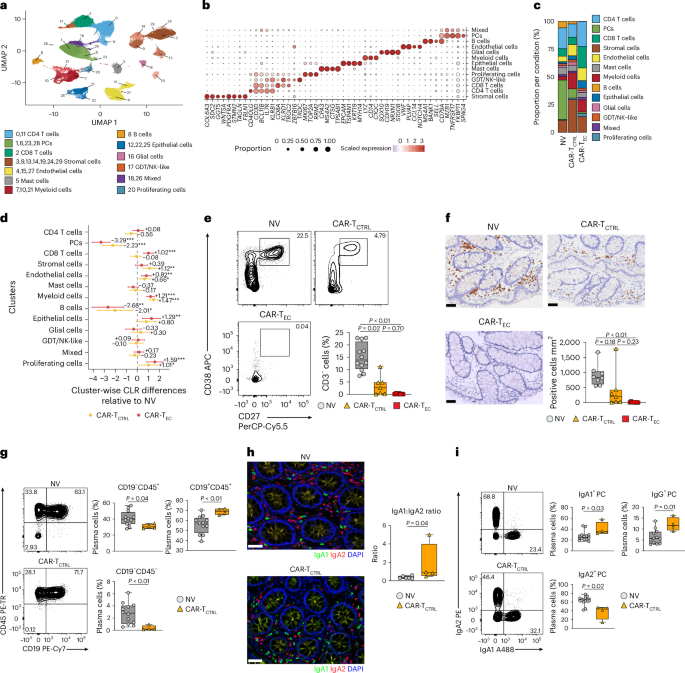
The paper's title points to two connected observations — the persistence of mucosal CAR-T cells and inflammatory remodeling in the gut. Together they suggest investigators are looking past a simple cause-and-effect model of drug toxicity and toward something more complex happening at the tissue level.
How BCMA CAR-T Therapy Targets Myeloma
Multiple myeloma is a cancer of plasma cells, the antibody-producing cells of the immune system. B-cell maturation antigen, or BCMA, is expressed at high levels on those malignant plasma cells, which makes it an appealing anchor for engineered cell therapy.
The treatment pathway is by now familiar in oncology:
- T cells are collected from the patient through apheresis.
- The cells are genetically modified to carry a chimeric antigen receptor that recognizes BCMA.
- The engineered population is expanded in the laboratory to reach therapeutic numbers.
- The patient receives lymphodepleting chemotherapy, followed by infusion of the modified cells.
- Clinical teams then monitor closely for known toxicities, including cytokine release syndrome and neurologic effects.
Over time, the field has learned that the side-effect landscape is broader than those earliest concerns. Gastrointestinal symptoms after CAR-T infusion have drawn increasing scrutiny, and enterocolitis has emerged as one of the more challenging presentations to interpret.
Why Gut Inflammation Becomes a Diagnostic Puzzle
Enterocolitis involves inflammation affecting both the small intestine and the colon. Patients may present with diarrhea, abdominal pain, and other signs that are difficult to attribute to a single cause. CAR-T recipients are typically heavily pretreated and immunocompromised, which widens the list of possible explanations.
Infections can produce nearly identical symptoms. Medications, including antibiotics and other supportive drugs, can contribute. And the engineered cells themselves are a candidate explanation that cannot be ruled out from symptoms alone. Separating these possibilities matters because the management strategies diverge sharply — antimicrobial therapy for an infection, for instance, looks very different from immunosuppression aimed at calming an immune-driven inflammatory process.
The Persistence Question
CAR-T cells are prized partly for their durability. Long-lived engineered cells that continue patrolling the body are associated with sustained remissions in myeloma, which is one reason the therapy has been so impactful. But that same longevity raises a question the Nature Medicine analysis appears to address directly: what happens when engineered cells take up residence in tissues that were never the intended target?
Mucosal Tissue as a Reservoir
The study's framing centers on mucosal CAR-T cells — engineered cells found within the mucosal lining of the gut. Persistence in that environment implies an ongoing local presence rather than a transient passage through the intestinal tract. If the cells remain in mucosal tissue, they may continue to interact with local immune networks long after the initial infusion period.
Why Location Matters
Where a cell lives shapes what it does. A CAR-T cell circulating in blood operates in a very different immunological context than one embedded in the gut mucosa, surrounded by barrier cells, resident immune populations, and a dense microbial environment. Localized persistence could plausibly translate into localized, sustained immune activation — a mechanism distinct from the systemic reactions clinicians have learned to expect and manage.

Inflammatory Remodeling in the Gut Lining
The second half of the paper's title points to something beyond transient inflammation: structural change. Inflammatory remodeling describes the way chronic immune activity can alter tissue architecture over time. Under sustained inflammatory pressure, the mucosal barrier can change in ways that affect how it functions — how it absorbs nutrients, regulates permeability, and maintains its defensive role.
Pairing that concept with mucosal CAR-T persistence suggests a plausible reinforcing cycle, in which engineered cells that linger in gut tissue help sustain an inflammatory environment, and that environment in turn reshapes the tissue. The published summary of the work does not, by itself, establish causality. Establishing how these two phenomena relate is exactly the kind of question that a multimodal analysis is designed to interrogate.
Why a Multimodal Approach Was Necessary
A single biopsy taken at a single moment offers only a snapshot. The published description of the study characterizes it as a multimodal analysis of patients with multiple myeloma who developed enterocolitis after BCMA CAR-T treatment — meaning the investigators drew on several complementary lines of evidence rather than relying on one assay or one time point.
That breadth is important for a practical reason: the behavior of CAR-T cells in peripheral blood does not necessarily mirror what those cells are doing inside gut tissue. A patient's bloodwork could look unremarkable while a localized mucosal process continues. Only by combining cellular, molecular, and tissue-level observations can researchers begin to reconstruct what is actually happening in the intestinal lining.

What This Means for Clinicians and Patients
Even as a focused investigation into a specific complication, the analysis carries implications that extend to routine care.
- Recognition. Gastrointestinal symptoms following CAR-T infusion deserve a structured workup, with enterocolitis considered alongside infectious causes rather than after them.
- Monitoring. If engineered cells can persist in mucosal tissue, the timeline for follow-up may need reconsideration, since late-onset symptoms could reflect a process that began much earlier.
- Managing the trade-off. Treating inflammation typically involves suppressing immune activity, but the anti-myeloma benefit of CAR-T therapy depends on that same activity. Clinicians face a genuine balancing act.
- Trial design. Long-term toxicity endpoints and tissue-level sampling could become more prominent in studies of BCMA-directed therapies.
Questions the Field Still Needs to Answer
The findings open as many questions as they answer. Among the most pressing:
- How frequently does this complication arise across the broader population of BCMA CAR-T recipients?
- What drives mucosal persistence — antigen recognition in gut tissue, resident memory T-cell biology, or some combination?
- Is the inflammatory remodeling reversible, and does it respond to existing immunosuppressive strategies?
- Are there biomarkers that could flag patients at elevated risk before symptoms appear?
- Can the engineered cells be designed to limit tissue infiltration without sacrificing anticancer potency?
A Wider Lens on Cell Therapy's Next Chapter
CAR-T therapy is moving steadily outward from its original territory — into earlier lines of treatment, into autoimmune conditions, and toward solid tumors where the tissue environment matters enormously. As the indications broaden, understanding how engineered cells behave inside tissues, not just in the bloodstream, becomes central rather than niche.
The Nature Medicine paper, published with the identifier doi:10.1038/s41591-026-04632-y, offers a detailed look at one such tissue-level interaction in multiple myeloma care. Its value lies in the specificity: a defined patient population, a defined complication, and a framing that treats mucosal persistence and inflammatory remodeling as linked phenomena worth explaining. For a field that has spent years optimizing how well engineered cells kill cancer, the next challenge may be understanding where they settle — and what they leave behind.
This article is based on reporting by Nature Medicine. Read the original article.
Originally published on nature.com


