A double advantage for later-born generations
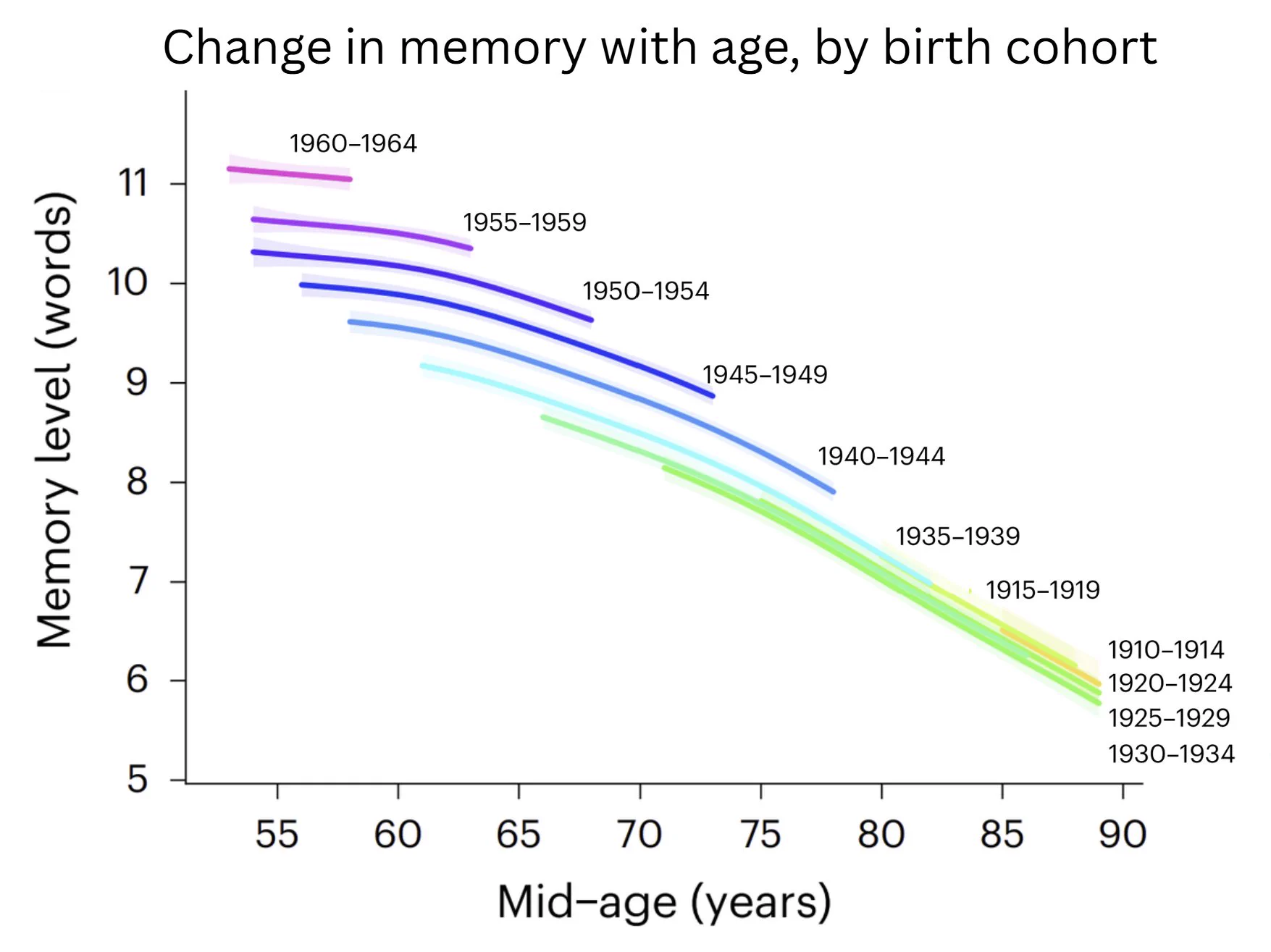
People born more recently may be reaching old age with a substantial cognitive advantage over earlier generations, according to a large study published in Nature Medicine. The researchers report that later-born cohorts not only had higher episodic-memory levels as they entered older age, but also experienced slower memory decline thereafter.
The finding addresses a central question in dementia research. Dementia incidence at a given age has declined over recent decades in Europe and the United States, but it has been unclear whether that trend reflects better cognitive capacity before old age, a slower pace of deterioration in later life, or a combination of the two. The study's answer is that both patterns appear to be present.
Its authors describe the result as a “double dividend”: later-born generations showed an advantage in memory level and in the rate of subsequent decline. The combination, they say, is large enough to plausibly account for a previously reported 13% decline in dementia incidence per decade.
Evidence from five long-running studies
The analysis drew on about 783,000 episodic-memory assessments from roughly 219,000 people participating in five longitudinal studies in Europe and the United States. Participants were followed for as long as 30 years, allowing the researchers to compare overlapping age ranges across birth cohorts rather than relying on a single snapshot of different age groups.
Episodic memory concerns the ability to remember experiences and events. Tracking repeated assessments over time gave the researchers a way to distinguish between the level at which people entered older age and the change in performance that followed.
The differences were not limited to average scores. Improvements were concentrated among the people who would otherwise have been expected to decline most quickly. Later-born cohorts spent longer periods with stable memory and had fewer steep declines. Those memory patterns were mirrored by lower rates of clinical impairment and slower hippocampal atrophy, according to the study.
The hippocampus is closely associated with memory, and its deterioration is relevant to many forms of cognitive impairment. Seeing changes in both memory trajectories and hippocampal atrophy strengthens the study's case that the generational pattern is not simply an artifact of one testing measure.

Why timing matters for prevention
The study also separates two parts of brain health that may be shaped at different points in life. Memory level is built mainly in early life, the authors write, while the rate of decline is more influenced by conditions in adulthood. That distinction has important consequences for prevention policy.
If societies want to sustain falling dementia incidence, interventions cannot be restricted to care in late life. The researchers argue that protecting brain health needs to span the whole life course, beginning in childhood. A strategy focused only on detecting decline after it begins could miss the conditions that help establish stronger cognitive capacity decades earlier.
The research does not identify a single cause for the gains across generations. Instead, it establishes a broad population-level pattern across multiple cohorts and repeated measurements. The authors also conclude that calendar-time trends affecting every generation at the same time are unlikely to explain the observed differences. That makes birth-cohort differences a more compelling explanation than a temporary effect from when a test happened to be administered.
A hopeful trend, not a reason for complacency
The findings offer a more hopeful account of aging than the assumption that longer lives must automatically produce more years of cognitive decline. They suggest that population health and social conditions can shift both the starting point for cognitive aging and its later trajectory.
But the paper's policy message is not that dementia risk has been solved. It is that progress may depend on preserving the conditions behind the generational gains. Better memory entering older age and slower decline afterward are separate benefits, and losing either could weaken the wider trend in dementia incidence.
For health systems, the result emphasizes that dementia prevention is not solely a clinical problem for older adults. It also involves the long arc of brain health: the conditions of childhood that help shape cognitive capacity, and the adult conditions that influence whether that capacity is maintained or eroded.
The study's scale and long follow-up make it a notable contribution to a question with major implications for aging societies. Its central conclusion is straightforward: later-born generations appear to be arriving at old age with more cognitive reserve and retaining it for longer. Whether that advantage continues will depend on policies and environments that support brain health throughout life.
This article is based on reporting by Nature Medicine. Read the original article.

Originally published on nature.com


