Rapid sequencing moves from specialist option to citywide critical care tool
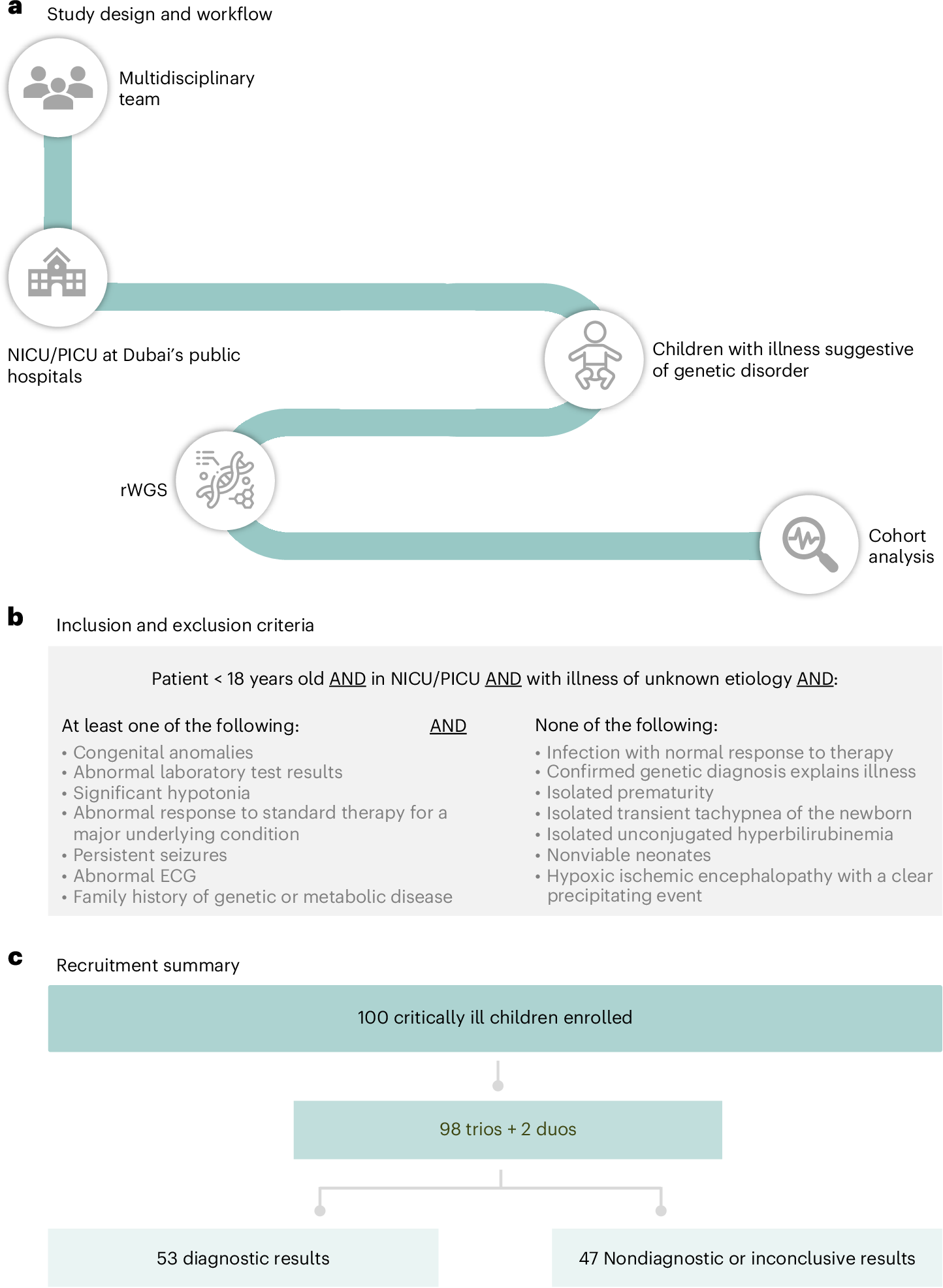
A new study in Nature Medicine describes what happens when rapid whole-genome sequencing is no longer treated as an exceptional test and is instead built into routine intensive care for very sick children. In Dubai, a program called Little Falcon integrated rapid whole-genome sequencing across centralized neonatal and pediatric intensive care units and reported results that suggest the model can materially change how hospitals diagnose and manage critically ill patients.
The program enrolled 100 critically ill children from 18 Middle Eastern and Asian countries and used trio rapid whole-genome sequencing, meaning the child and both biological parents were sequenced together when possible. The median turnaround time was 3.4 days. That speed matters because many of the children entering neonatal and pediatric intensive care present with severe, fast-moving conditions where delayed diagnosis can mean missed treatment windows, prolonged uncertainty for families, and more invasive or less targeted care.
According to the study, the overall diagnostic yield was 53%. In practical terms, that means more than half of the children received a molecular diagnosis that could explain their condition. The yield was even higher in consanguineous families, reaching 80%, a finding the authors say is especially relevant in populations with a higher burden of recessive genetic disease.
Why the study stands out
Rapid sequencing studies have shown promise before, but this one is notable for its system-level design. Rather than evaluating a one-off pilot embedded in a single hospital department, the researchers examined a citywide implementation inside a centralized healthcare network. That shifts the conversation from whether rapid sequencing can work in principle to whether it can be operationalized at scale in real clinical settings.
The answer, based on the reported data, is yes. The study found that rapid whole-genome sequencing did more than produce lab results. It led to clinically meaningful management changes in 53% of patients. Those changes occurred not only among children with confirmed molecular diagnoses, but also in a smaller number of children without one, suggesting the test influenced care decisions by ruling conditions in or out and helping clinicians move more confidently.
The researchers also reported that disease trajectories were altered in 16% of cases. The source text does not break down every intervention behind that figure, but the implication is clear: faster genetic answers can translate into different treatment choices, not just better documentation.
Comparison with standard testing
The study becomes more compelling when measured against standard practice. The authors compared the rapid sequencing cohort with a matched historical cohort of critically ill pediatric patients who received conventional genetic testing. Diagnostic time fell from 38 days to 3.4 days. Diagnostic yield rose from 30% to 53%. Clinical management changes increased from 18% to 53%.
Those comparisons suggest that speed and breadth are reinforcing advantages. Traditional genetic workups can be fragmented, with tests ordered sequentially and escalated over time. Rapid whole-genome sequencing compresses that path by surveying the genome broadly and quickly. In critical care, where clinicians often face complex symptoms that do not fit a single obvious diagnosis, that wider net can be decisive.
The study also identified multiple molecular findings in 12% of patients, including dual diagnoses in 5%. That matters because some children do not have a single unifying disease explanation. A narrower testing strategy can miss that complexity, while whole-genome sequencing is better positioned to capture it.
Additional findings beyond the main diagnosis
The program produced findings outside the immediate primary diagnosis as well. The authors reported newborn screening-relevant variants in 4% of patients and secondary or incidental findings defined under American College of Medical Genetics guidance in 3%. Those results broaden the value proposition of rapid sequencing, but they also add complexity.
Health systems adopting this approach need more than sequencing machines. They need consent processes, clinical genetics expertise, counseling capacity, and governance for what to report back to families. The promise of rapid genomics depends as much on interpretation and care integration as on raw sequencing speed.
A signal for precision medicine in diverse populations
The study is also important because of who it includes. The patient group spanned 18 Middle Eastern and Asian countries, and the program operated in a region where consanguinity remains clinically significant for inherited disease patterns. Genomics research has often been criticized for overrepresenting populations of European ancestry. Real-world implementation in more diverse settings helps test whether precision medicine infrastructure can serve broader populations and produce high-value results outside the best-funded Western centers.
That does not mean the Dubai model will translate directly everywhere. Centralized intensive care services, payer structures, sequencing capacity, and specialist availability vary widely across health systems. But the study strengthens the case that rapid whole-genome sequencing can be treated as frontline critical care infrastructure rather than an occasional referral pathway.
What changes next
For hospitals and policymakers, the practical question is no longer whether rapid genomic testing is scientifically interesting. It is whether the economics, staffing, and clinical workflow can support routine deployment. The source text emphasizes improved diagnostic speed, better yield, and more frequent management changes, all of which are the kinds of outcomes administrators and health ministries can use to justify expansion.
The findings do not suggest that every critically ill child will benefit equally, and they do not remove the need for follow-up testing, specialist review, or long-term care. But they do point toward a more aggressive model of genomic medicine: test early, test broadly, and make those results available fast enough to matter during the acute phase of treatment.
If that model continues to hold up in other healthcare systems, rapid whole-genome sequencing may shift from being one of the most advanced tools in pediatric medicine to one of the most expected.
This article is based on reporting by Nature Medicine. Read the original article.
Originally published on nature.com